Wize University Chemistry Textbook > Electrochemistry
Other Applications (including Batteries and Corrosion)
Popular Courses
CHEM 1302A/B
Western University
General Chemistry
University Study Guides
CHEM 112
Queen's University
DAT
General Course
Chemistry
General Course
General Chemistry
University Study Guides
CHEM 1E03
McMaster University
ENGG 204
University of Calgary
CHM135H1
University of Toronto
CHEM 102
University of Alberta
CHEM*1050
University of Guelph
CHEM 120
McGill University
APSC 132
Queen's University
CHEM 112B
Queen's University
CHEM 123
University of Waterloo
CHEM 130
University of British Columbia
CHEM 1100
University of Manitoba
CHEM 1481
Texas A & M University
CHEM 122
Simon Fraser University
CHMA10H3
University of Toronto
0:00 / 0:00
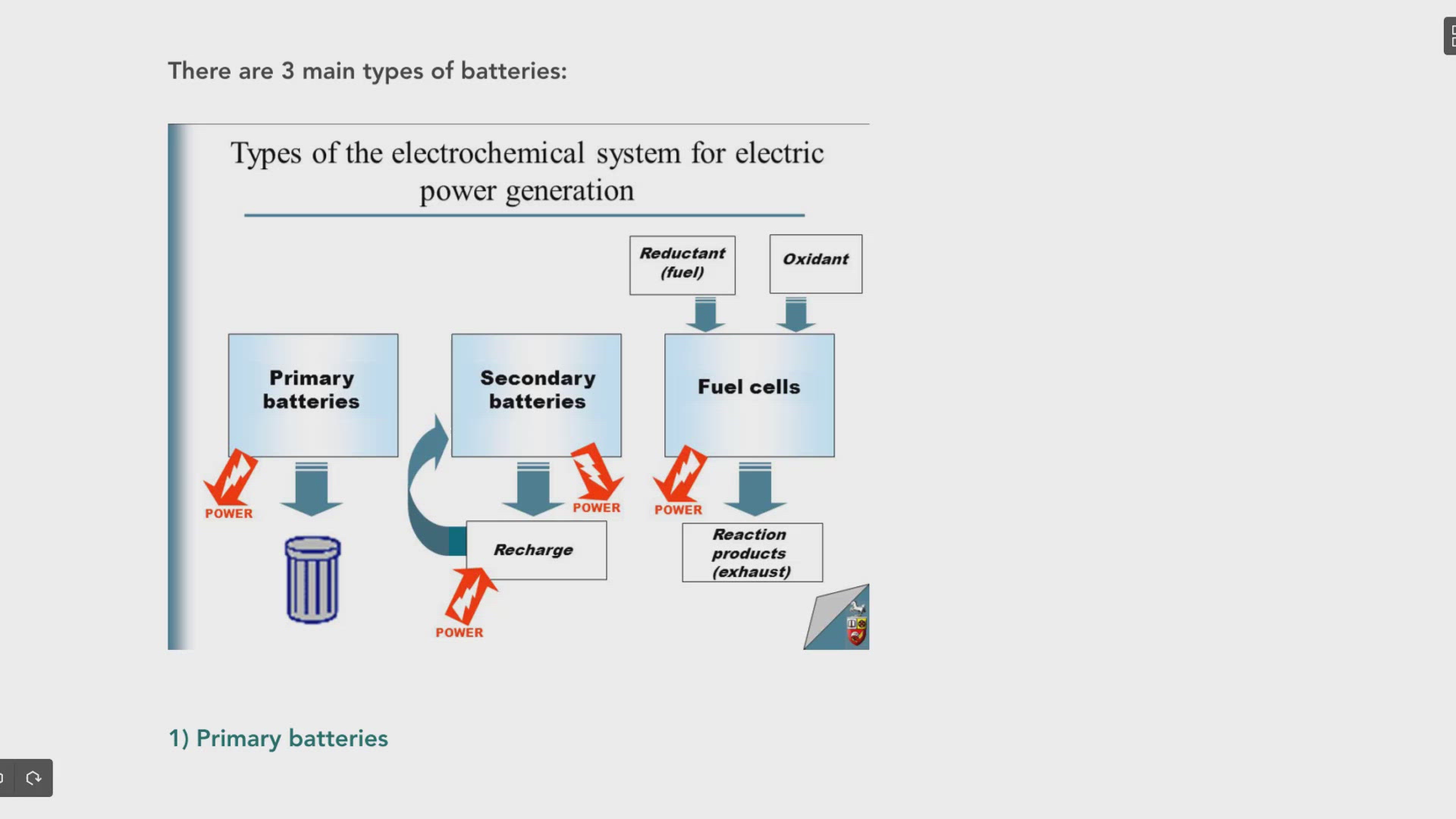
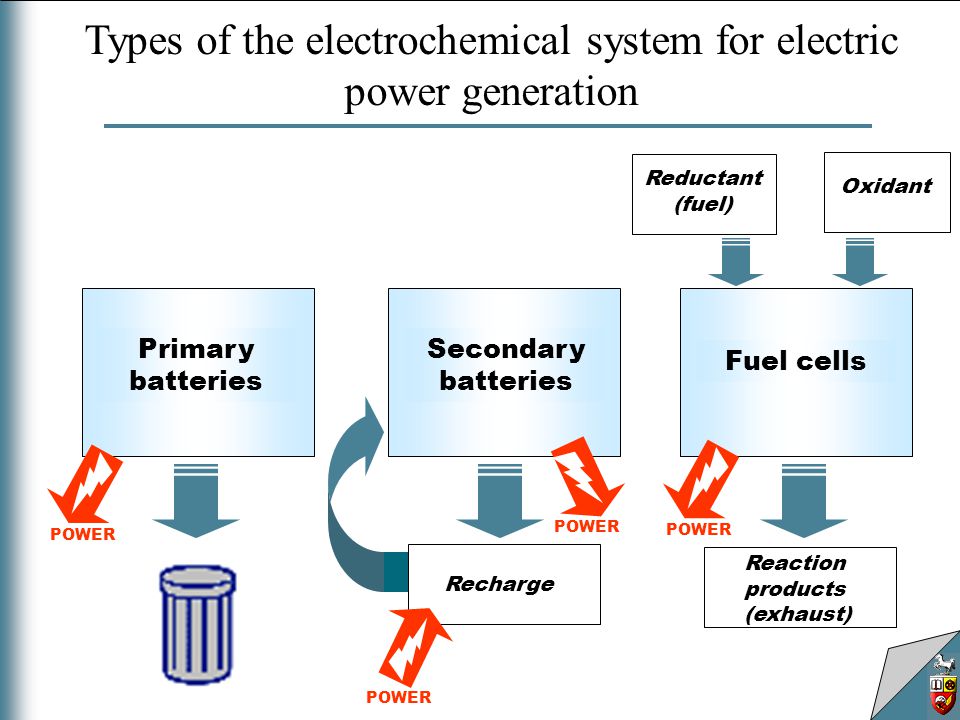
There are 3 main types of batteries:
1) Primary batteries
- non-rechargeable (discarded when the cell reaction reaches equilibrium)
- one way (irreversible)
- self-contained series of voltaic cells
- ex. modern alkaline battery, silver button battery (like the one we see in watches), lithium battery,
- alkaline cells is about 1.5V

2) Secondary Batteries
- rechargeable
- self-contained series of voltaic cells
- electrical current supplied to reverse the cell reaction
- ex: lead-acid batteries (car batteries), nickel-metal hydride batteries (power tools), lithium ion battery (laptops, cell phone)
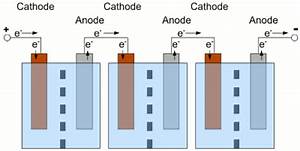
a) Charging
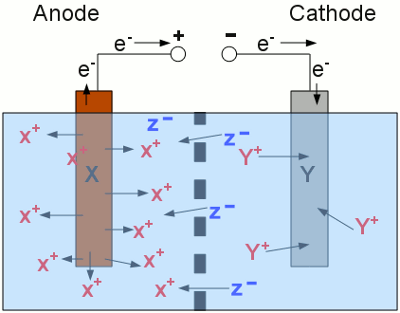
- electrolysis (not a voltaic cell)
- need a voltage source
- reaction stops when the cathodic solution runs out of cations
b) Discharging
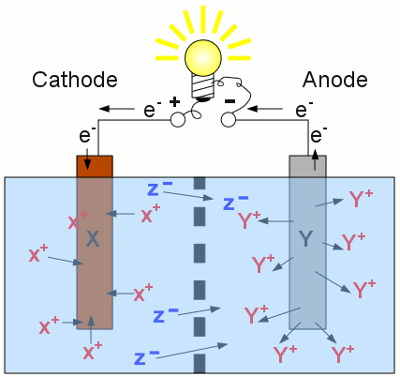
- this acts like a galvanic cell (spontaneous electron flow)
- reverse process is occurring, metal on right is now the anode, metal on left is the cathode
3) Fuel Cells
- non self-contained voltaic cells
- controlled combustion (O2 and H2 enter cells, H20 leaves cells)
- can flow chemicals through system to generate electricity

0:00 / 0:00
Rechargeable Batteries
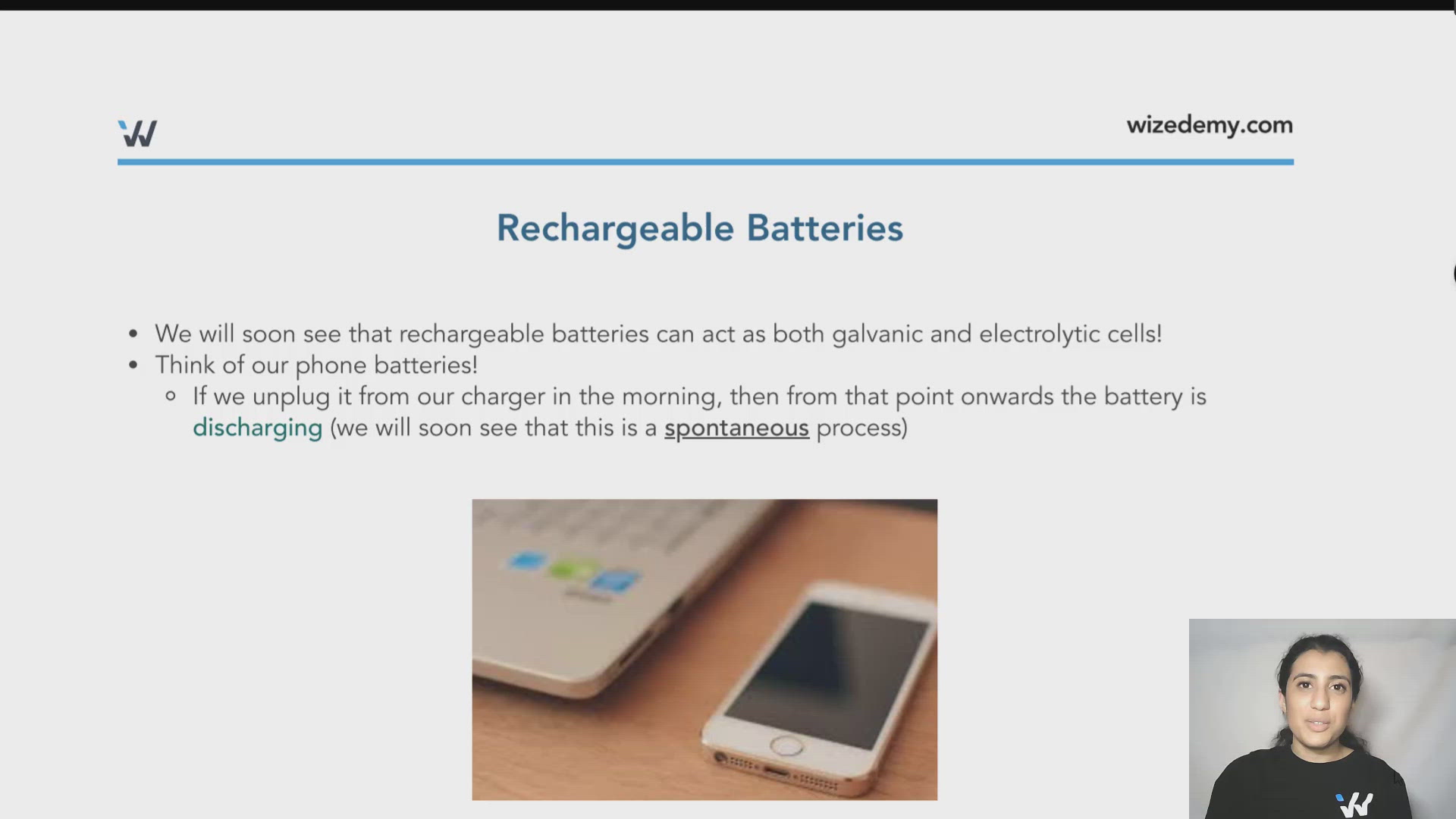
- We will soon see that rechargeable batteries can act as both galvanic and electrolytic cells.
- Think of our phone batteries:
- If we unplug it from our charger in the morning, then from that point onwards the battery is discharging (we will soon see that this is a spontaneous process)

- Then at night, when we go to plug it into the charger, the battery is charging (this part requires a battery, which is an external source of energy so this part is nonspontaneous)

- Based on this info do you think the discharging process is more like a galvanic or electrolytic cell?galvanic
- What about for the charging process?electrolytic
Let's consider a rechargeable lead-acid battery...
The overall equation for this battery is:
Pb(s) + PbO2(s) +2 H2SO4(aq) ⇌ 2 PbSO4(s) + 2 H2O(s)
1) Draw in the oxidation states for Pb in the above equation
Pb(s) = 0, PbO2-Pb has 4+, PbSO4-Pb has 2+
2) Now let's consider the discharge process
We have these 2 reactions:
a) Pb(s) → Pb2+(aq) + 2 e– Eo
oxidation
= 0.13 V b) Pb4+(aq) + 2 e– → Pb2+(aq) Eo
reduction
= 1.83 V Eoredox = 1.96 V
Is this process spontaneous or not?
Yes (ΔG would be negative)
We can now draw out the cell for this:
galvanic
cell Make one electrode Pb(s) and the other PbO2(s), which is Pb4+
- Is a battery needed for this reaction?No
- label the anode and the cathode
- Show the direction in which electrons flow
- Label the charges of both the anode and the cathode
3) Now let's consider the charging process
To charge the battery, we have the same 2 reactions but want them to run in reverse:
a) Pb2+(aq) + 2 e– → Pb(s) Eo
reduction
= -0.13
V b) Pb2+(aq) → 2 e– + Pb4+(aq) Eo
oxidation
= -1.83
V Eoredox =
-1.96
V Is this process spontaneous or not?
No (ΔG would be positive)
We can now draw out the cell for this:
electrolytic
cell Make one electrode PbSO4 (which is also Pb2+) and the other electrode the same.
- Is a battery needed for this reaction?Yes
- Label the anode and the cathode
- Show the direction in which electrons flow
- Label the charges of both the anode and the cathode
- What are the charges on the battery (if there is one?)
Wize Concept
You don't need to memorize the equation for the rechargeable lead-acid battery. Just know that rechargeable batteries have a discharging process (spontaneous, acts as a galvanic cell) and a charging process (non-spontaneous, requires a battery, acts as an electrolytic cell)!!
0:00 / 0:00
Corrosion and Prevention
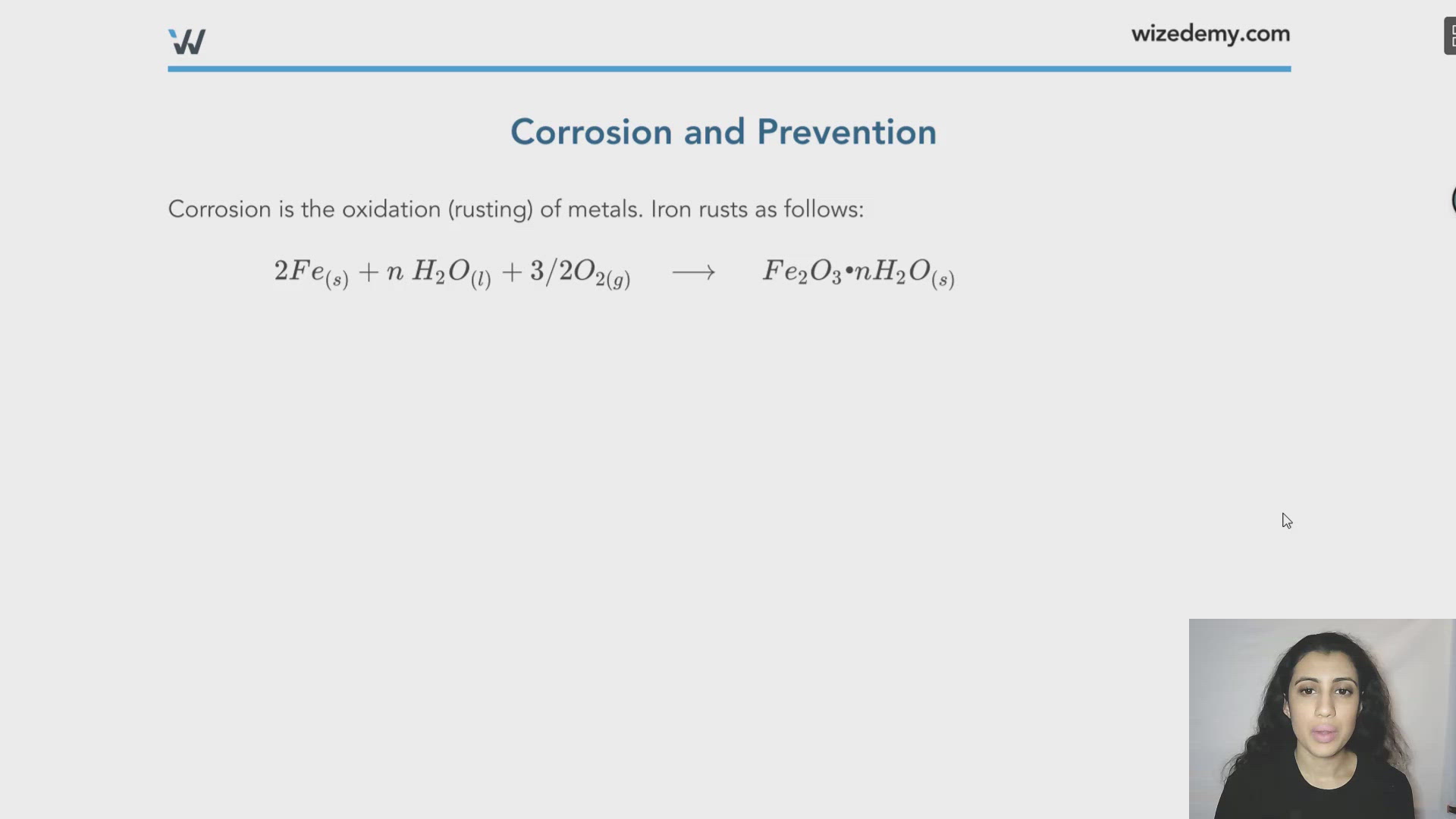
Corrosion is the oxidation (rusting) of metals.
Iron rusts as follows:

1) Oxidation of Fe yields electrons that travel through the metal (anodic site)
2) Electrons that traveled through the metal reduce O2 and form water (cathodic site)
3) Fe2+ migrates through the water drop and reacts with O2 and H2O to form rust
Corrosion prevention:
1. Coating
- Galvanizing: Zn Coating - this helps because Zinc is more easily oxidized than Fe is.
- Zn acts as the anode instead of Fe!
- If this is the case, how do the reduction potentials of Fe2+ and Zn2+ compare?
- Zn2+ has a lower reduction potential than Fe2+and Zn(s) has a higher oxidation potential than Fe(s)
- Na2CrO4 should not be used to coat iron because it is toxic!
2. Cathodic protection (sacrificial anode)
- Instead of coating the iron with another metal, a second metal is just placed in electrical contact with the first metal and we call the second metal the "sacrificial anode"
- Attach more active metals (e.g. Mg) to a material (e.g. iron tank/pipe) to be protected.
- Mg is a better reducing agent than iron and will be oxidized first. The iron then becomes the cathode!
Given the following Ered, which would be more suitable to protect iron against corrosion, Al(s) or Pb(s)?
Al3+ + 3e- --> Al(s) Ered=-1.66V
Fe2+ + 2e- --> Fe(s) Ered=-0.45V
Pb2+ + 2e- -->Pb(s) Ered=-0.13V
For this question we have to think about what happens to Fe during corrosion. During corrosion is Fe oxidized or reduced?
Oxidized
So if we are trying to protect against corrosion do we want Fe to be oxidized or reduced?
Reduced
Now looking at the Ered, which metal would help to prevent corrosion?
Al(s)
0:00 / 0:00
Concentration Cells
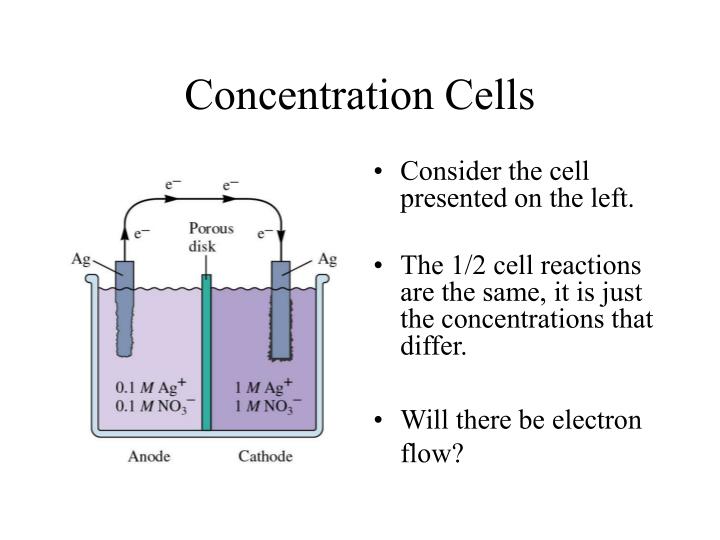
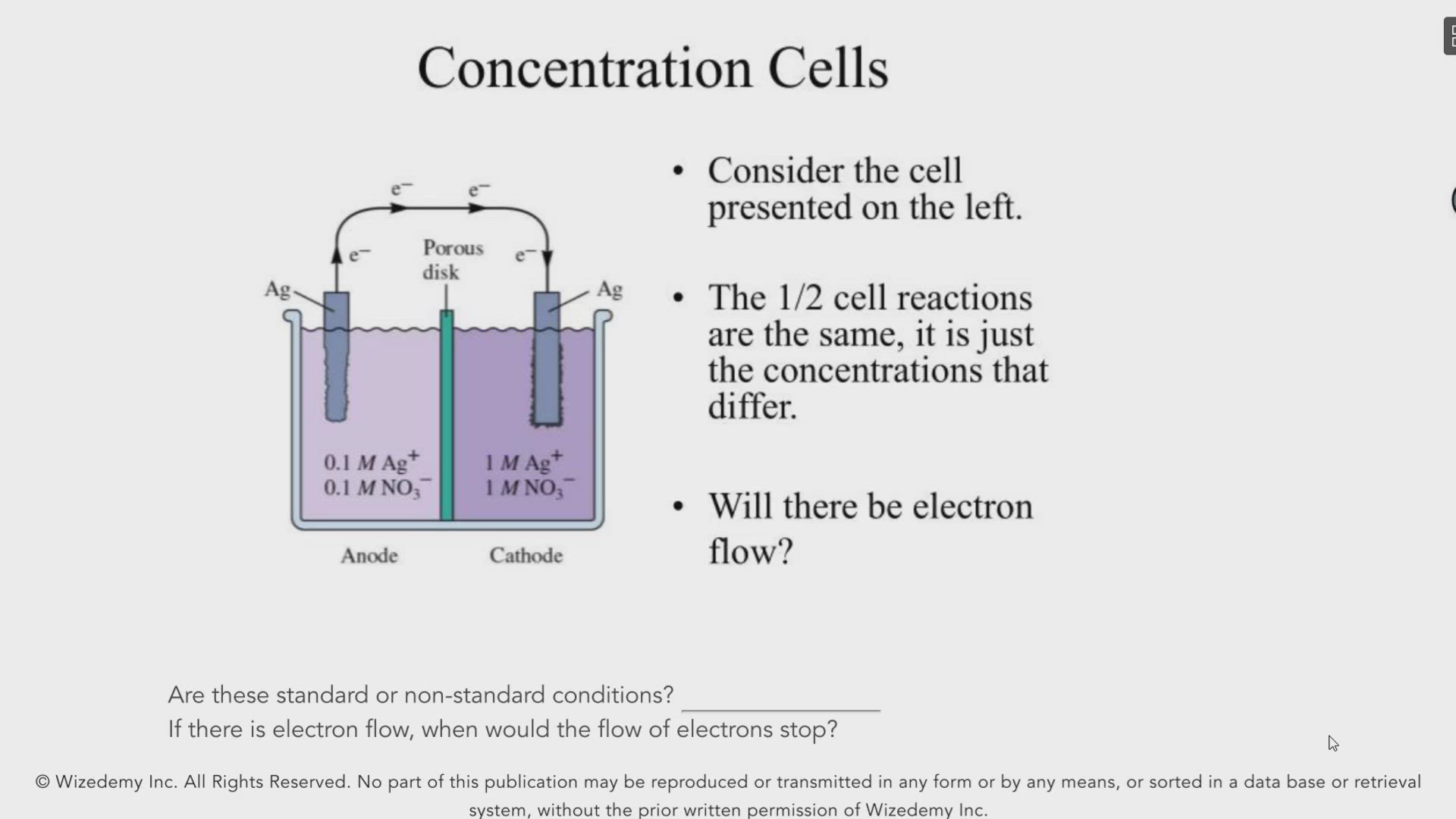
Are these standard or non-standard conditions?
Non-standard
If there is electron flow, when would the flow of electrons stop?
Flow of electrons would stop when there is an equal concentration of ions in both half cells
Problem:
There are two half-cells connected together. Both half-cells have a zinc electrode
and ZnCl2 electrolyte. The concentration of Zn2+ in one cell is 0.20 M and in the other cell is more dilute but unknown. The voltage across the electrodes is 0.0289 V. Find the unknown [Zn2+].
We will need to use the Nernst equation since the conditions are
non-standard
! Ecell=Eocell - (RT/nF)(lnQ)
In concentration cells, the net equation involves a more concentrated species becoming a more dilute species. Here,
The E°cell of a concentration cell is zero since it is the same half reaction Zn2+ (aq)
+ 2 e- Zn(s) but only in different directions at the anode versus the cathode.