Wize University Chemistry Textbook > Electrochemistry
Important Equations + Nonstandard conditions (Nernst Equation)
Popular Courses
MCAT
General Course
CHEM 1302A/B
Western University
General Chemistry
University Study Guides
AP Chemistry Exam Prep Course
AP Exam Prep
CHEM 1A03
McMaster University
CHEM 112
Queen's University
CHEM 203
University of Calgary
DAT
General Course
Chemistry
General Course
General Chemistry
University Study Guides
CHEM 1E03
McMaster University
ENGG 204
University of Calgary
CHM135H1
University of Toronto
CHEM 154
University of British Columbia
CHEM 102
University of Alberta
CHEM*1050
University of Guelph
CHEM 120
McGill University
APSC 132
Queen's University
CHEM 112B
Queen's University
CHEM 205
University of British Columbia

0:00 / 0:00
Cell Potentials and Gibbs Free Energy
- Free energy (ΔG°) and cell potential (E°cell) are related through the following equation:
ΔG° = Free energy difference between products and reactants in their standard states
n = # moles of electrons
F = Faraday constant
E°cell = Standard electrochemical reduction potential
** If E°cell is positive, the process is spontaneous **
- Remember that ΔG° and E° are for the cell at standard conditions (1 atm for gases and 1 M for solutions)
- Under nonstandard conditions we have:
- We can correct E° to reflect the nonstandard conditions by using the Nernst equation
0:00 / 0:00
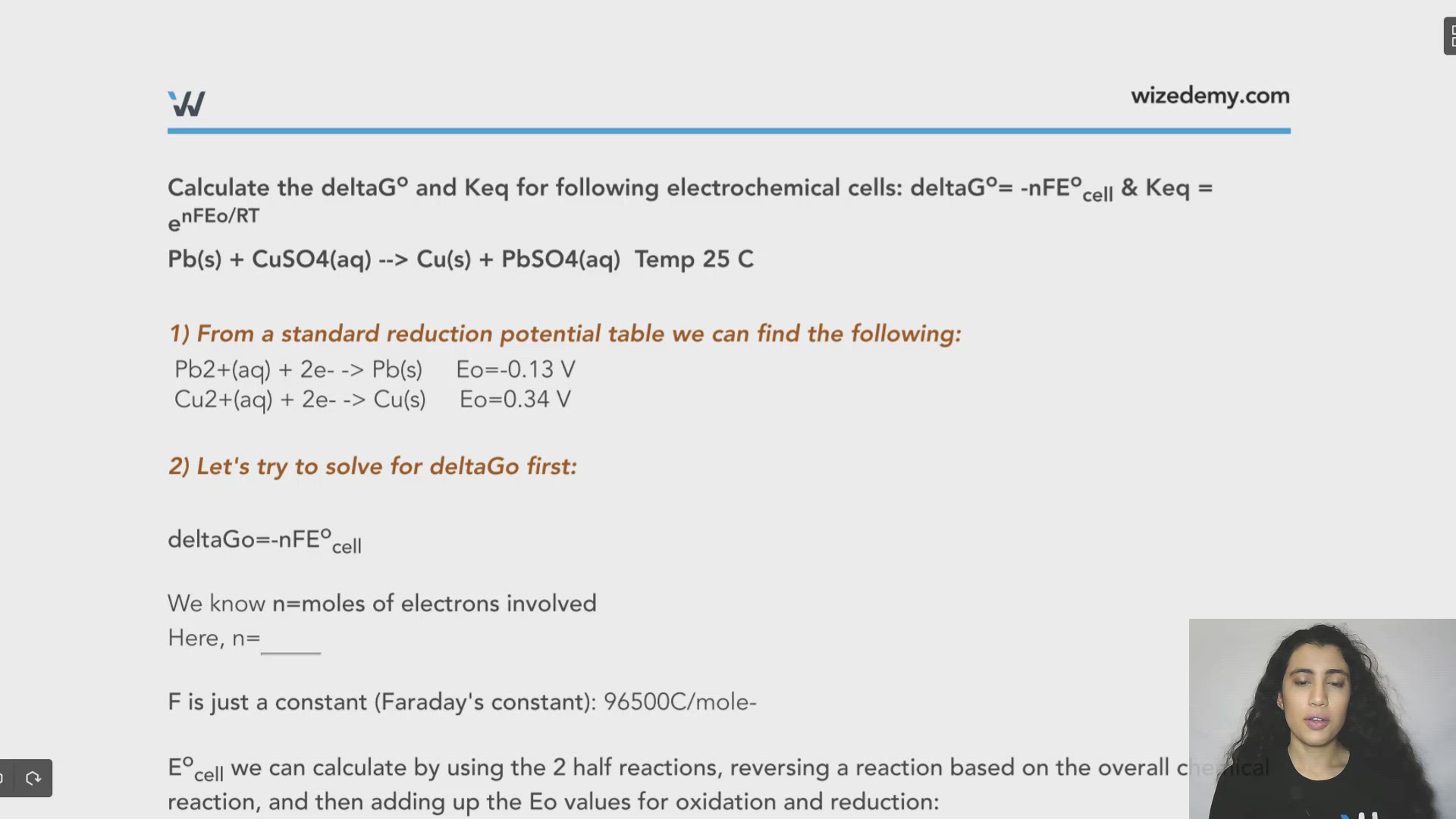
Calculate the deltaGo and Keq for following electrochemical cells: deltaGo= -nFEocell & Keq = enFEo/RT
Pb(s) + CuSO4(aq) --> Cu(s) + PbSO4(aq) Temp 25 C
1) From a standard reduction potential table we can find the following:
Pb2+(aq) + 2e- -> Pb(s) Eo=-0.13 V
Cu2+(aq) + 2e- -> Cu(s) Eo=0.34 V
2) Let's try to solve for deltaGo first:
deltaGo=-nFEocell
We know n=moles of electrons involved
Here, n=
2
F is just a constant (Faraday's constant): 96500C/mole-
Eocell we can calculate by using the 2 half reactions, reversing a reaction based on the overall chemical reaction, and then adding up the Eo values for oxidation and reduction:
In our overall equation, when we look at the reactants, which is being oxidized and which is being reduced?
Pb(s) is being oxidized, Cu2+ is being reduced.
Based on this info, which equation should we reverse from the table?
First equation
What is the Eocell(redox)=?
Eocell=0.13 + 0.34
Eocell=0.47 V
Now we can plug these values in and solve for deltaGo:
deltaGo=-nFEocell
=(-2mole-)(96500C/mole-)(0.47V)
=-90710 J/mol
If we wanted our deltaGo to be in kJ/mol what would our answer be?
-90.71kJ/mol
3) Now let's solve for Keq:
Keq = enFEo/RT
We already found n and Eo, we know F (96500C/mole-), we know R (8.314J/molK) and the temperature is given in the question (25C=298K!) Note: These equations are used for standard conditions, so the temperature would have to be 25C or 298K!
Keq = enFEo/RT
=e(2)(96500)(0.47)/8.314x298
=e36.61246
=7.95x10¹⁵
Use the following reduction potentials to calculate the Ksp of La(OH)3(s)

0:00 / 0:00
Cells Operating at Non-Standard Conditions: Nernst Equation
- If we want to operate a cell at non-standard conditions (not 1 M solutions) we need to use the Nernst equation to find new electromotive force
R: Ideal gas constant (8.314 J/molK)
T: Temperature (K)
n: # of electrons involved
F: Faraday constant (96500 C/mol e–)
Eocell: standard electromotive force
0:00 / 0:00
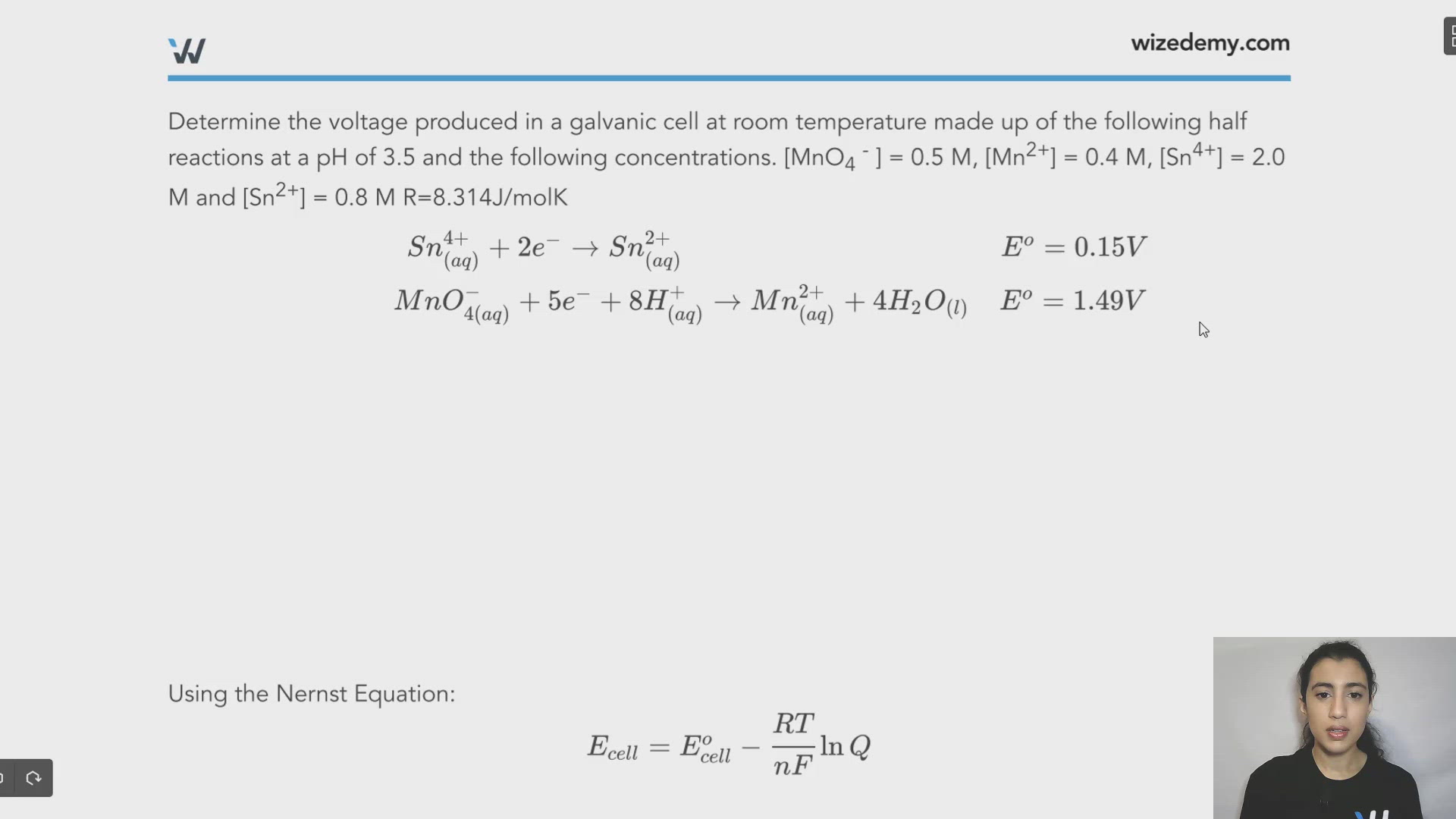
Determine the voltage produced in a galvanic cell at room temperature made up of the following half reactions at a pH of 3.5 and the following concentrations. [MnO4 - ] = 0.5 M, [Mn2+] = 0.4 M, [Sn4+] = 2.0 M and [Sn2+] = 0.8 M R=8.314J/molK
A galvanic cell must have a positive voltage so the Sn half-cell must be the oxidation half cell.
The chemical equation id shown below:
Using the Nernst Equation:
=-340V

Mark Yourself Question
- Grab a piece of paper and try this problem yourself.
- When you're done, check the "I have answered this question" box below.
- View the solution and report whether you got it right or wrong.
At 25C, what is the potential of the following cell and what is the Keq?
Ni|Ni2+(aq)(0.010 M)||Cr-(0.20 M)|Cr2(g) | Pt
1) Is the reaction occuring in standard or non-standard conditions?
If it is occuring in standard conditions --> it is asking us to solve for Eocell
If it is occuring in nonstandard conditions --> it is asking us to solve for Ecell
2) Which equation will we use to solve this problem?
Nernst equation for non-standard conditions!
E = Eo - (RT/nF)ln(Q)
E is what the question is asking us to solve
Eo we can calculate by using the SRP from a table
R=8.314J/molK
n=# of electrons involved in the overall reaction
F=faraday's constant (96500C/mole-)
Q=[products]/[reactants]
3) Solve for Eocell using SRP tables:
Ni2+(aq) + 2e- --> Ni(s) Eo=-0.25 V
Cr2(g) + 2e- --> 2Cr-(aq) Eo=+1.36 V
From this the standard cell reaction would be:
Cr2(g) + 2e- --> 2Cr-(aq)
Eo=
Ni(s) --> Ni2+(aq) + 2e-
Eo=
to give Cr2(g) + Ni(s) --> 2Cr-(aq) + Ni2+(aq)
Eo=
1.61V
4) Now we can determine E at non-standard conditions via the NERNST Equation:
E = Eo - (RT/nF)ln(Q)
Bonus: Is this reaction spontaneous or not?
5) What is Keq at 298 K?
Keq = enFEo/RT