Wize University Chemistry Textbook > Electrochemistry
Electrolytic Cells
Popular Courses
MCAT
General Course
CHEM 1302A/B
Western University
General Chemistry
University Study Guides
AP Chemistry Exam Prep Course
AP Exam Prep
CHEM 1A03
McMaster University
CHEM 112
Queen's University
Chemistry
General Course
DAT
General Course
General Chemistry
University Study Guides
CHEM 1E03
McMaster University
ENGG 204
University of Calgary
Chemistry 12
British Columbia High School
CHM135H1
University of Toronto
CHEM 102
University of Alberta
CHEM*1050
University of Guelph
CHEM 120
McGill University
CHE 102
University of Waterloo
APSC 132
Queen's University
CHEM 112B
Queen's University
CHEM 205
University of British Columbia
0:00 / 0:00
Electrolytic Cells
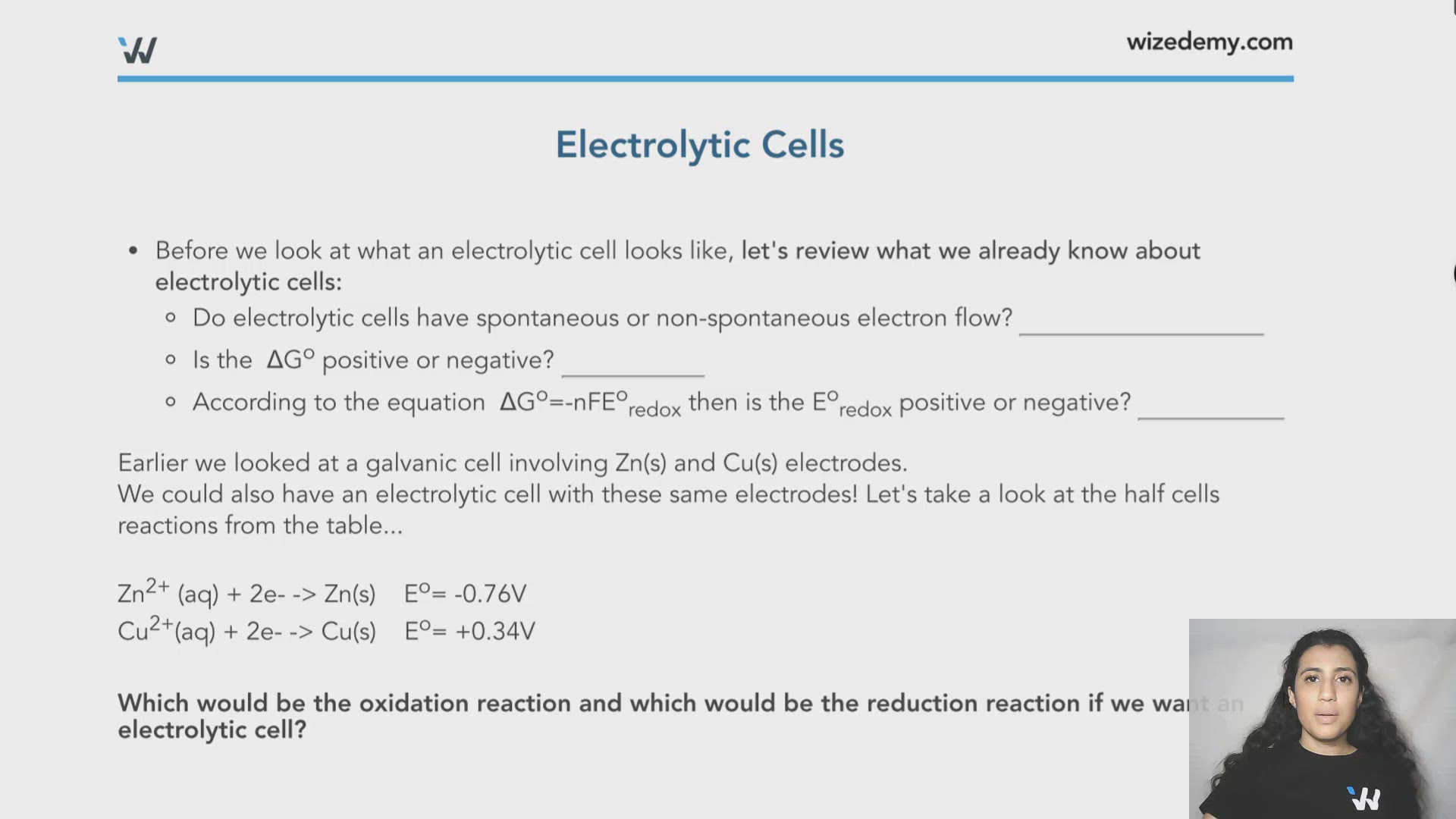
- Before we look at what an electrolytic cell looks like, let's review what we already know about electrolytic cells:
- Do electrolytic cells have spontaneous or non-spontaneous electron flow?non-spontaneous
- Is the ΔGo positive or negative?positive
- According to the equation ΔGo=-nFEoredox then is the Eoredox positive or negative?negative
Earlier we looked at a galvanic cell involving Zn(s) and Cu(s) electrodes.
We could also have an electrolytic cell with these same electrodes! Let's take a look at the half cells reactions from the table...
Zn2+ (aq) + 2e- -> Zn(s) Eo= -0.76V
Cu2+(aq) + 2e- -> Cu(s) Eo= +0.34V
Which would be the oxidation reaction and which would be the reduction reaction if we want an electrolytic cell?
Zn2+ (aq) + 2e- -> Zn(s) Eo= -0.76V reduced
Cu(s) --> Cu2+(aq) + 2e- Eo= -0.34V oxidized
Eoredox=-1.1V
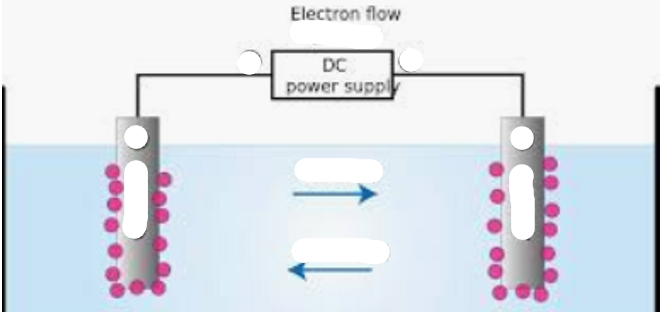
Based on this, label the following:
1) Let's say we are told that Zn(s) is on the left and Cu(s) is on the right. Label the anode and cathode.
2) Draw in electron flow.
3) Draw in charges on the electrodes and on the battery.
Wize Concept
Note that because electrolytic cells have non-spontaneous flow of electrons, the only way to get the electrons to flow to where they don't want to go is by adding an external source of energy like a battery.
Electrons still flow from anode (where oxidation happens) to the cathode (where reduction happens).
But the difference between an electrolytic and galvanic cell is not only the battery needed for an electrolytic cell but also the charges on the electrodes.
In an electrolytic cell, electrons are going to where they don't want to go, but still going to the cathode. Therefore the cathode is negatively charged and the anode is positively charged!
- Also note that electrolytic cells do not require separation of the half reactions like galvanic cells do.
0:00 / 0:00
Faraday's Law of Electrolysis
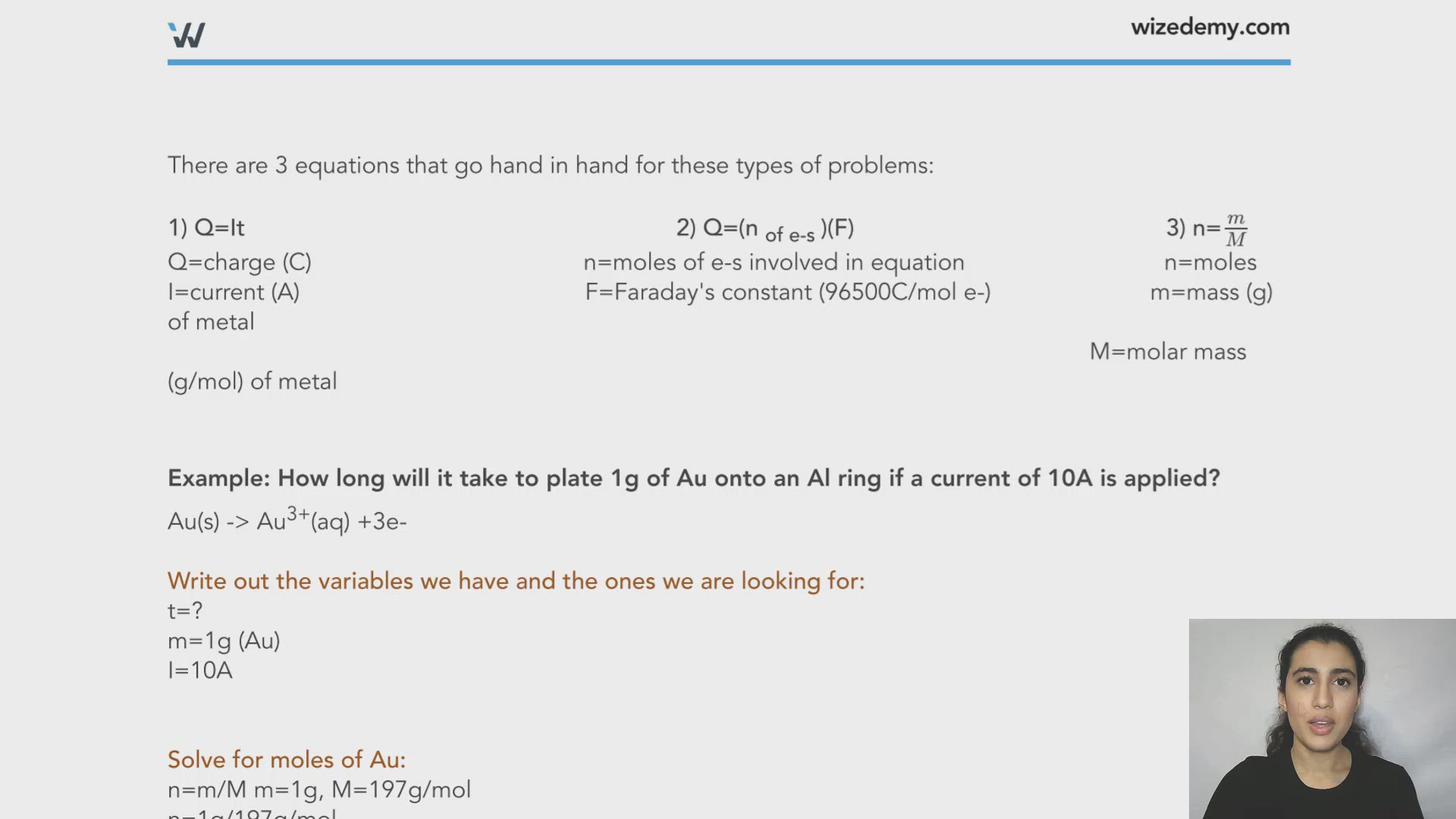
There are 3 equations that go hand in hand for these types of problems:
1) Q=It 2) Q=(n of e-s )(F) 3) n=
Q=charge (C) n=moles of e-s involved in equation n=moles
I=current (A) F=Faraday's constant (96485C/mol e-) m=mass (g) of metal
t=time (s) M=molar mass (g/mol) of metal
Example: How long will it take to plate 1g of Au onto an Al ring if a current of 10A is applied?
Au(s) -> Au3+(aq) +3e-
Write out the variables we have and the ones we are looking for:
t=?
m=1g (Au)
I=10A
Solve for moles of Au:
n=m/M m=1g, M=197g/mol
n=1g/197g/mol
=
=0.5x10⁻²
n=0.005mol of Au
Find the moles of electrons:
n of e-s= 3 x 0.005mol of Au
n of e-s= 0.015 mol e-
Solve for Q:
Q=(n of e's)(F)
Q=(0.015moles of e-)(96500C/mol e-)
~(1.5x10⁻²)(9.65x10⁴C)
~(1.5x10⁻²)(10x104C)
~15x102C
Q=1500C
Solve for time (t):
Q=It
t=Q/I
t=1500C/10A
t=150s
Summary of Galvanic Vs Electrolytic Cell
Galvanic Cell:
- Spontaneous electron flow towards a positive charge
- Electrons go from the anode -> cathode where the anode is negatively charged and the cathode is positively charged
Electrolytic Cell:
- Non-spontaneous electron flow (requires an external source of energy like a battery)
- Electrons still go from the anode -> cathode but the anode is positively charged and the cathode is negatively charged
Watch Out!
If you see a cell being called an "electrochemical cell" this could be either a galvanic cell or an electrolytic cell.
We use the term "electrochemical cell" to refer to any cell.

0:00 / 0:00
Summary of Free Energy, Equilibrium, and Electromotive Force
- Row 1 applies to a galvanic cell
- Since the reaction is spontaneous in the forward direction, it wants to proceed towards the products and so Q < K since the reaction is going to the right.
- Row 3 applies to an electrolytic cell
- Since the forward reaction is non-spontaneous, that means the reverse reaction is spontaneous
- This reaction would want to go from products to reactants
- This reaction wants to go towards the left and has more products than reactants, which is why Q > K