Wize University Chemistry Textbook > Solutions and Colligative Properties
Solution Stoichiometry
Popular Courses
General Chemistry
University Study Guides
AP Chemistry Exam Prep Course
AP Exam Prep
DAT
General Course
CHM135H1
University of Toronto
CHY 102
Toronto Metropolitan University
CHEM 121
Simon Fraser University
CHEM 120
McGill University
APSC 131
Queen's University
APSC 131
Queen's University
CHEM 205
University of British Columbia
CHEM-1100
University of Windsor
CHEM 130
University of British Columbia
CHEM 1481
Texas A & M University
CHEM 206
Concordia University
CHEM 1001
Carleton University
CHM 2045
University of Florida
CHEM 1035
Virginia Tech
CHEM 1P91
Brock University
CHMA11H3
University of Toronto
CHEM 1110
University of Manitoba
0:00 / 0:00
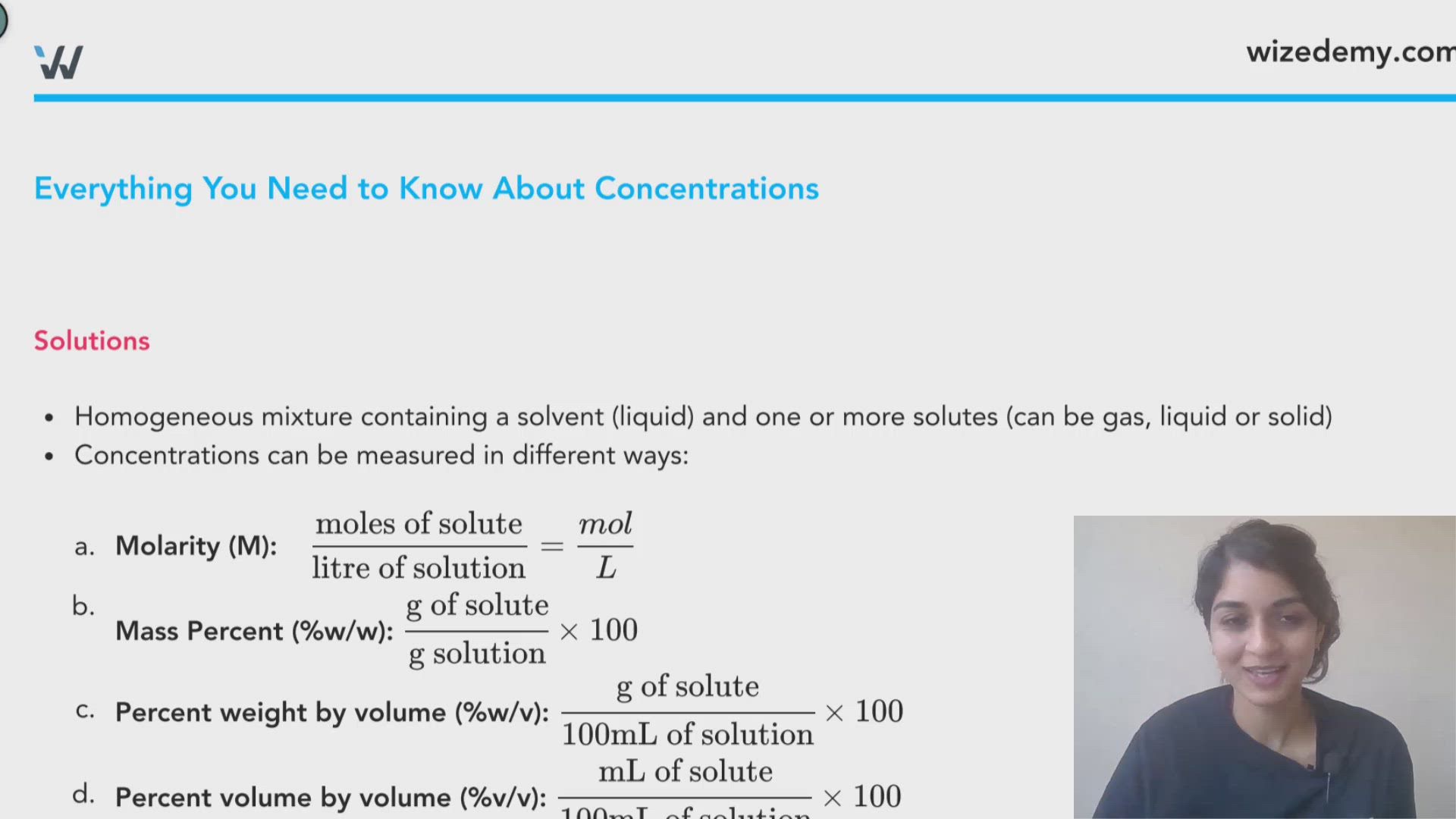
Everything You Need to Know About Concentrations
Solutions
- Homogeneous mixture containing a solvent (liquid) and one or more solutes (can be gas, liquid or solid)
- Concentrations can be measured in different ways:
- Molarity (M):
- Mass Percent (%w/w):
- Percent weight by volume (%w/v):
- Percent volume by volume (%v/v):
- Concentration can be expressed in parts per million (ppm) or parts per billion (ppb), usually when working with trace impurities (ex: the label on bottled water)
- To convert from mL of a liquid to grams, use the density.
Dilutions
- When diluting a solution from an initial concentration, we can find the final volume for a desired final concentration or vice versa:
- The number of moles of solute does not change, but the volume of the solvent increases.
Note that a diluted/standard/and stock solution are all different!
Standard solution: solution that we know the concentration for accurately
Stock solution: standard solutions kept in concentrated form
Dilution: Stock and standard solutions are diluted to prepare solutions of a lower concentration
0:00 / 0:00
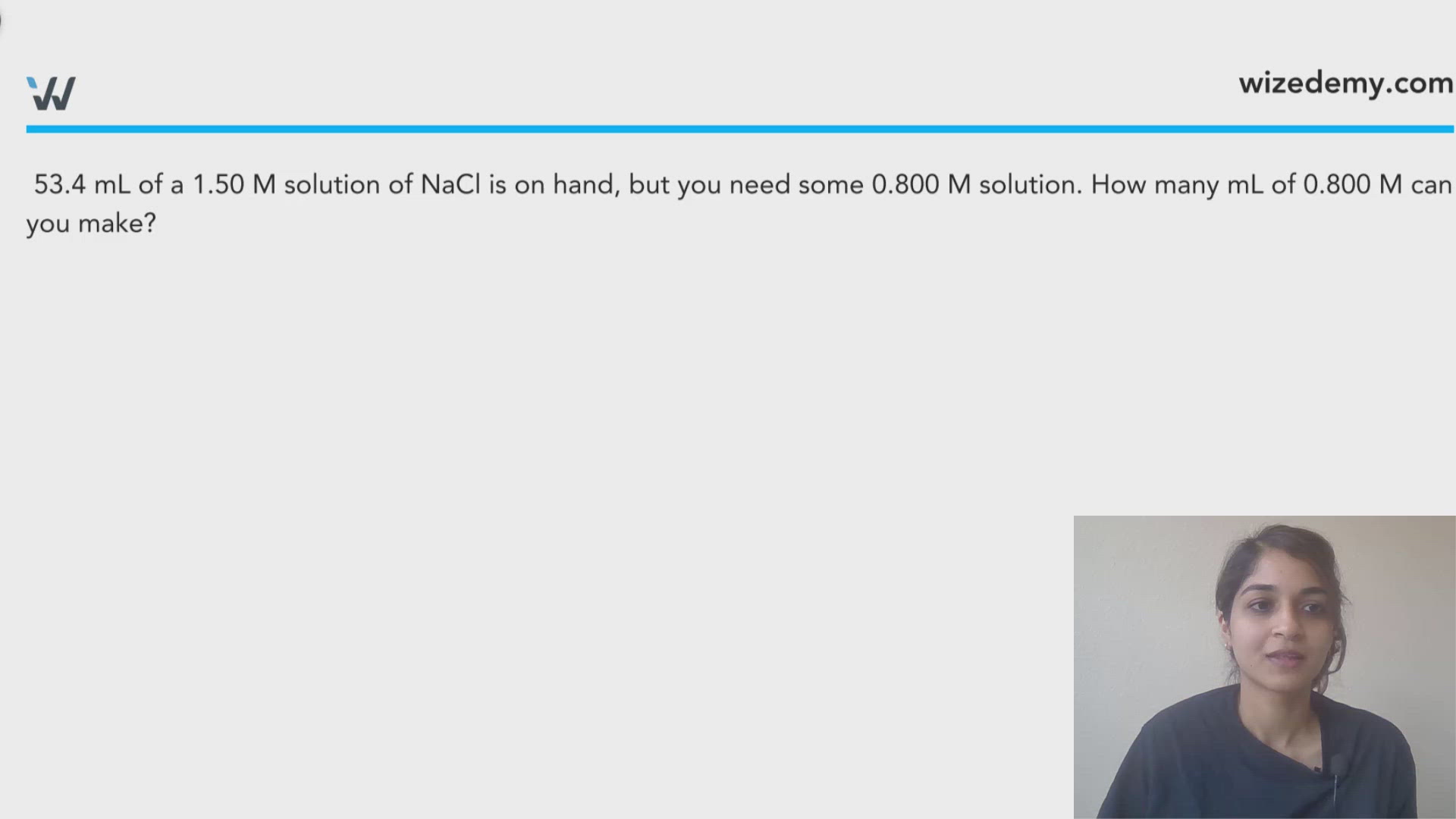
53.4 mL of a 1.50 M solution of NaCl is on hand, but you need some 0.800 M solution. How many mL of 0.800 M can you make?
Using the dilution equation, we write:
(1.50 mol/L) (53.4 mL) = (0.800 mol/L) ( X mL)
x = 100 mL
Notice that the volumes need not be converted to liters, as long as volume units are the same on both sides.
What is the molarity (M) of potassium ions in a solution prepared by mixing 100 mL of 0.250 M potassium bicarbonate with 400 mL of 0.400 potassium sulfate?

Mark Yourself Question
- Grab a piece of paper and try this problem yourself.
- When you're done, check the "I have answered this question" box below.
- View the solution and report whether you got it right or wrong.
How many carbon atoms are in 10.00 mL of ethanol ( CH3CH2OH)?
The density of ethanol is 0.789 g/mL.