Wize University Chemistry Textbook > Solutions and Colligative Properties
Solutions & Solubility
Popular Courses
General Chemistry
University Study Guides
CHEM 112
Queen's University
DAT
General Course
CHM135H1
University of Toronto
CHY 102
Toronto Metropolitan University
CHEM 121
Simon Fraser University
CHEM 120
McGill University
CHE 102
University of Waterloo
APSC 131
Queen's University
APSC 131
Queen's University
CHEM 205
University of British Columbia
CHEM-1100
University of Windsor
CHEM 130
University of British Columbia
CHEM 1481
Texas A & M University
CHEM 206
Concordia University
CHM 2045
University of Florida
CHEM 1001
Carleton University
CHEM 1P91
Brock University
CHMA11H3
University of Toronto
CHEM 1110
University of Manitoba
0:00 / 0:00
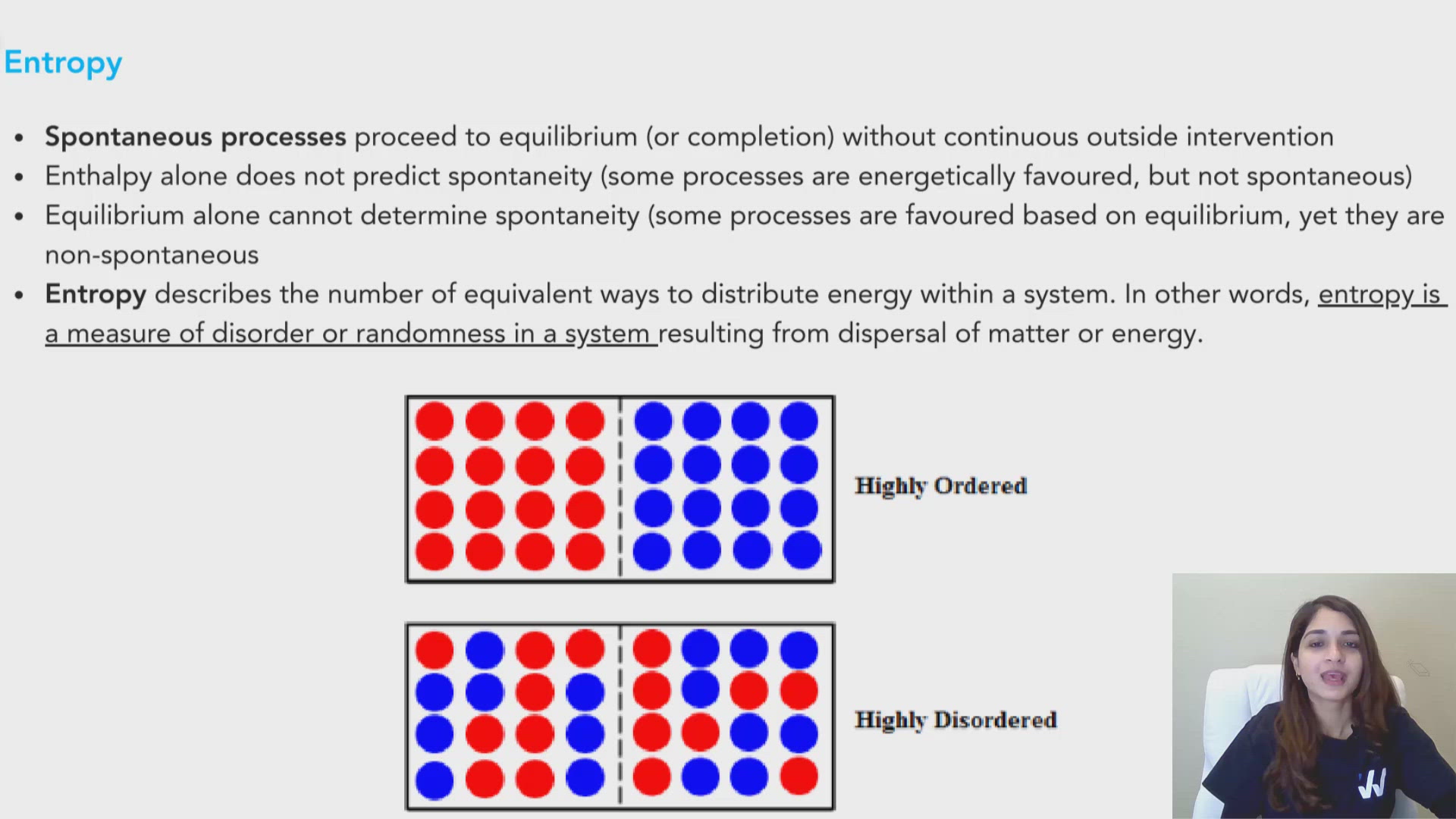
Entropy
- Spontaneous processes proceed to equilibrium (or completion) without continuous outside intervention
- Enthalpy alone does not predict spontaneity (some processes are energetically favoured, but not spontaneous)
- Equilibrium alone cannot determine spontaneity (some processes are favoured based on equilibrium, yet they are non-spontaneous
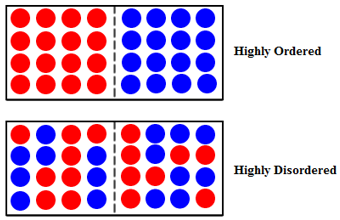
- Entropy describes the number of equivalent ways to distribute energy within a system. In other words, entropy is a measure of disorder or randomness in a system resulting from dispersal of matter or energy.
- Entropy is defined as:
- At constant temperature and pressure:
- The second law of thermodynamics states that whenever a spontaneous event takes place in the universe, the total entropy of the universe increases
- Factors that affect entropy:
- State: solids < liquids < gas
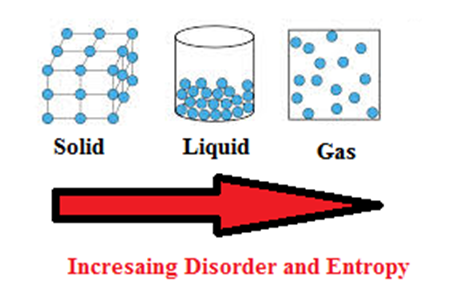
- Temperature: entropy increases with temperature
- Moles of gas: the higher the amount of gas, the higher the entropy
- Volume occupied by a gas: entropy increases with volume
- Molecular size: larger molecules have higher entropy

0:00 / 0:00
Example: Qualitatively Estimating Entropy Changes
Determine if the entropy change will be positive or negative for the following reactions:
- On the left side we only have a solid
- On the right side we have a solid, a liquid, and a gas
- Since there is a liquid and gas on the right side, we automatically know that there is more disorder on the right side
- There are also more molecules on the right than the left
- The entropy change is positive (entropy increases going to the right)
- Each reactant and product are in the gaseous phase
- On the left side, there are 3 moles of gas
- On the right side, there are 2 moles of gas
- The entropy change is negative since there are less moles of gas on the products side of the reaction
- 1 mole of gas on the left side
- 2 moles of gas on the right side
- Since there are more moles of gas on the right side it means that there is more disorder on the right side
- The entropy change is positive (entropy increases going to the right)

0:00 / 0:00
Colligative Properties
Solution properties which depend only on the concentration of the solute and not the type of solute are known as colligative property:
- Vapor pressure
- Boiling Point Elevation
- Freezing Point Depression
- Osmotic Pressure
Note: colligative properties are driven by entropic forces. Ignore intermolecular interactions.
1. Vapor Pressure Lowering
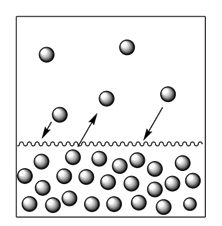
- The vapor pressure is the pressure produced by molecules in the gas phase above a liquid
Calculations of Vapor Pressure
- PTotal= Pvapor1 +Pvapor2
- Ideal Gas Law -
- Boyle's Law - At constant temperature, the pressure of an ideal gas is inversely proportional to its volume. i.e.
- Henry's Law - describes the solubility of a gas in a liquid, where solubility= k x P, where k = Henry's constant and P = vapor pressure of the gas over the solution
- Vapor pressure is hindered by the presence of solute molecules. More solute → lower vapor pressure
- How much does the pressure of the solution change as we add more solute? Raoult's Law - non-volatile solutes decrease the vapor pressure such that , where Xsolvent = mole fraction = # solvent particles / total # particles
- Raoult's Law works for IDEAL solutions
2. Boiling Point Elevation
- Addition of solute increases the boiling point
- where
- Kb is a constant
- m = molality = nsolute / kg solvent
- i = van't Hoff factor
i = moles of particle in solution or moles of solute dissolved (assume complete dissociation)
i = sum of ions
For ionic solute, e.g. NaCl i=2 , CaCl2 → Ca Cl Cl i=3
For non-ionic solute, e.g. Ethylene Glycol, Methanol i=1
3. Freezing Point Depression
- Addition of solute requires a lower temperature to freeze
4. Osmotic Pressure
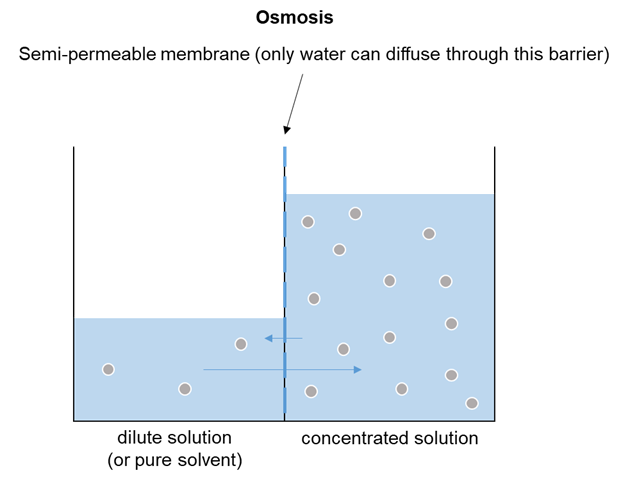
- Rate of diffusion of water to the right is faster than rate of diffusion of water to the left because of the presence of a higher concentration of solute particles on the right side
- The osmotic pressure is proportional to the molarity of the solution (M)
- The osmotic pressure is the pressure that needs to be applied to prevent increased volume
M = Molarity (mol/L)
Wize Tip
Remember the equations above refer to the change in VP, BP, or FP. To calculate the new VP, BP, or FP after the addition of solute to a solution, we have to ADD or SUBTRACT the change:
Freezing point goes down with the addition of solute, so we subtract the change in T:
normal freezing point - = new freezing point
Boiling point goes up with the addition of solute, so we add the change in T:
normal boiling point + = new boiling point
0:00 / 0:00
An aqueous solution contains 25.0g of an ionic compound (i=2) dissolved in 250.0 g of water. The freezing point of the solution is -2.50 ̊C. Kf for water is 1.86 ̊C/m and normal freezing point of water is 0.00 ̊C. What is the molar mass of the substance?
Aim: Find the Molar mass after finding the molality: # of mols of solute/mass of solvent kg
Kf of water= 1.86 oC/m
Freezing point of solution= -2.50oC
Freezing point of water= 0.00oC
mass of solute= 25.0 g (ionic)
i=2
V of water= 250.0g= 0.2500 kg
m = -2.50/-3.72 = 0.672 m
molality = 0.672 m = n of solute / mass of solvent (kg)
n of solute= molality x mass of solvent= 0.672 mol/kg x 0.2500 kg= 0.168 mol
m = nM
M = m/n = 25.0g / 0.168mol = 148.8 g/mol

Mark Yourself Question
- Grab a piece of paper and try this problem yourself.
- When you're done, check the "I have answered this question" box below.
- View the solution and report whether you got it right or wrong.
A sample of N2 gas was collected over water. The temperature of the vessel was 300.0 K and the volume of the sample was 18.0 L. The vapour pressure of water at 300.0 K is 3.53 kPa and the total pressure of the sample was 122.00 kPa. What is the mass of the N2 in this sample?
Estimate the molecular weight of a biological macromolecule, if a 0.2 g sample dissolved in 100g of water has an osmotic pressure of 80 torr at 25oC.