Wize University Chemistry Textbook > Nuclear Chemistry
Types of Nuclear Decay
Popular Courses
MCAT
General Course
General Chemistry
University Study Guides
DAT
General Course
CHEM 121
Simon Fraser University
CHEM 1481
Texas A & M University
CHMA10H3
University of Toronto
CHEM 1001
Carleton University
CHM 2045
University of Florida
CHEM 1P91
Brock University
CHM 1301
University of Ottawa
CHEM 1300
University of Manitoba
CHEM 151
University of Arizona
CHEM 119
Texas A&M University
CHM 1045
Florida State University
CHEM 124
California Polytechnic State University-San Luis Obispo
NE 121
University of Waterloo
CHEM 161
Rutgers University
CHEM 107
Texas A&M University
CHM220H1
University of Toronto
CHEM 102
University of Illinois at Urbana - Champaign

Mark Yourself Question
- Grab a piece of paper and try this problem yourself.
- When you're done, check the "I have answered this question" box below.
- View the solution and report whether you got it right or wrong.
Atomic Structure and Weight
What’s an atom?
Proton: Found in the nucleus, these particles have a +1 charge and weigh ~1u (1.0073u)
Neutron: Found in the nucleus, these particles have a charge of 0 and weigh ~1u (1.0087u)
Electron: These particles surround the nucleus. They have a charge of -1 and weigh ~0u(0.00055u), however, they represent >99.99% of an atoms volume.
Note: The unit ‘u’ is the unified atomic mass unit and we typically use it to refer to subatomic particles or single isotopes

Disclaimer: This is a very simplified view of the atom and was developed in the early 1900’s. However, it is still a useful model for some things due to its simplicity.
Chemical Symbols:
- We use symbols to abbreviate the large picture above. Imagine having to draw uranium…
A – Mass number (# of protons + # of neutrons)
E – Elemental symbol (ex. Iron – Fe)
Z – Atomic Number (# of protons)
n – Charge (# of protons - # of electrons)
- Z is usually omitted because the same information can be obtained by the elemental symbol
- n is omitted when n = 0
- If A is omitted, then we are referring to all isotopes of the given element
What are isotopes?
Definition: Isotopes are defined as two atoms with the same # of protons (Z) but differing # of neutrons.
- For example, Carbon-12, Carbon-13, Carbon-14 which chemists represent as 12C, 13C,and 14C are all naturally occurring forms of carbon.
- Isotopes react nearly identically because the number of protons and electrons are the same. Remember, electrons are involved in bond making and breaking, which is the basis of chemical reactivity.
# Protons = Z
# Electrons = Z – n
# Neutrons = A-Z
0:00 / 0:00
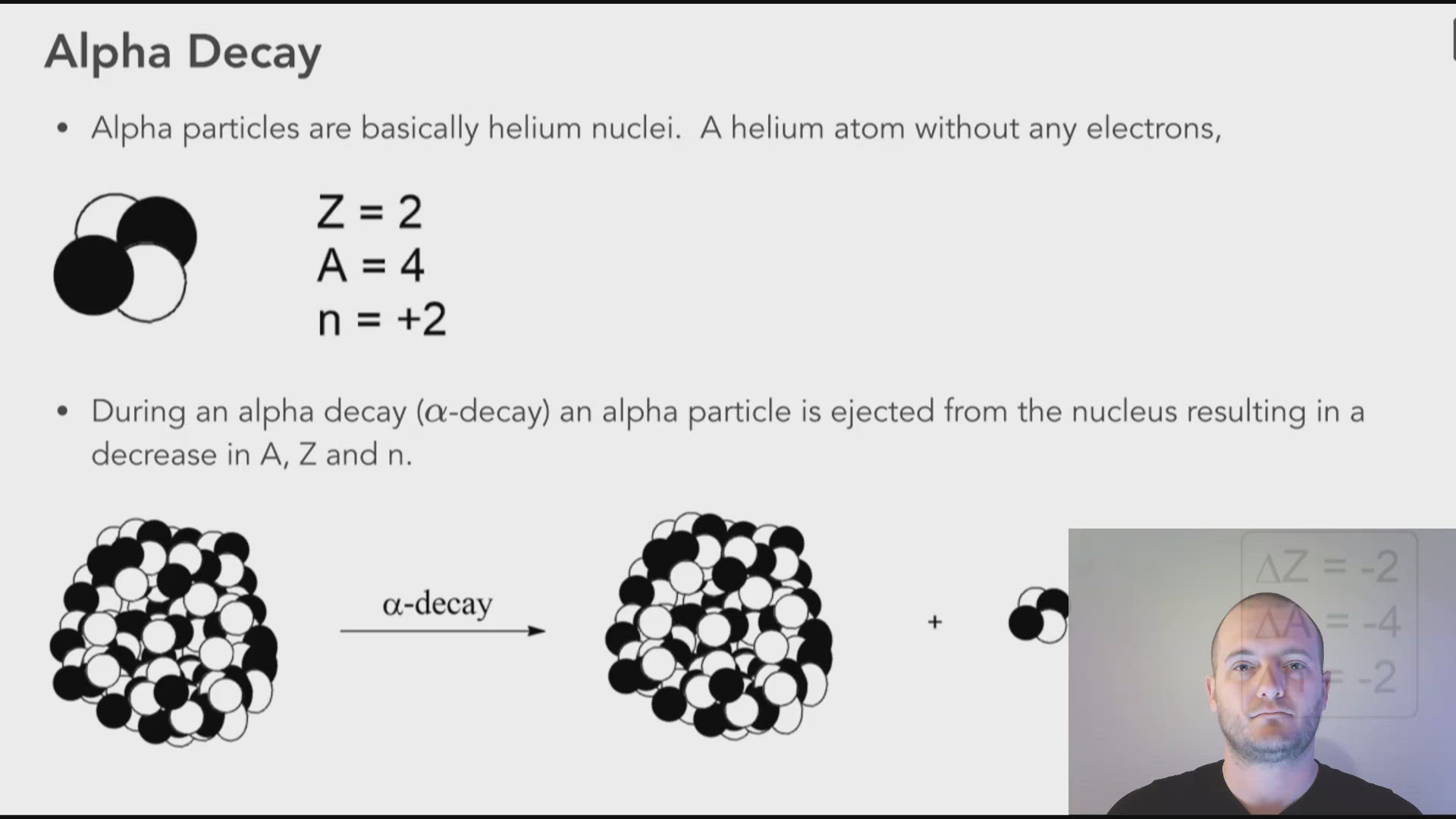
Alpha Decay
- Alpha particles are basically helium nuclei. A helium atom without any electrons,
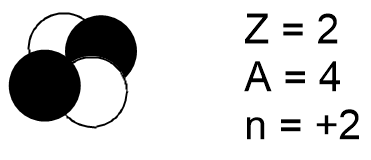
- During an alpha decay (-decay) an alpha particle is ejected from the nucleus resulting in a decrease in A, Z and n.

- Alpha particles, due to there large mass, are easily stopped in just a few centimeters. You could protect yourself from alpha radiation with a few sheets of paper! Your skin is able to stop all alpha radiation and so it is not harmful to humans when outside the body
- However, alpha radiation can be harmful if the alpha emitter is inside the human body! Without the skin to stop it, the alpha particles can mess with our DNA causing radiation poisoning.
Examples include:
- The Polonium-210 poisoning of Alexander Litvinenko by the Russian Government in the United Kingdom which escalated tensions between between Great Britain and Russia.
- Americanium-241 is an alpha emitter and on of the isotopes in nuclear waste. It is used in ionization type smoke detectors and is totally safe because of the low penetrating power of alpha particles. Just don't eat your smoke detector!
0:00 / 0:00
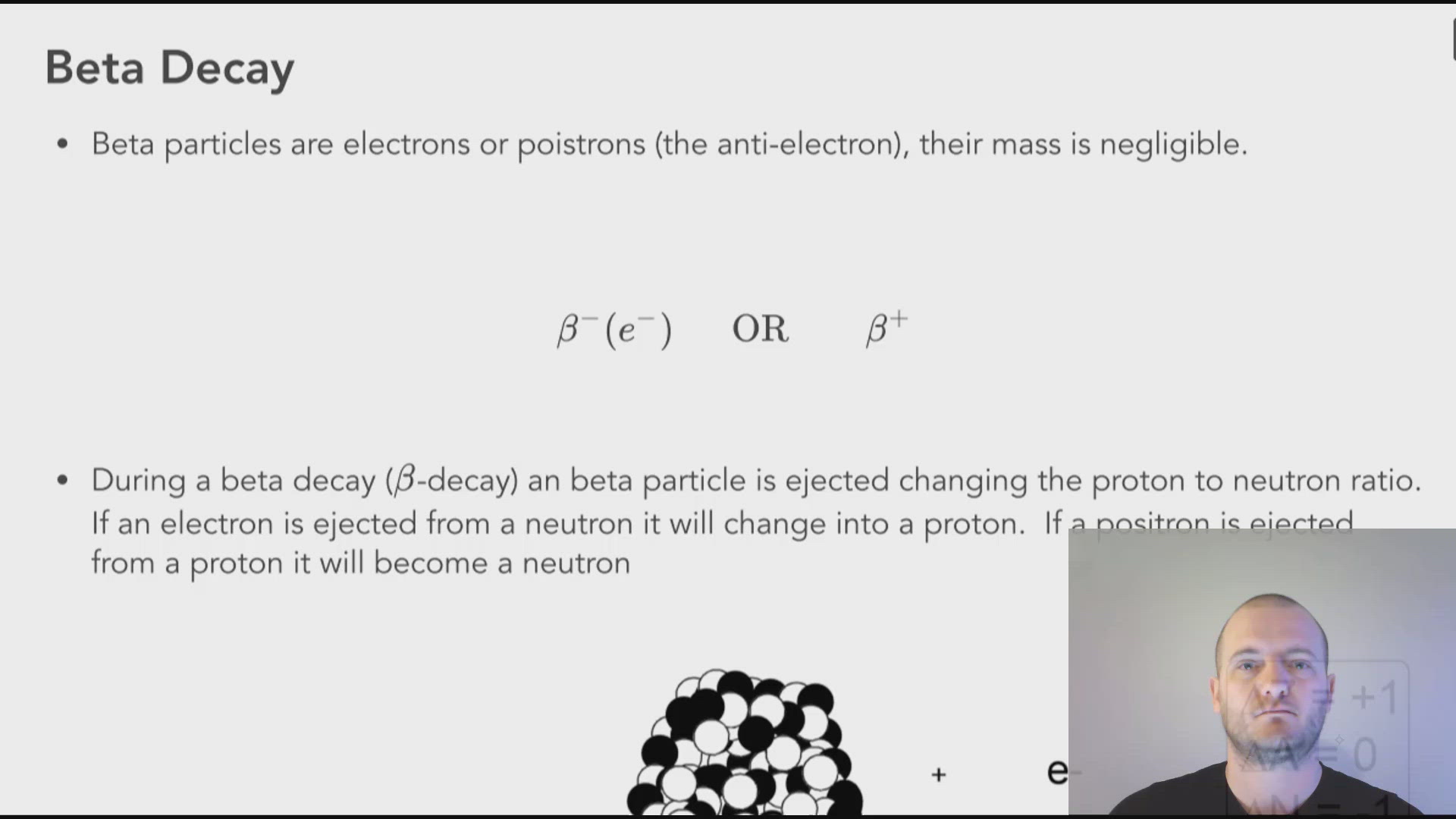
Beta Decay
- Beta particles are electrons or poistrons (the anti-electron), their mass is negligible.
- During a beta decay (-decay) an beta particle is ejected changing the proton to neutron ratio. If an electron is ejected from a neutron it will change into a proton. If a positron is ejected from a proton it will become a neutron

- Beta particles are alot smaller than alpha particles so they have greater penetrating ability. However, they can still be stopped relatively easily with a thin sheet of metal like aluminum
Examples include:
- Carbon-14 is generated from nitrogen through a positron emission event.
- Controlled positron emission allows for PET (Positron Emission Tomography) a medial imaging technique where positron emitters are placed in the body.
0:00 / 0:00
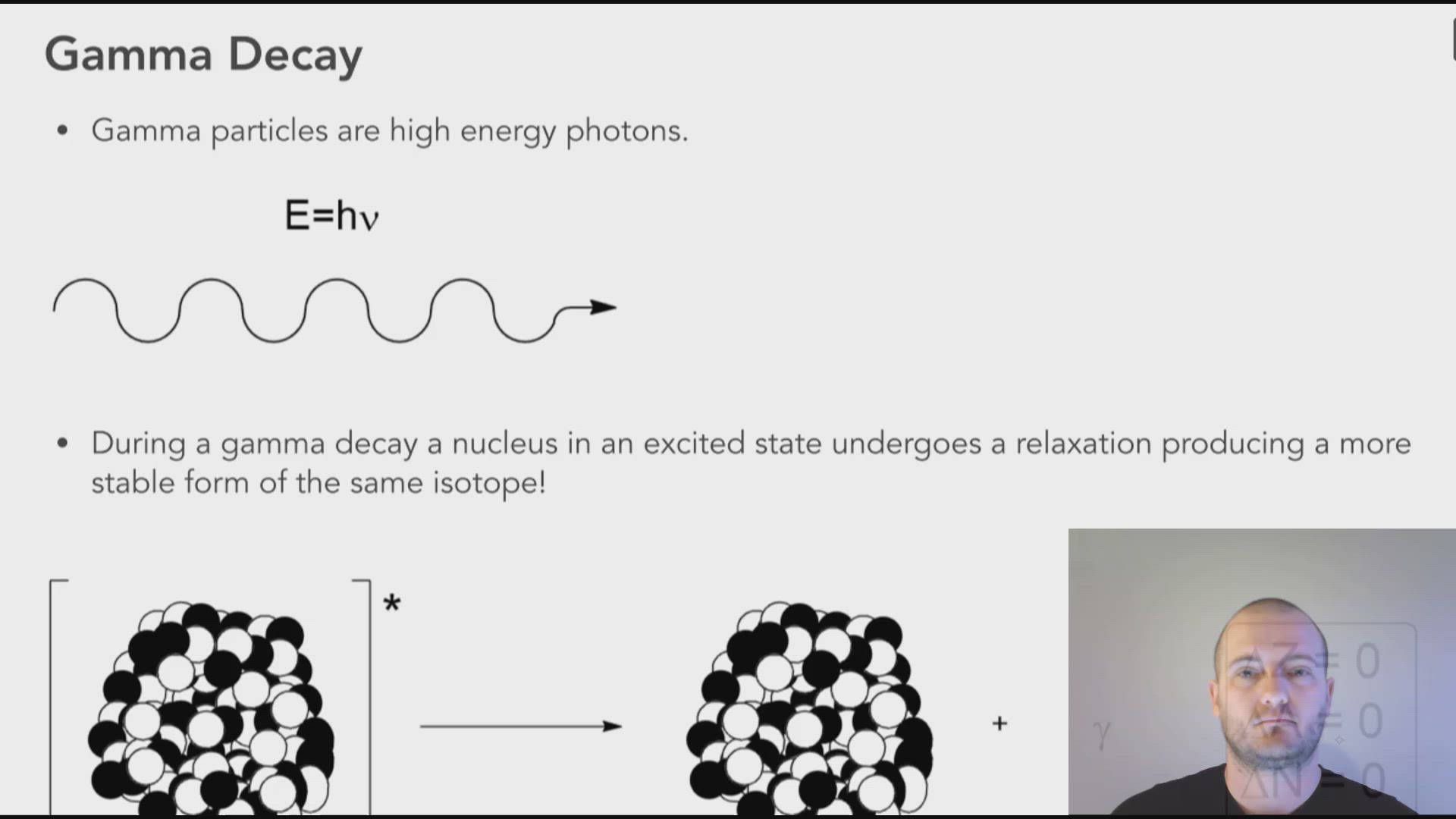
Gamma Decay
- Gamma particles are high energy photons.
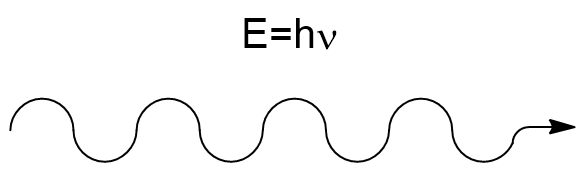
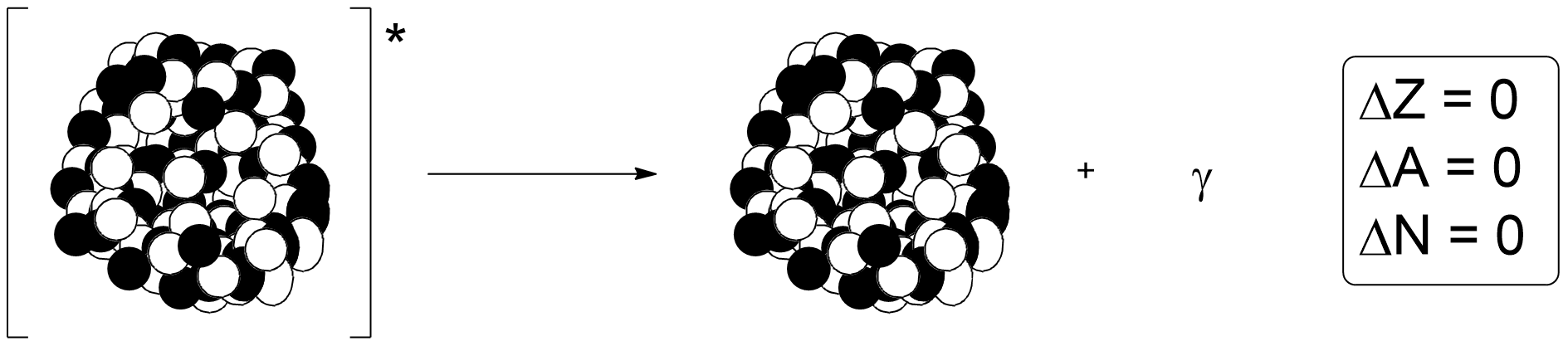
- During a gamma decay a nucleus in an excited state undergoes a relaxation producing a more stable form of the same isotope!
- Gama rays have much higher penetrating ability than alpha particles or beta particles. To stop gamma rays we must use thick pieces of lead!
- High doses of gama rays can be toxic but small doses are fine and these are actually the rays we use to diagnoses illness in positron emission tomography (PET imaging)
Examples include:
- Tc99m converting to Tc99 which is an important imaging agent
- Gamma rays can also be generated when positrons and electrons collide and annihilate!
Mark Yourself Question
- Grab a piece of paper and try this problem yourself.
- When you're done, check the "I have answered this question" box below.
- View the solution and report whether you got it right or wrong.
For each of the following, write a balanced reaction for the nuclear decay described.
a) Thorium-232 underoges an alpha decay
b) Aluminium-26 undergoes positron emission decay
c) Carbon-14 undergoes electron emission decay
d) Radium-228 undergoes alpha decay