Wize University Chemistry Textbook > Nuclear Chemistry
Predicting Nuclear Decay
Popular Courses
MCAT
General Course
General Chemistry
University Study Guides
DAT
General Course
CHEM 121
Simon Fraser University
CHEM 1481
Texas A & M University
CHMA10H3
University of Toronto
CHEM 1001
Carleton University
CHM 2045
University of Florida
CHEM 1P91
Brock University
CHM 1301
University of Ottawa
CHEM 1300
University of Manitoba
CHEM 119
Texas A&M University
CHEM 151
University of Arizona
CHM 1045
Florida State University
CHEM 124
California Polytechnic State University-San Luis Obispo
NE 121
University of Waterloo
CHEM 161
Rutgers University
CHEM 107
Texas A&M University
CHM220H1
University of Toronto
CHEM 127
California Polytechnic State University-San Luis Obispo
0:00 / 0:00
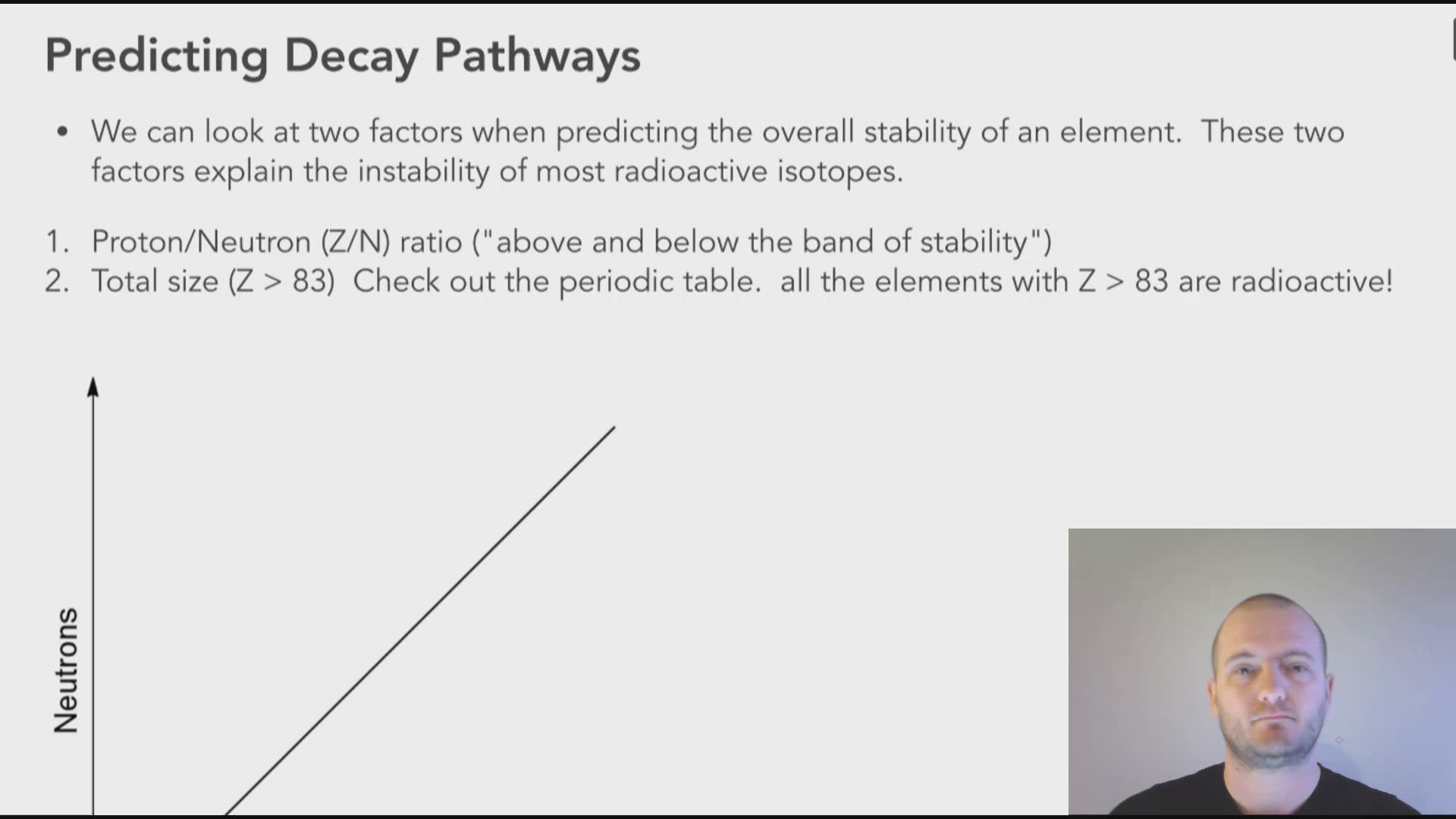
Predicting Decay Pathways
- We can look at two factors when predicting the overall stability of an element. These two factors explain the instability of most radioactive isotopes.
- Proton/Neutron (Z/N) ratio ("above and below the band of stability")
- Total size (Z > 83) Check out the periodic table. all the elements with Z > 83 are radioactive!

Alpha Decay: Common for large nuclei. Elements where Z > 83 undergo alpha decay, Elements where Z < 83 rarely do.
Beta Decay:
- If the species is "neutron-rich" meaning more neutrons than the stable isotope for that element, it is likely to undergo electron emission decay. This turns one neutron into a proton.
- If the species is "proton-rich" meaning less neutrons than the stable isotope for that element, it is likely to undergo positron emission decay (or electron capture decay). This turns a proton into a neutron.
Gamma Decay: Occurs only for meta-stable isotopes like Tc99m. these decays do not affect the number of protons or neutrons.
Mapping Decay
- We can graphically represent decay pathways by showing how a nucleus transforms via alpha and beta decays.
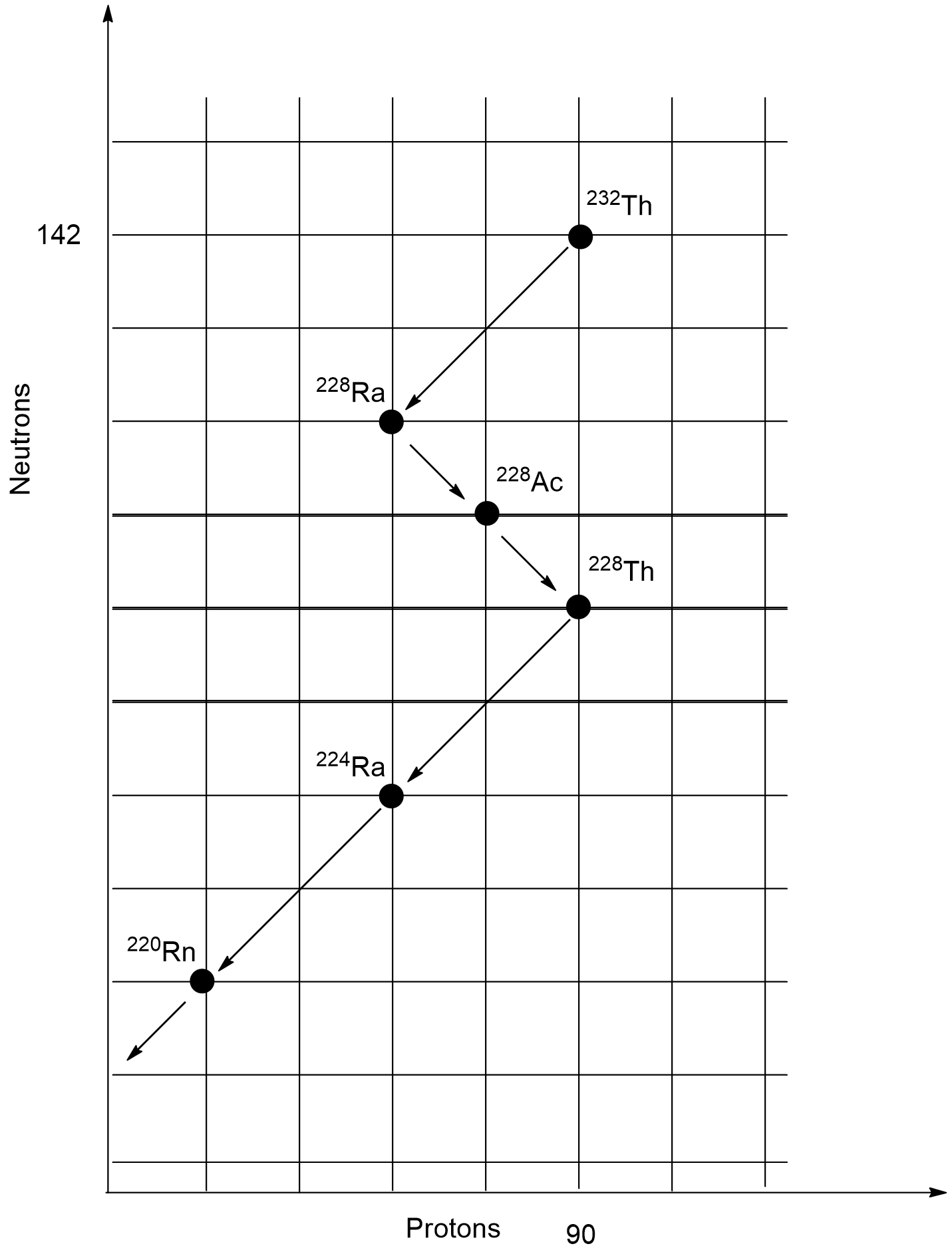
- Notice how decays always move down to the left by two protons and two neutrons while decays always move down to the right by one proton and one neutron.
- Which way would a move?

Mark Yourself Question
- Grab a piece of paper and try this problem yourself.
- When you're done, check the "I have answered this question" box below.
- View the solution and report whether you got it right or wrong.
Rate and Half-Life
- Radioactive decays are first order!
- There is nothing special here, we can use the same old integrated rate laws for a first order reaction
Mark Yourself Question
- Grab a piece of paper and try this problem yourself.
- When you're done, check the "I have answered this question" box below.
- View the solution and report whether you got it right or wrong.
Isotopic Dating
- Each radioactive isotope has it's own half-life which is characteristic of the isotope.
- We can use the changes in these isotopes to figure out how old things are!
Where n is the number of half lives, Nt is the number of radioactive nuclei remaining and N0 is the initial number of those nuclei.
- We can find a more useful formula by combining the half-life equation and the integrated rate law,
For example, if we find a fossil of an organism and we know that there is 14% of the 14C that there was orginally and we know that the half life for 14C is 5730 years,
The organism must have dies 16 257 years ago.
- We use different isotopes for different time frames depending on their half-life.
- Carbon is great for things between 10 years and 1 000 000 years old, but for older objects we need other isotopes
Use the periodic table to predict which radioactive decay pathway each of the following radioisotopes is most likely to decay by? For extra practice predict what species the isotope will it decay into.
Fluorine-18
The activity of a recently obtained sample of calcium-41 from a rock slide is 2.1 x 10³ s-1. Please answer the following questions using the information below.
t1/2 = 102 000 years
What fraction of the nuclei remain after the sample has decayed for 1000 years in a lab setting?
Express your answer as a percentage to one decimal place
A fossil has a specific activity of 4.18 d/min g. If the 12C/14C ratio for most organisms while alive results in a specific activity of 15.27 d/min g, how old is the fossil? t1/2 = 5730 years.
Report your answer as an integer in years