Wize University Chemistry Textbook > Nuclear Chemistry
Harnessing Nuclear Energy
Popular Courses
MCAT
General Course
General Chemistry
University Study Guides
DAT
General Course
CHEM 121
Simon Fraser University
CHEM 1481
Texas A & M University
CHMA10H3
University of Toronto
CHEM 1001
Carleton University
CHM 2045
University of Florida
CHEM 1P91
Brock University
CHM 1301
University of Ottawa
CHEM 1300
University of Manitoba
CHEM 119
Texas A&M University
CHEM 151
University of Arizona
CHM 1045
Florida State University
CHEM 124
California Polytechnic State University-San Luis Obispo
NE 121
University of Waterloo
CHEM 161
Rutgers University
CHEM 107
Texas A&M University
CHM220H1
University of Toronto
CHEM 102
University of Illinois at Urbana - Champaign

0:00 / 0:00
Mass Energy Conversion
- Perhaps the most famous formula ever written is
- The equation shows us that the total amount of mass energy in the universe is constant. If we loose mass we gain energy and vice-versa.
- In a chemical reaction the atoms are balanced and so there is no change in mass so no energy is given off in this way. We could still have endothermic or exothermic reactions due to the energy stored in chemical bonds.
- However, when nuclei are transformed their mass changes!! This is called the mass defect.
- proton = 1.007825 u
- neutron = 1.008665 u
- 56Fe = 55.9349363 u
- Let's look at the change in mass when we break a 56Fe nucleus into it's constituent protons and neutrons,
- We can find the energy change by,
- For one mole that would be,
WOW!!! That's a lot of energy!
- We call this energy the nuclear binding energy, it's the amount of energy needed to break a nucleus into it's protons and neutrons.
- We often express this in MeV out of convenience,
0:00 / 0:00
Types of Nuclear Reactions
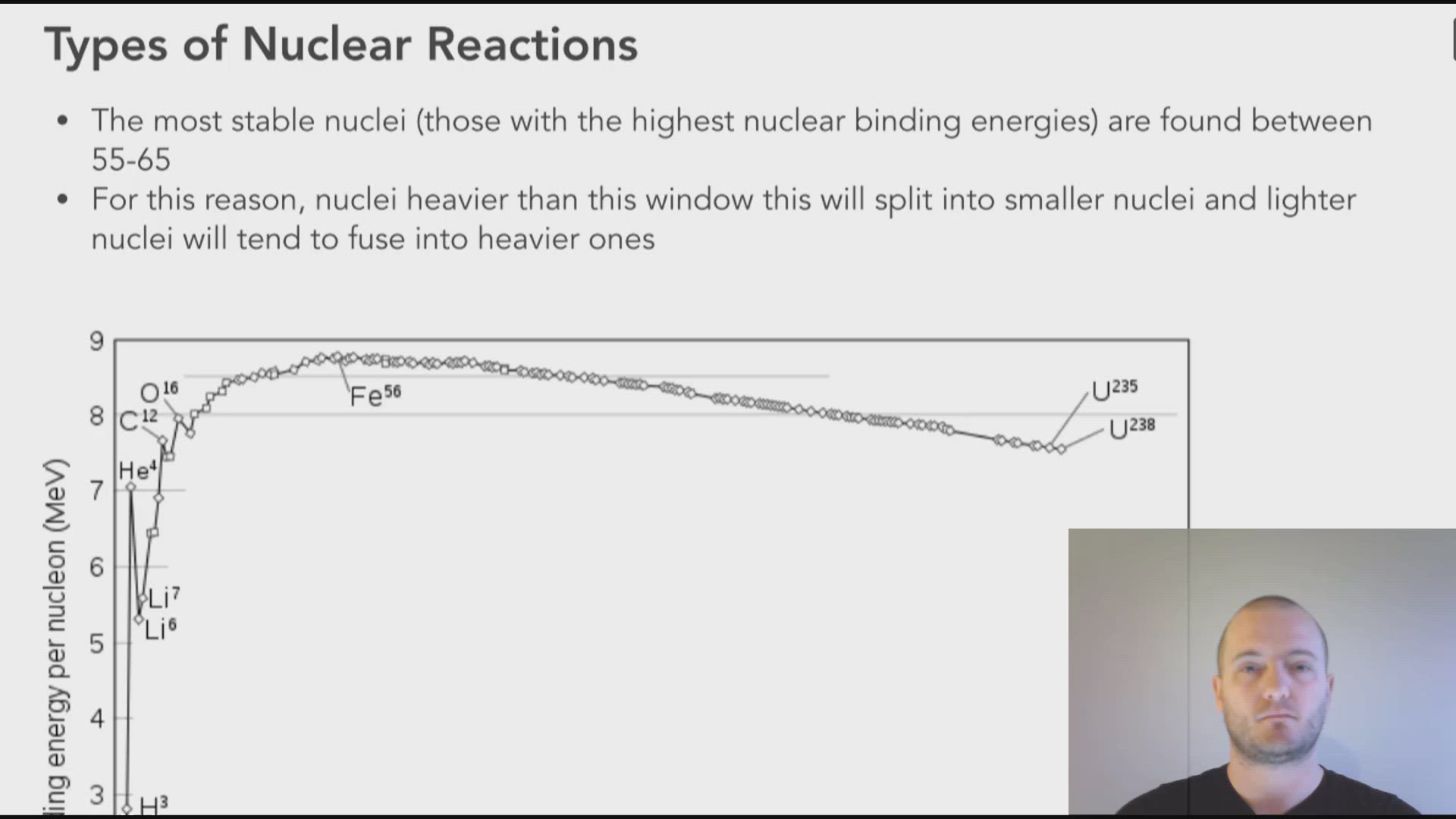
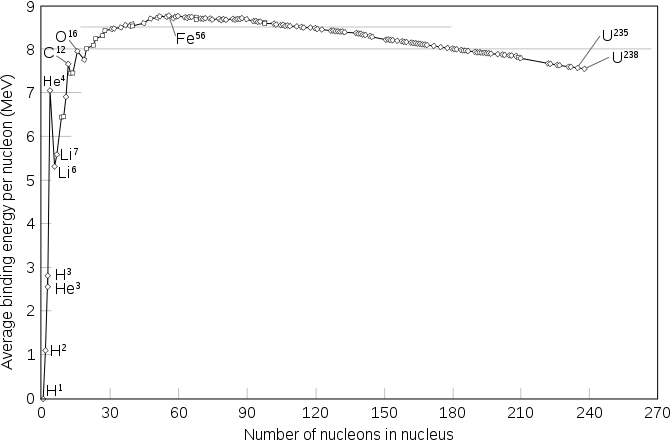
- The most stable nuclei (those with the highest nuclear binding energies) are found between 55-65
- For this reason, nuclei heavier than this window this will split into smaller nuclei and lighter nuclei will tend to fuse into heavier ones
Fission Chain Reactions
- One nuclei is hit with a neutron, splits into two lighter nuclei and produces another neutron which can split another neutron.
Controlled Fission
- If the change is controlled the energy released can be harnessed in nuclear reactors
Uncontrolled Fission
- If the change is uncontrolled this becomes an atomic bomb!!
- The bombs dropped on Nagasaki and Hiroshima during World War 2 were Fission bombs based on 235U
Controlled Fussion
- The dream reaction for energy production!
- Fusing hydrogen nuclei into helium, no waste!!
- In the sun, the fusion of hydrogen atoms happens numerous times,
- Two 1H nuclei produce 2H
- 2H reacts with another 1H produces 3H
- Two 3H nuclei collide to produce 4He, and two 1H
- To figure it out here on earth we are trying to develop,
Uncontrolled Fussion
- If these types of reactions are not controlled we will see a huge explosion!
- This is a hydrogen bomb!
Calculate the nuclear binding energy of a 60Co nucleus and a 232Th nucleus in MeV using the information below.
mass of 60Co = 59.9338222 u
mass of 232Th = 232.0380553 u
proton = 1.007825 u
neutron = 1.008665 u
Binding Energy of 60Co
Report your answer to one decimal place in MeV