Wize University Calculus 3 Textbook > Vector Functions

Tangent, Normal, Binormal Vectors - Applications of Vector Functions

Create a free account to get started

Unlock full course notes by signing up

  • Video lessons taught by top educators
  • Practice questions with guided solutions
  • Written review notes for reference
  • Expert answers anytime from course tutors

Tangent, Normal, Binormal Vectors


The derivative, f′(x)f'(x), of a function f(x)f(x) represented the slope of the tangent line in single variable calculus.


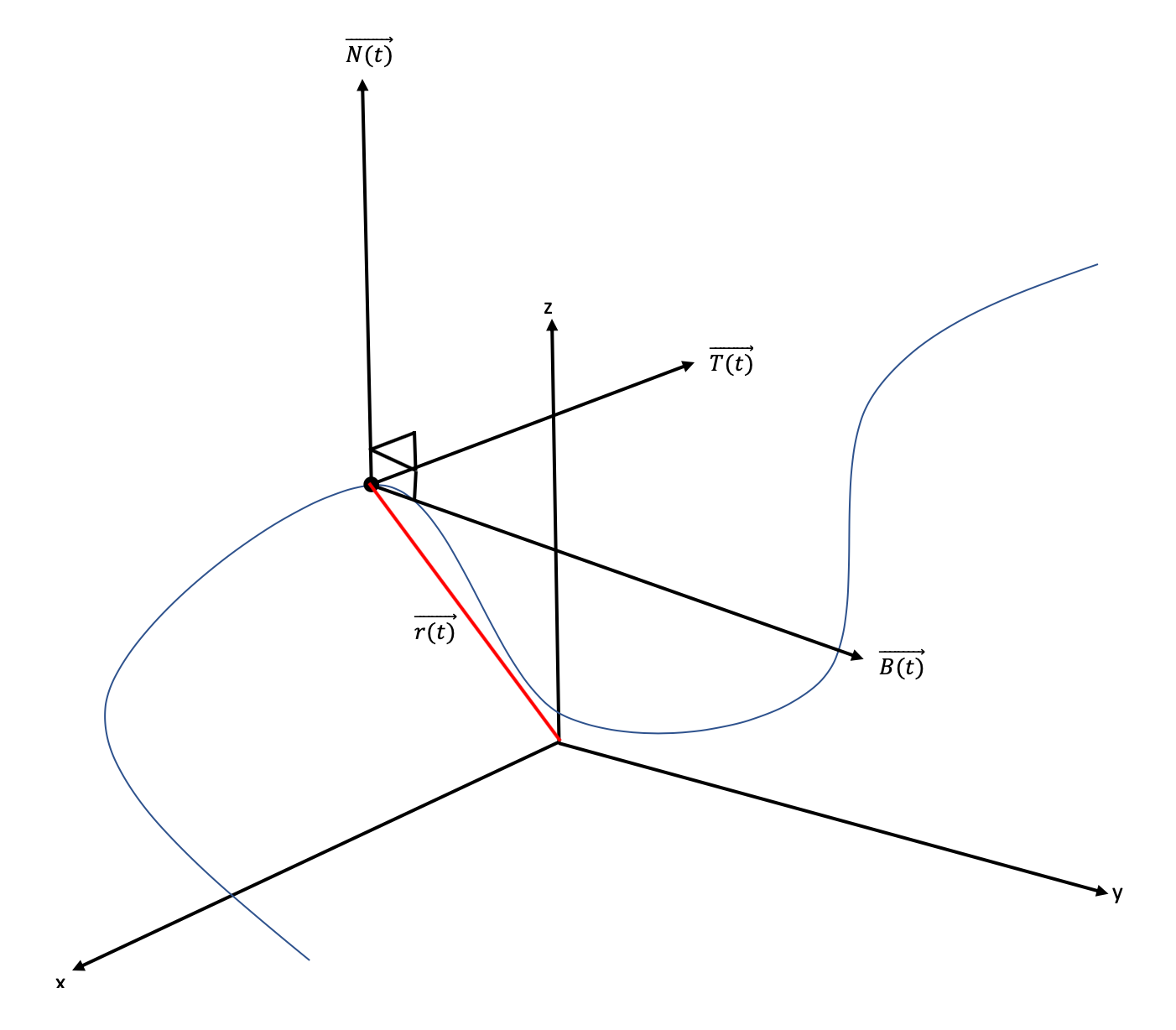
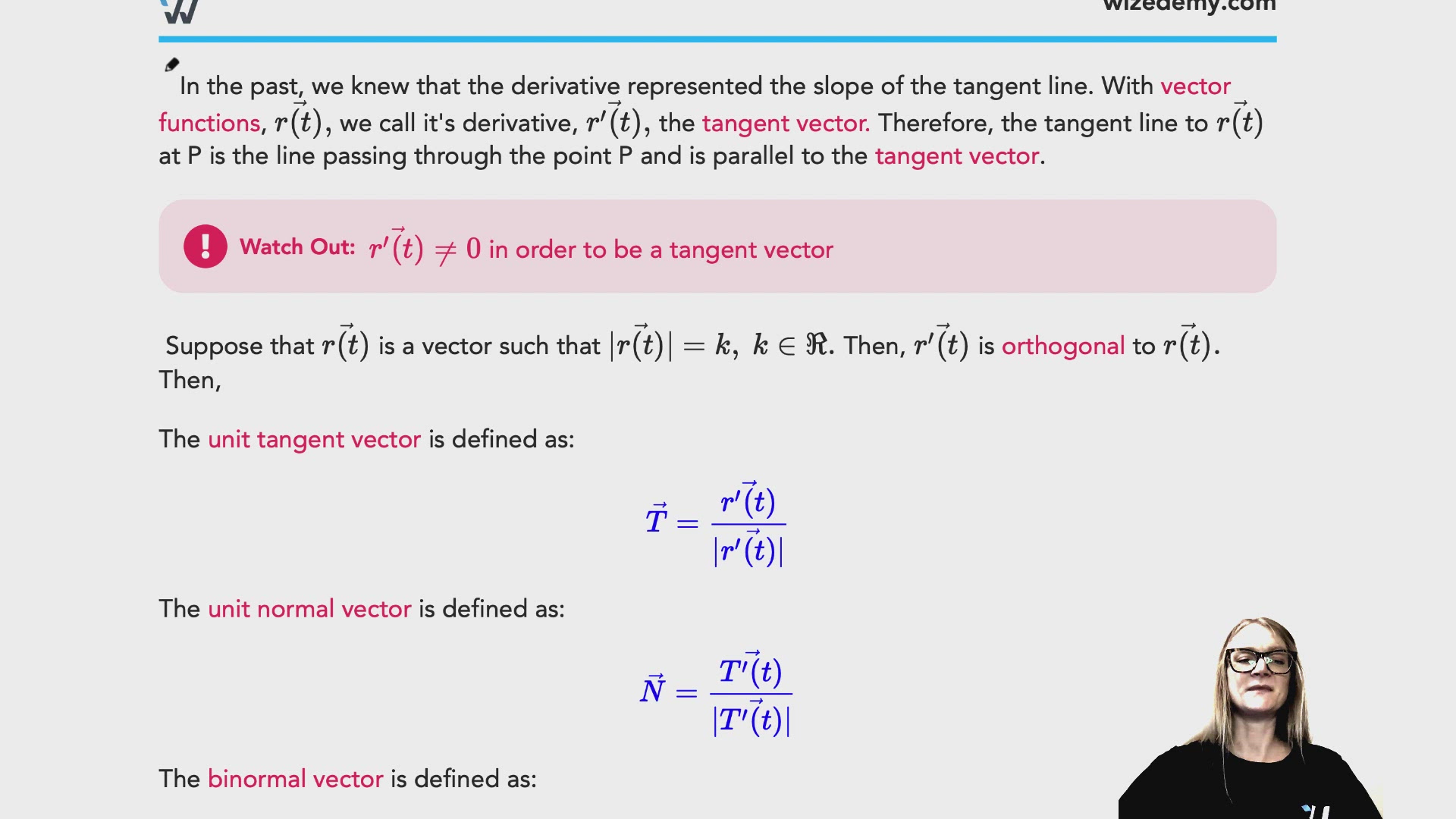
In multivariable calculus, vector functions, r(t)⃗\vec{r(t)}, have a derivative, r′(t)⃗, \vec{r'(t)},~ called the tangent vector.


Therefore, the tangent line to r(t)⃗ \vec{r(t)}~ at P(x0,y0,z0)P(x_0,y_0,z_0) is the line passing through the point PP and is parallel to the tangent vector.


Suppose that r(t)⃗ \vec{r(t)}~is a vector and

  • ∣r(t)⃗∣=k, k∈ℜ|\vec{r(t)}|=k,~k\in\Re
  • r′(t)⃗ \vec{r'(t)}~is orthogonal to r(t)⃗\vec{r(t)}


The unit tangent vector is defined as:

T⃗=r′(t)⃗∣r′(t)∣⃗\boxed{\vec{T}=\frac{\vec{r'(t)}}{|\vec{r'(t)|}}}

The unit normal vector is defined as:

N⃗=T′(t)⃗∣T′(t)∣⃗\boxed{\vec{N}=\frac{\vec{T'(t)}}{|\vec{T'(t)|}}}

The binormal vector is defined as:

B(t)⃗=T(t)⃗×N(t)⃗\boxed{\vec{B(t)}=\vec{T(t)}\times\vec{N(t)}}

Let us take a look:

Image illustrating Tangent, Normal, Binormal Vectors

Create a free account to get started

Unlock full course notes by signing up

  • Video lessons taught by top educators
  • Practice questions with guided solutions
  • Written review notes for reference
  • Expert answers anytime from course tutors

Example

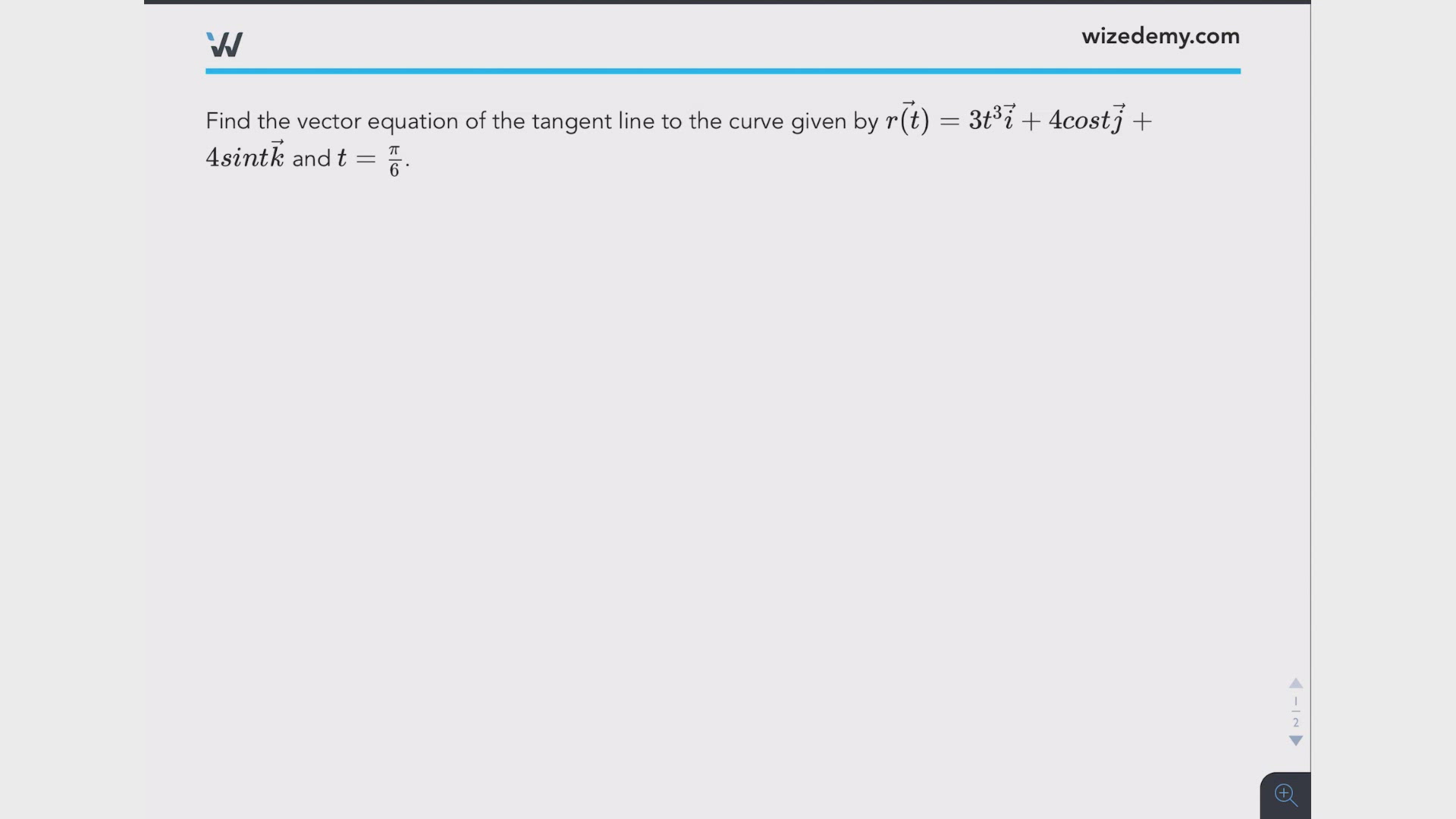
Find the vector equation of the tangent line to the curve given by r(t)⃗=3t3i⃗+4cos⁡tj⃗+4sin⁡tk⃗\vec{r(t)}=3t^3\vec{i}+4\cos{t}\vec{j}+4\sin{t}\vec{k} and t=π6t=\frac{\pi}{6}.


We need a point at t=π6 t=\frac{\pi}{6}~ and we need a "slope" (i.e. a vector tangent to r(t)⃗ \vec{r(t)}~ which is r′(t)⃗\vec{r'(t)} at t=π6.t=\frac{\pi}{6}.


The point:

r(π6)⃗=<3(π6)3+4cos(π6)+4sin(π6)>r(π6)⃗=<π372, 23, 2>\vec{r(\frac{\pi}{6})}=\Bigg<3(\frac{\pi}{6})^3+4cos(\frac{\pi}{6})+4sin(\frac{\pi}{6})\Bigg>\newline{}\newline{} \vec{r(\frac{\pi}{6})}=\big<\frac{\pi^{3}}{72},~2\sqrt{3},~2\big>

The vector tangent r′(t)⃗\vec{r'(t)}:

r′(t)⃗=<9t2, −4sint, 4cost>r′(π6)⃗=<9(π236), −4sin(π6), 4cos(π6)>r′(π6)⃗=<π24, −2, 23>\vec{r'(t)}=<9t^2,~-4sint,~4cost>\newline \vec{r'(\frac{\pi}{6})}=\Big<9(\frac{\pi^2}{36}),~-4sin(\frac{\pi}{6}),~4cos(\frac{\pi}{6})\Big>\newline{}\newline{}\vec{r'(\frac{\pi}{6})}=\big<\frac{\pi^2}{4},~-2,~2\sqrt{3}\big>

The equation of the tangent line is:

L1: <π372, 23, 2>+t<π24, −2, 23>L_1:~\big<\frac{\pi^{3}}{72},~2\sqrt{3},~2\big>+t\big<\frac{\pi^2}{4},~-2,~2\sqrt{3}\big>


Create a free account to get started

Unlock full course notes by signing up

  • Video lessons taught by top educators
  • Practice questions with guided solutions
  • Written review notes for reference
  • Expert answers anytime from course tutors

Example

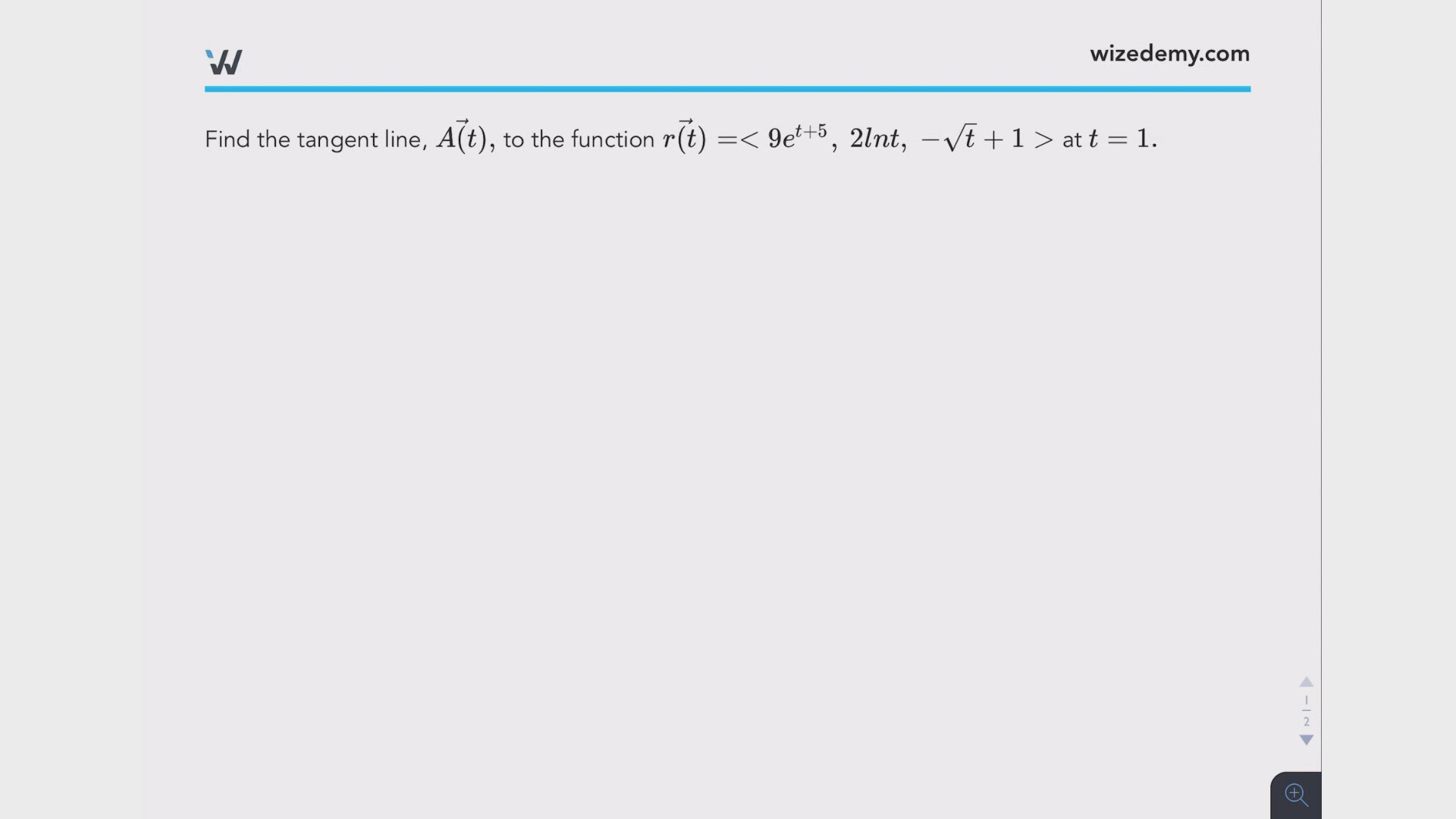
Find the tangent line, A(t)⃗,\vec{A(t)}, to the function r(t)⃗=<9et+5, 2ln⁡t, −t+1>\vec{r(t)}=<9e^{t+5},~2\ln{t},~-\sqrt{t}+1> at t=1t=1.


We need a point at t =1 and a tangent vector at t = 1. First, find the point:

r(1)⃗=<9e1+5, 2ln1, −1+1>=<9e6,0,0>\begin{array}{rcl} \vec{r(1)}&=&<9e^{1+5},~2ln1,~-\sqrt{1}+1>\\\\ &=&<9e^6,0,0> \end{array}

The tangent vector:

r′(t)⃗=<9et+5,2t,−12t>r′(1)⃗=<9e1+5,21,−121>=<9e6, 2,−12>\begin{array}{rcl} \vec{r'(t)}&=&\Big<9e^{t+5},\frac{2}{t},-\frac{1}{2\sqrt{t}}\Big>\\\\ \vec{r'(1)}&=&\Big<9e^{1+5},\frac{2}{1},-\frac{1}{2\sqrt{1}}\Big>\\\\ &=&<9e^6,~2,-\frac{1}{2}> \end{array}

So, the tangent line is:

A(t)⃗= <9e6,0,0>+ t<9e6,2,−12>\vec{A(t)}=~<9e^6,0,0>+~t\Big<9e^6,2,-\dfrac{1}{2}\Big>


Practice

Find the equation to the tangent line to the curve given by r(t)⃗=12t2i⃗+81cos⁡(t9)j⃗+81sin⁡(t9)k⃗\vec{r(t)}=\dfrac{1}{2}t^2\vec{i}+81\cos(\frac{t}{9})\vec{j}+81\sin(\frac{t}{9})\vec{k} at t=3πt=3\pi.


Your answers

Create a free account to get started

Unlock full course notes by signing up

  • Video lessons taught by top educators
  • Practice questions with guided solutions
  • Written review notes for reference
  • Expert answers anytime from course tutors