Wize University Calculus 3 Textbook > Partial Derivatives
Partial Derivatives
Popular Courses
MATH 121
Queen's University
MATH 121
Queen's University
MATH 200
University of British Columbia
MATH 253
University of British Columbia
MATH 222
McGill University
MA129
Wilfrid Laurier University
MATH 209
University of Alberta
SC/MATH 2015 3.00
York University
MAT 2322
University of Ottawa
MATH 237
University of Waterloo
MAT235Y1
University of Toronto
MAT 2384
University of Ottawa
MATH 200
University of Victoria
MATH 251
Simon Fraser University
MAT237Y1
University of Toronto
MATH 20C
University of California - San Diego
MAT 2122
University of Ottawa
MATH 2214
Virginia Tech
MATH 10C
University of California - San Diego
SC/MATH 2310 3.00
York University
0:00 / 0:00
Partial Derivatives
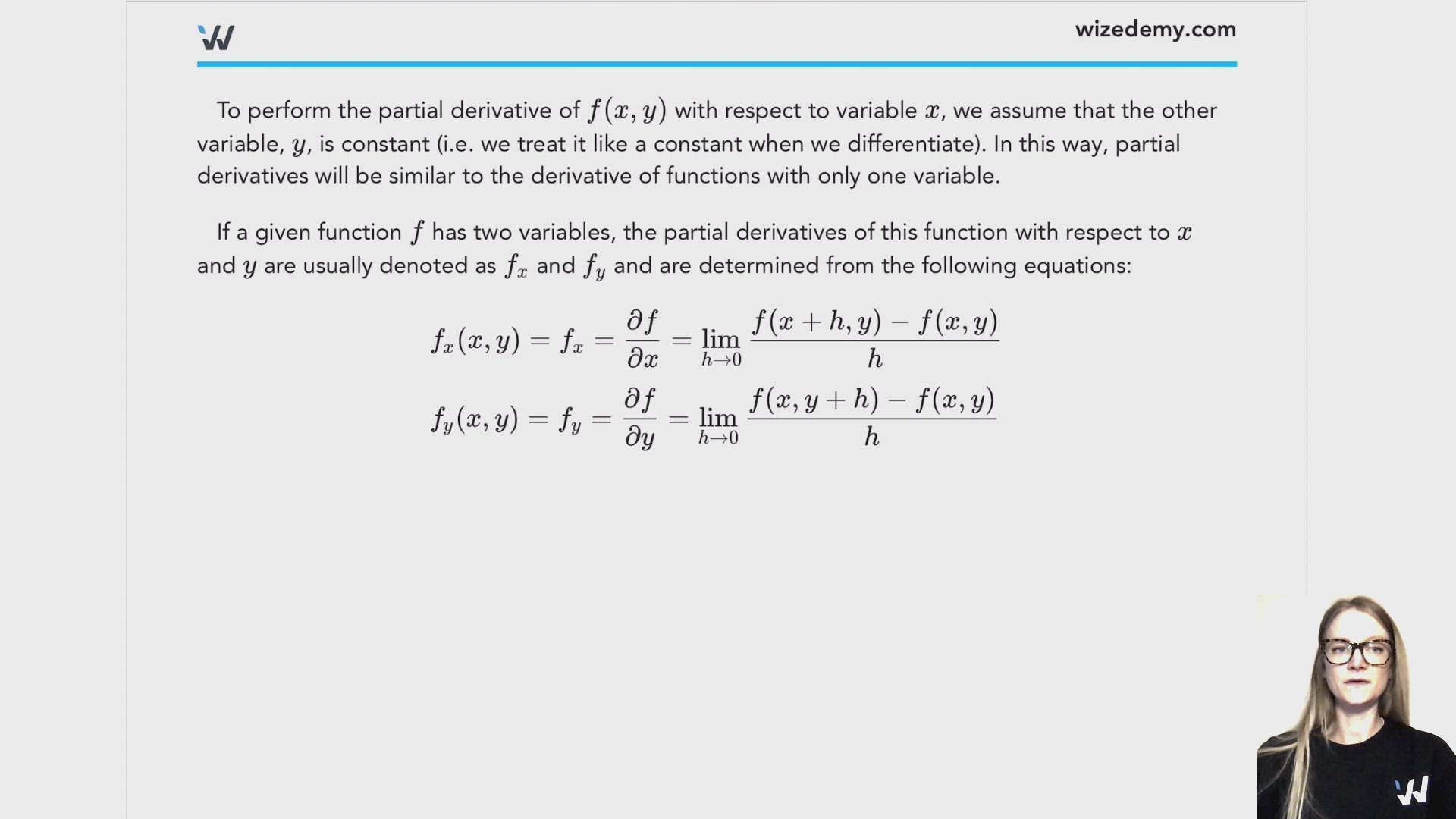
To perform the partial derivative of with respect to variable , we assume that the other variable, , is constant (i.e. we treat it like a constant when we differentiate).
In this way, partial derivatives will be similar to the derivative of functions with only one variable.
Theorem
If a given function has two variables, the partial derivatives of this function with respect to and are usually denoted as:
0:00 / 0:00
Higher Order Partial Derivatives & Differentials
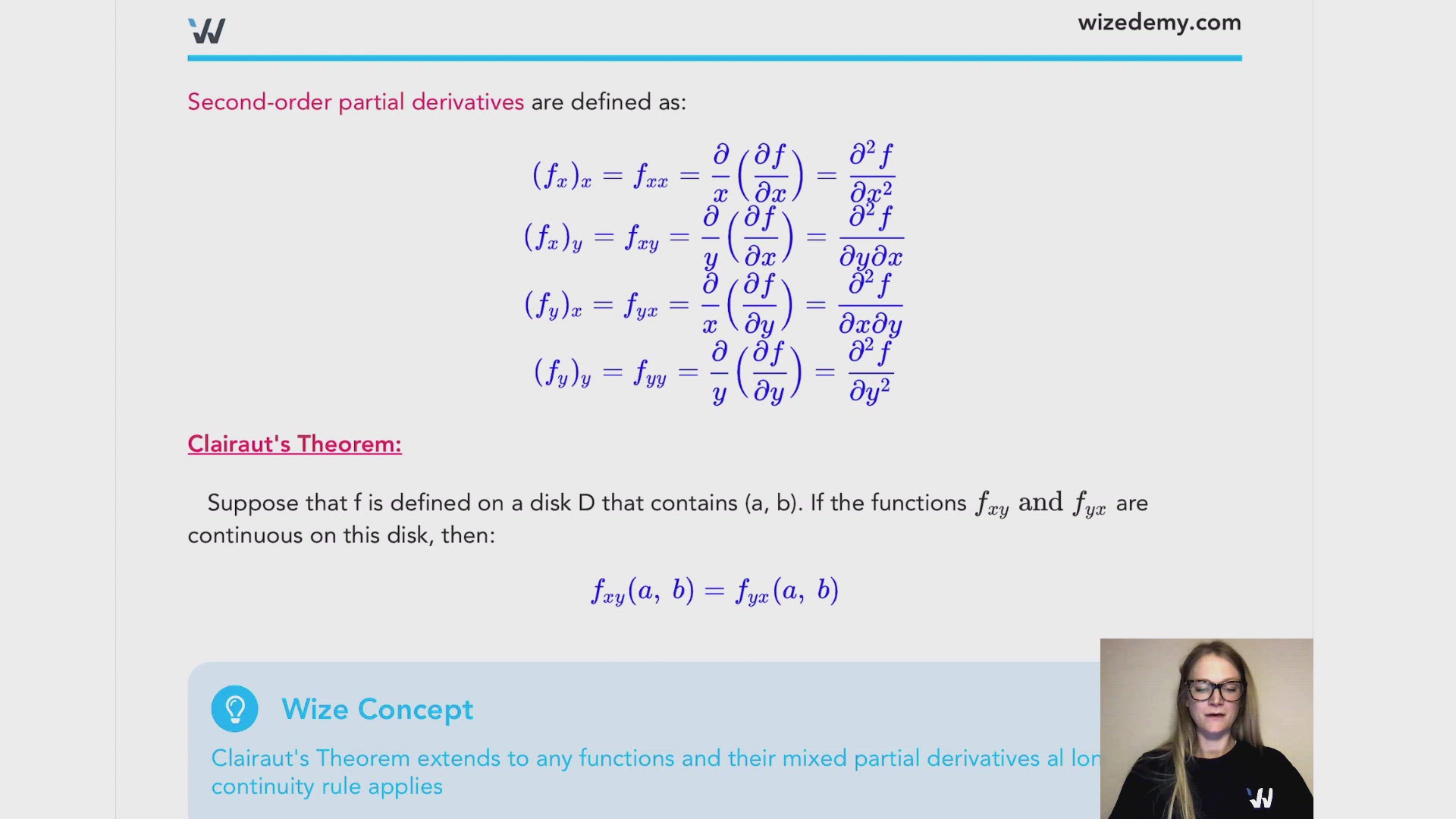
Second-order partial derivatives
Clairaut's Theorem
Suppose that is defined on a disk D that contains .
If the functions are continuous on this disk, then:
Wize Concept
Clairaut's Theorem extends to any functions and their mixed partial derivatives al long as continuity rule applies
Differentials
- Given the differential or is:
- Given , then:
0:00 / 0:00
Example
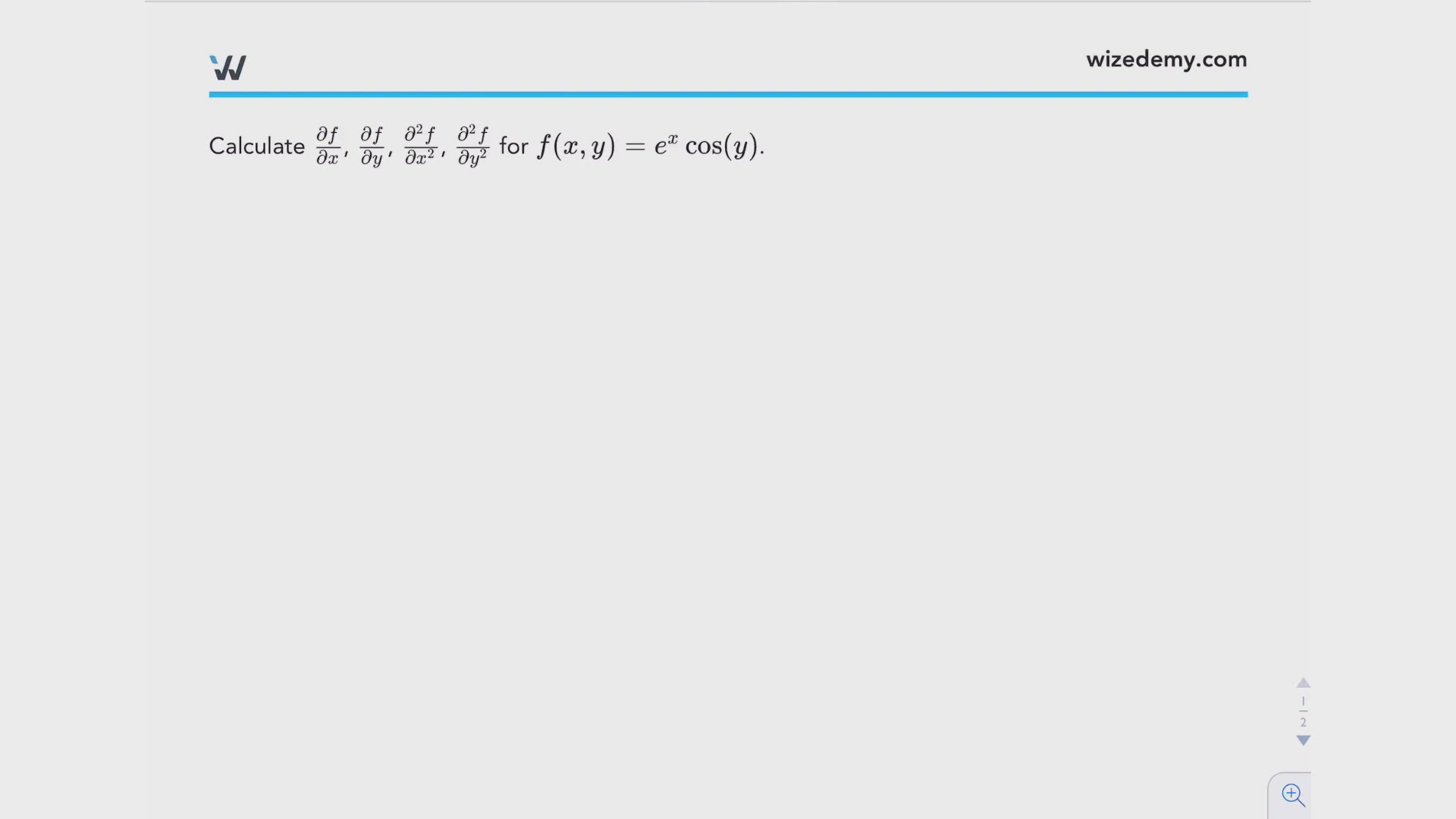
Calculate , , , for .
0:00 / 0:00
Example
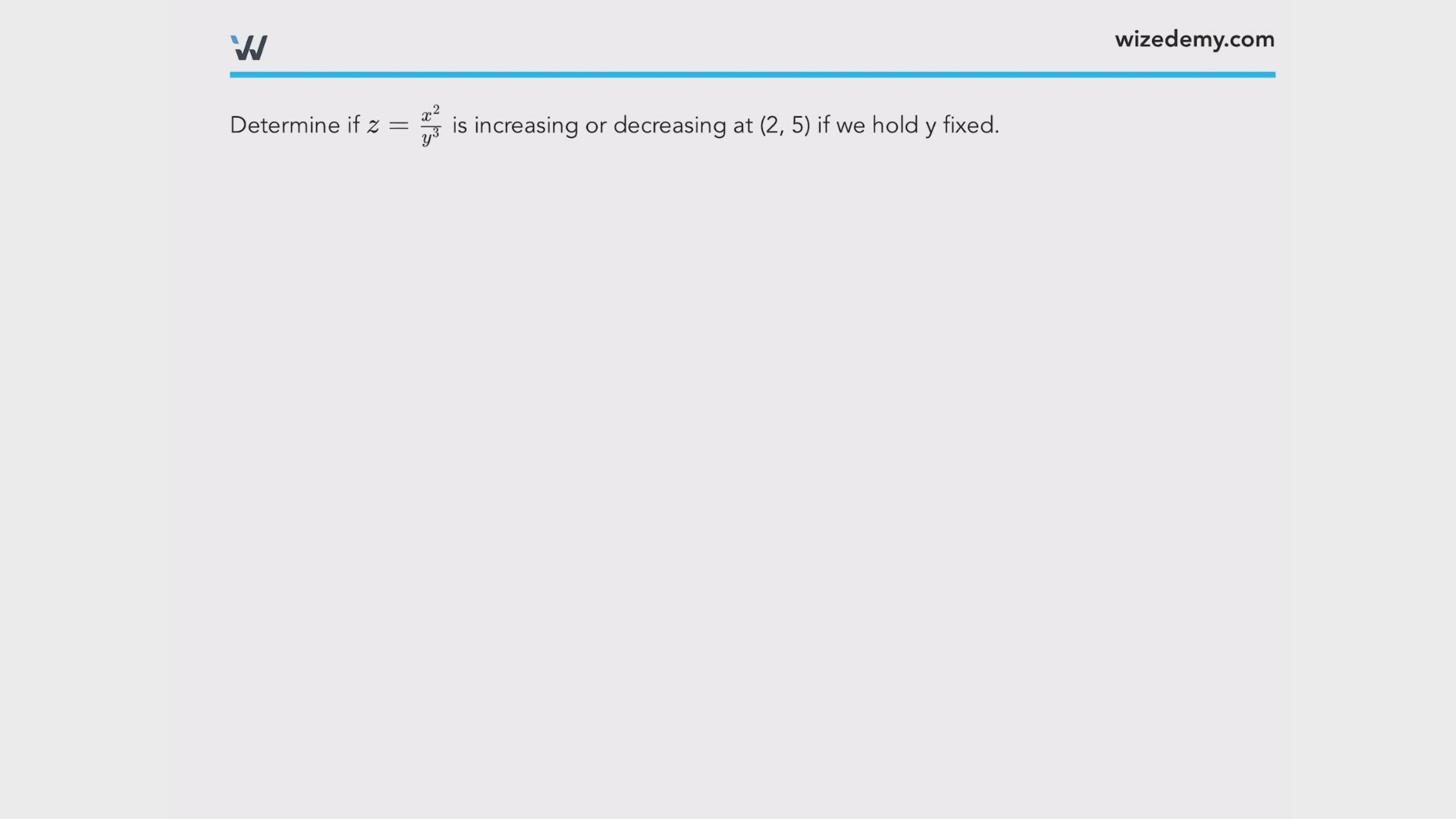
Determine if is increasing or decreasing at if we hold y fixed.
Let
If we hold y fixed, then we treat 'y' like a constant and find :
Our function is increasing at .
Practice
Find the first partial derivatives of the function
Practice
For what values of k does satisfy