Wize University Calculus 3 Textbook > Vector Functions
Tangent, Normal, Binormal Vectors - Applications of Vector Functions
Popular Courses
MATH 121
Queen's University
MATH 200
University of British Columbia
MATH 253
University of British Columbia
MAT187H1
University of Toronto
MATH 209
University of Alberta
MAST 218
Concordia University
SC/MATH 2015 3.00
York University
MAT 2322
University of Ottawa
MATH 237
University of Waterloo
MAT235Y1
University of Toronto
MAT 2384
University of Ottawa
MATH 200
University of Victoria
MATH 251
Simon Fraser University
MATH 20C
University of California - San Diego
MAT237Y1
University of Toronto
MAT 2122
University of Ottawa
MATH 2214
Virginia Tech
MATH 10C
University of California - San Diego
SC/MATH 2310 3.00
York University
MATH 20E
University of California - San Diego
0:00 / 0:00
Tangent, Normal, Binormal Vectors
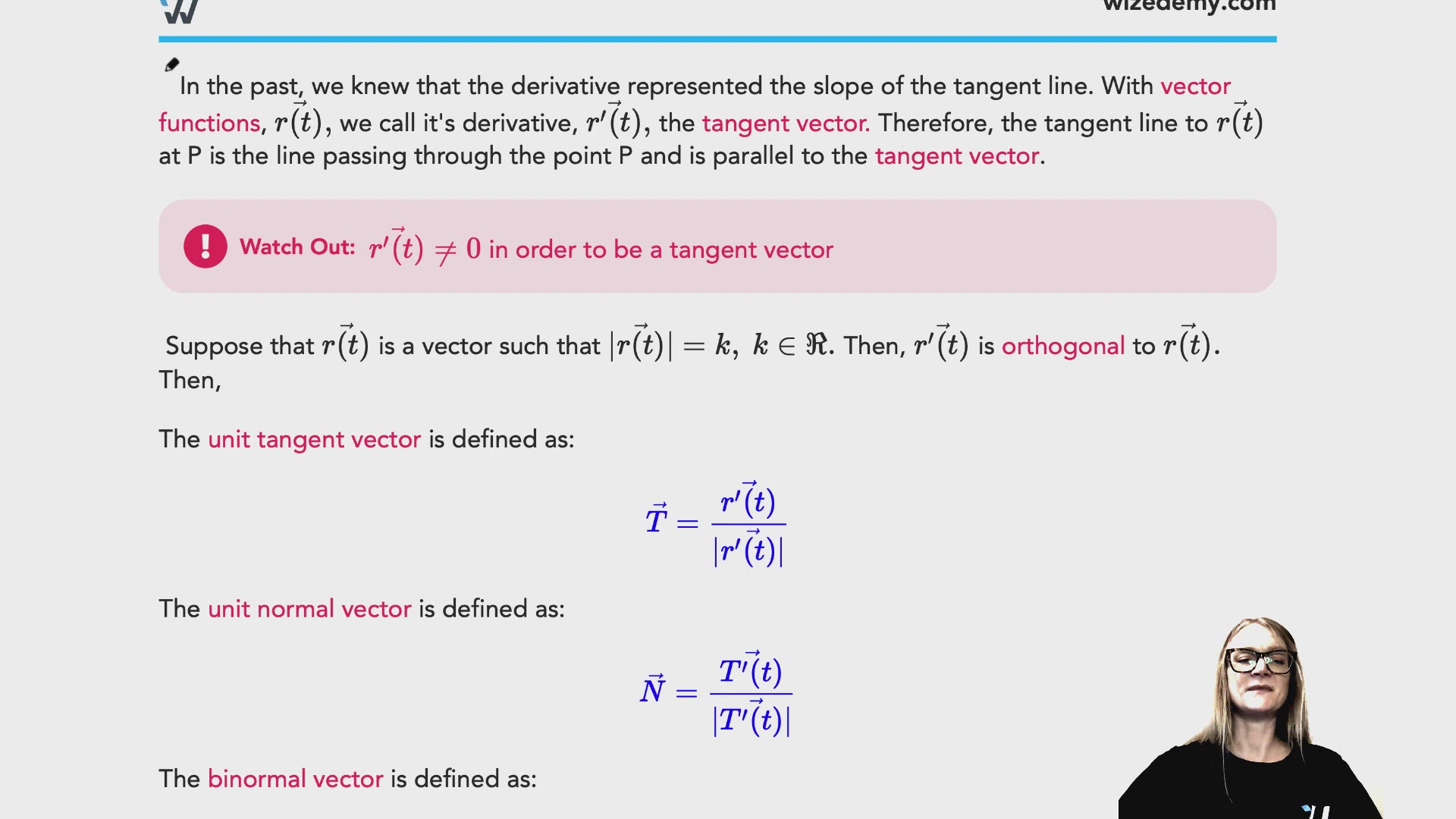
The derivative, , of a function represented the slope of the tangent line in single variable calculus.
In multivariable calculus, vector functions, , have a derivative, called the tangent vector.
Therefore, the tangent line to at is the line passing through the point and is parallel to the tangent vector.
Watch Out!
in order to be a tangent vector
Suppose that is a vector and
- is orthogonal to
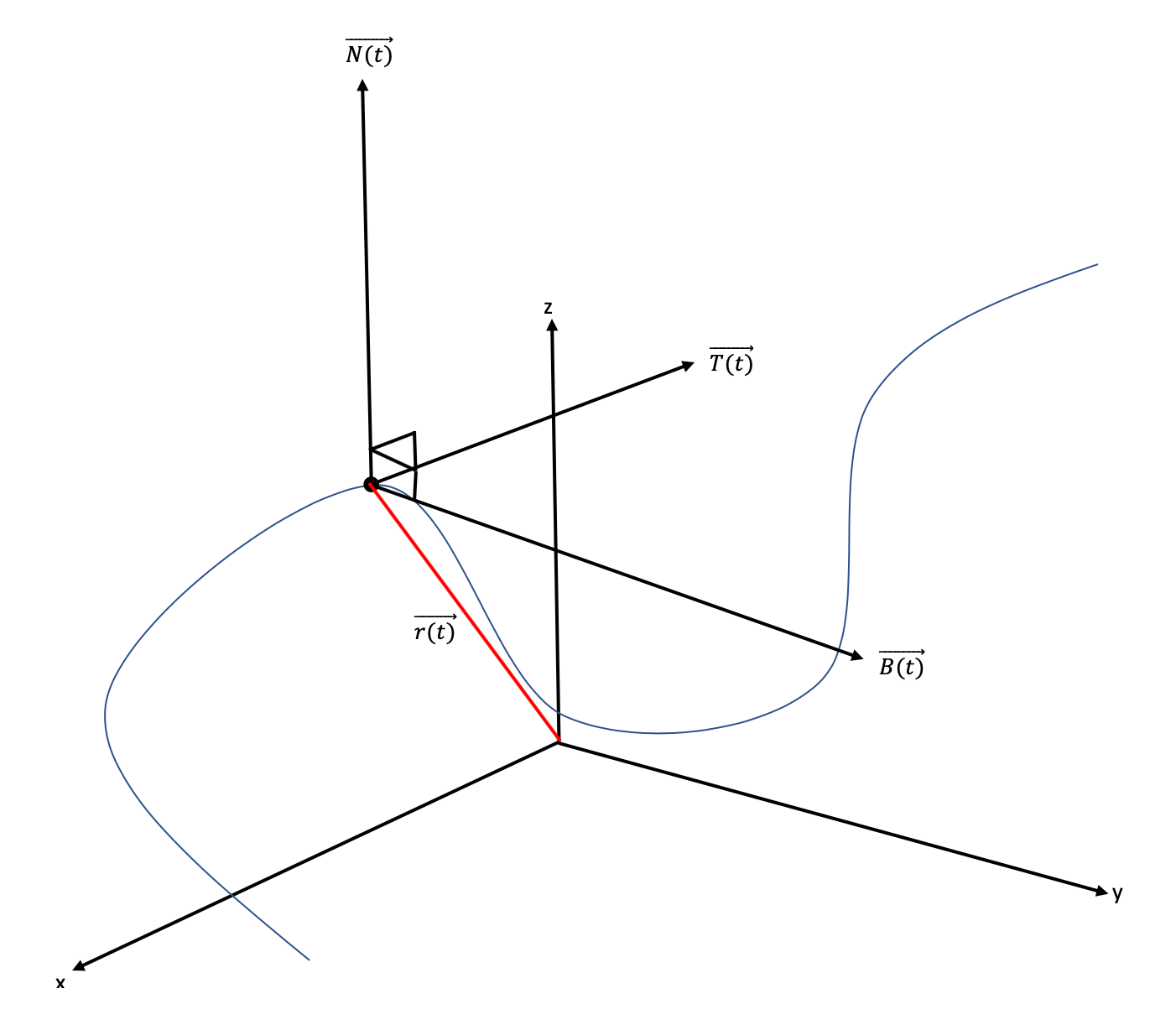
The unit tangent vector is defined as:
The unit normal vector is defined as:
The binormal vector is defined as:
Let us take a look:
0:00 / 0:00
Example
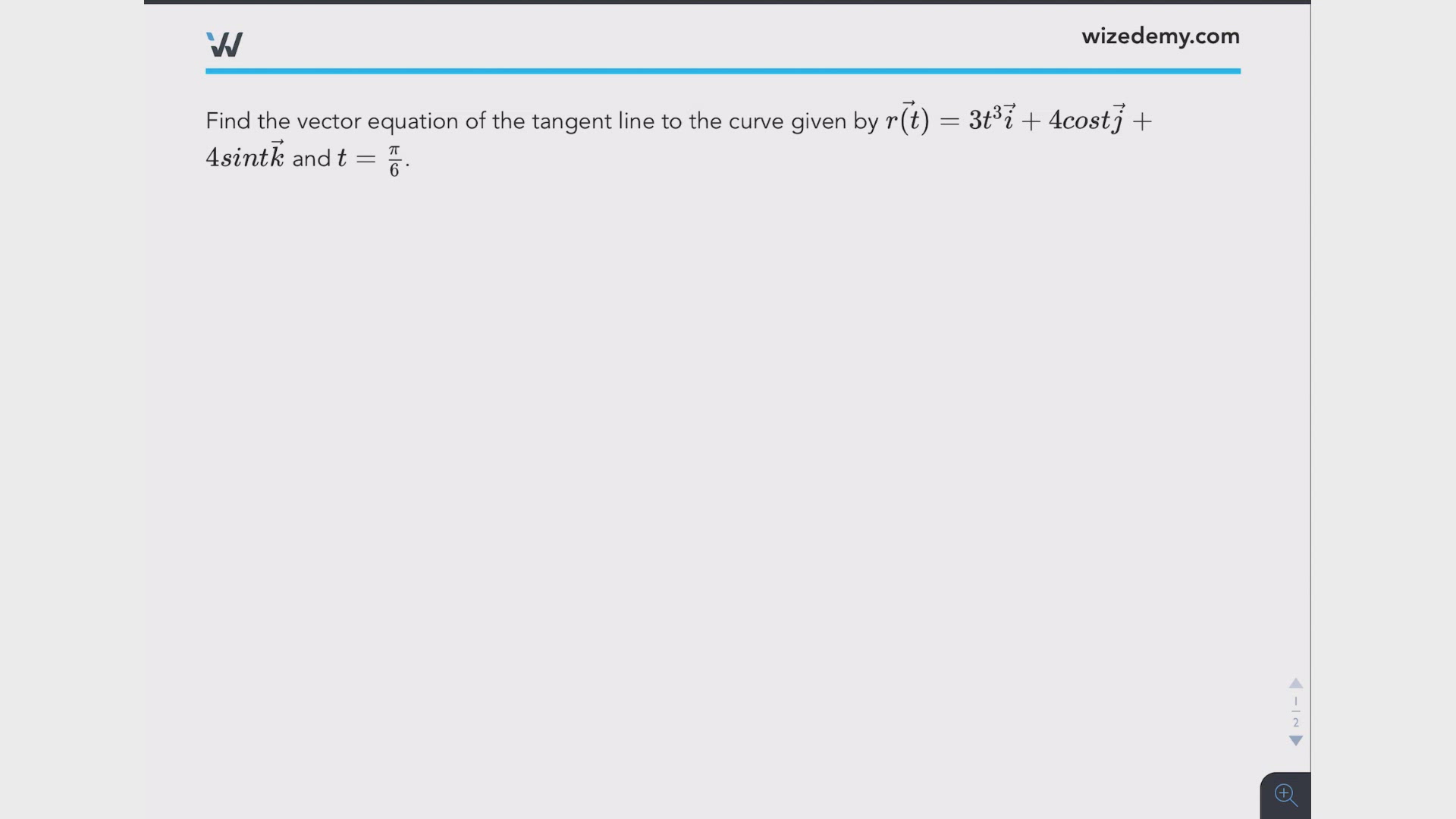
Find the vector equation of the tangent line to the curve given by and .
We need a point at and we need a "slope" (i.e. a vector tangent to which is at
The point:
The vector tangent :
The equation of the tangent line is:
0:00 / 0:00
Example
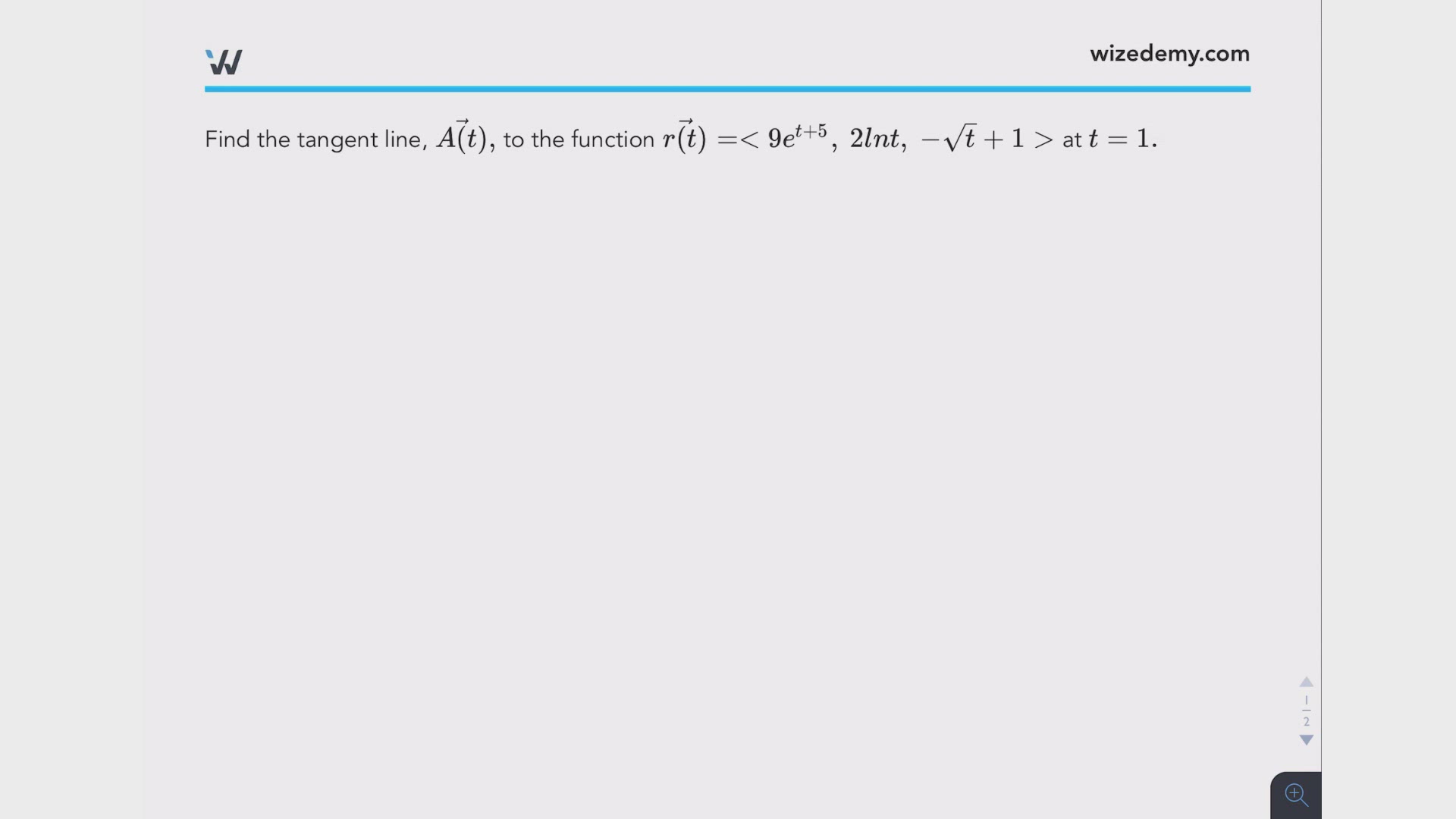
Find the tangent line, to the function at .
We need a point at t =1 and a tangent vector at t = 1. First, find the point:
The tangent vector:
So, the tangent line is:
Practice
Find the equation to the tangent line to the curve given by at .