Create a free account to get started

Unlock full course notes by signing up

  • Video lessons taught by top educators
  • Practice questions with guided solutions
  • Written review notes for reference
  • Expert answers anytime from course tutors

Cross Product

We saw that the dot product between two vectors produces a scalar.

Now we introduce the cross product (vector product) of two vectors in R3\reals^3 which produces a vector in R3\bm{\reals^3}.

Definition

The cross product of vectors a⃗=[a1a2a3]\vec{a}= \begin{bmatrix} a_1\\ a_2\\ a_3 \end{bmatrix} and b⃗=[b1b2b3]\vec{b}= \begin{bmatrix} b_1\\ b_2\\ b_3 \end{bmatrix} in R3\reals^3 is

a⃗×b⃗=[a2b3 − a3b2a3b1 − a1b3a1b2 − a2b1]\boxed{\quad \vec{a}\times\vec{b} = \begin{bmatrix} a_2 b_3 \ −\ a_3 b_2\\ a_3 b_1 \ −\ a_1 b_3\\ a_1 b_2 \ −\ a_2 b_1\\ \end{bmatrix} \quad}


Important Note

The cross product of vectors u⃗\vec u and v⃗\vec v is orthogonal to both u⃗\vec u and v⃗\vec v.


Shoelace Method

  1. Copy the column vector a⃗\vec a twice on the left, and b⃗\vec b twice on the right.
  2. Cross out the top and bottom rows, then "lace" the remaining diagonals by multiplying diagonally.
  3. Each diagonal pair makes a single component. Write a minus sign between every pair of products.
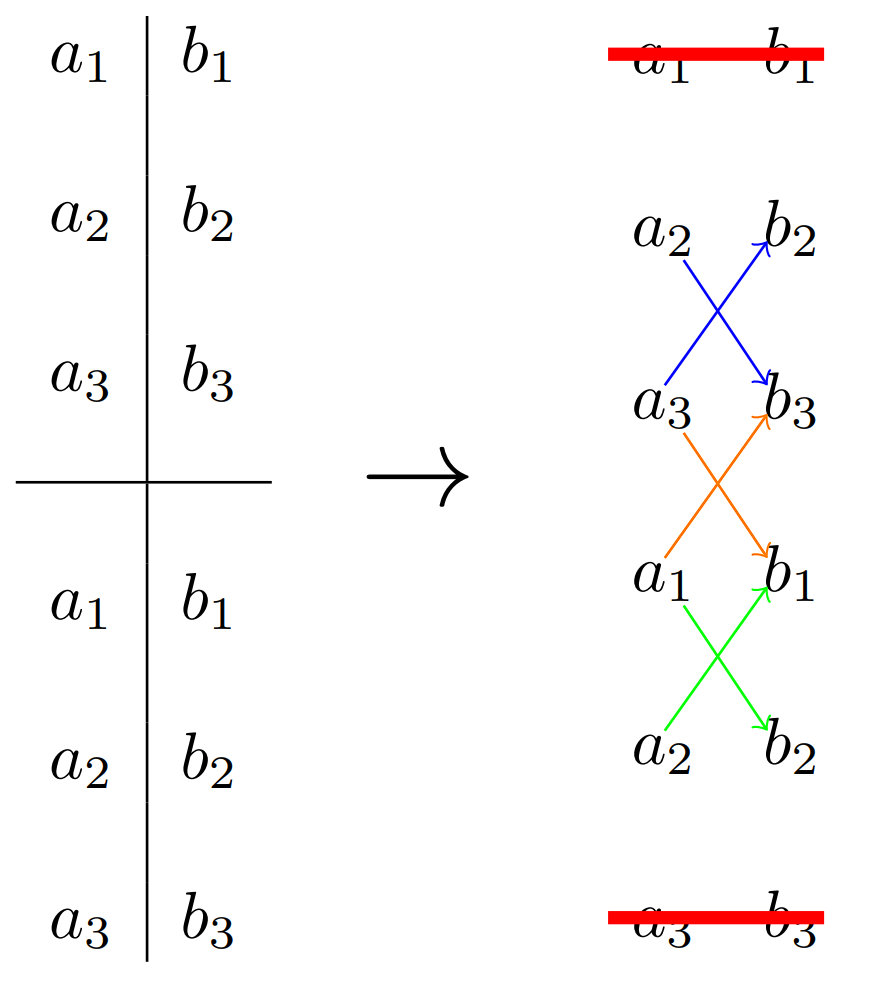
Image illustrating Cross Product

Pointing Method

(See video)

Create a free account to get started

Unlock full course notes by signing up

  • Video lessons taught by top educators
  • Practice questions with guided solutions
  • Written review notes for reference
  • Expert answers anytime from course tutors

Example: Cross Product

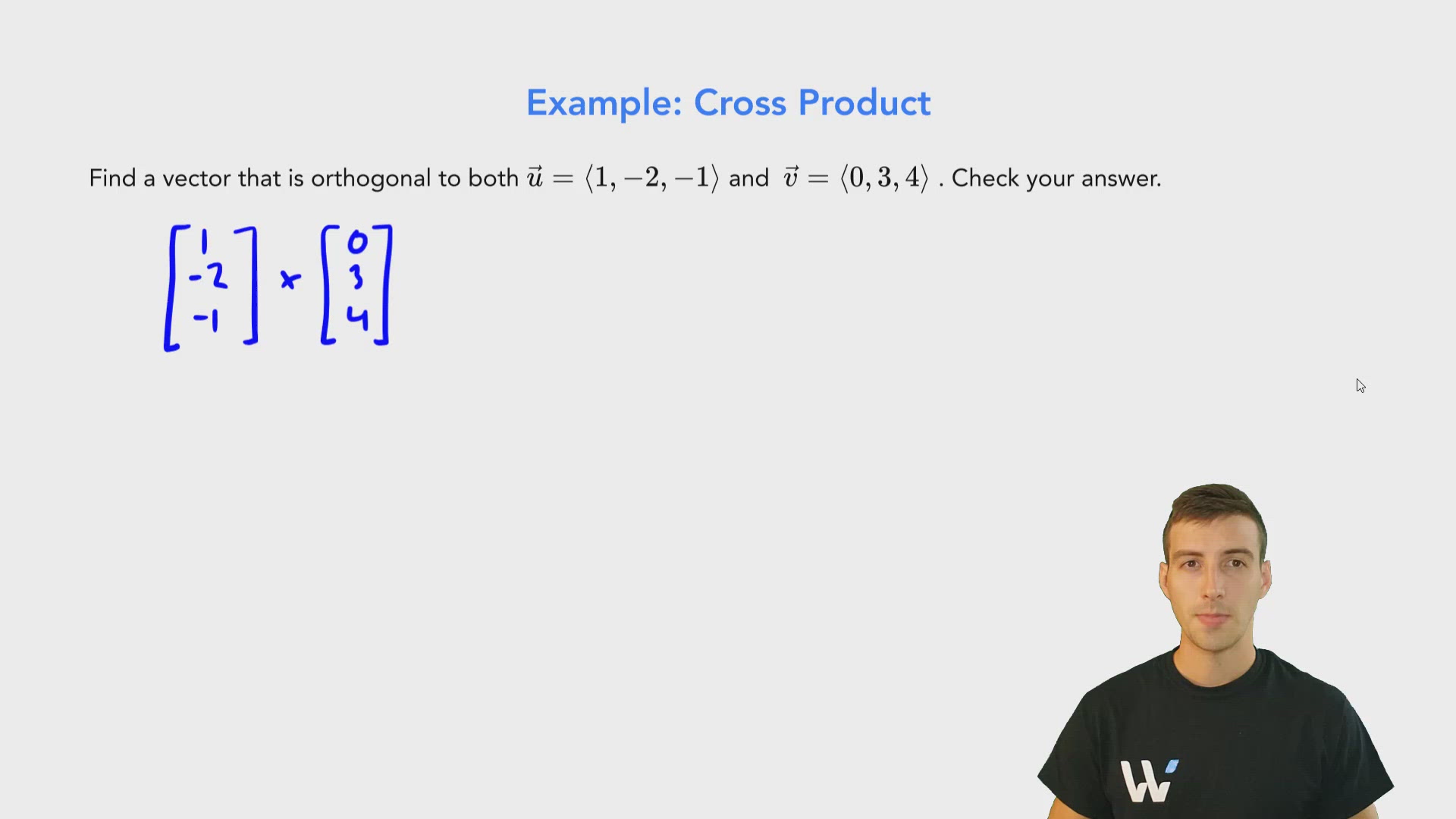
Find a vector that is orthogonal to both u⃗=⟨1,−2,−1⟩\vec{u}=\lang 1,-2,-1 \rang and v⃗=⟨0,3,4⟩\vec{v}=\lang 0,3,4 \rang . Check your answer.


Using the Shoelace Method:
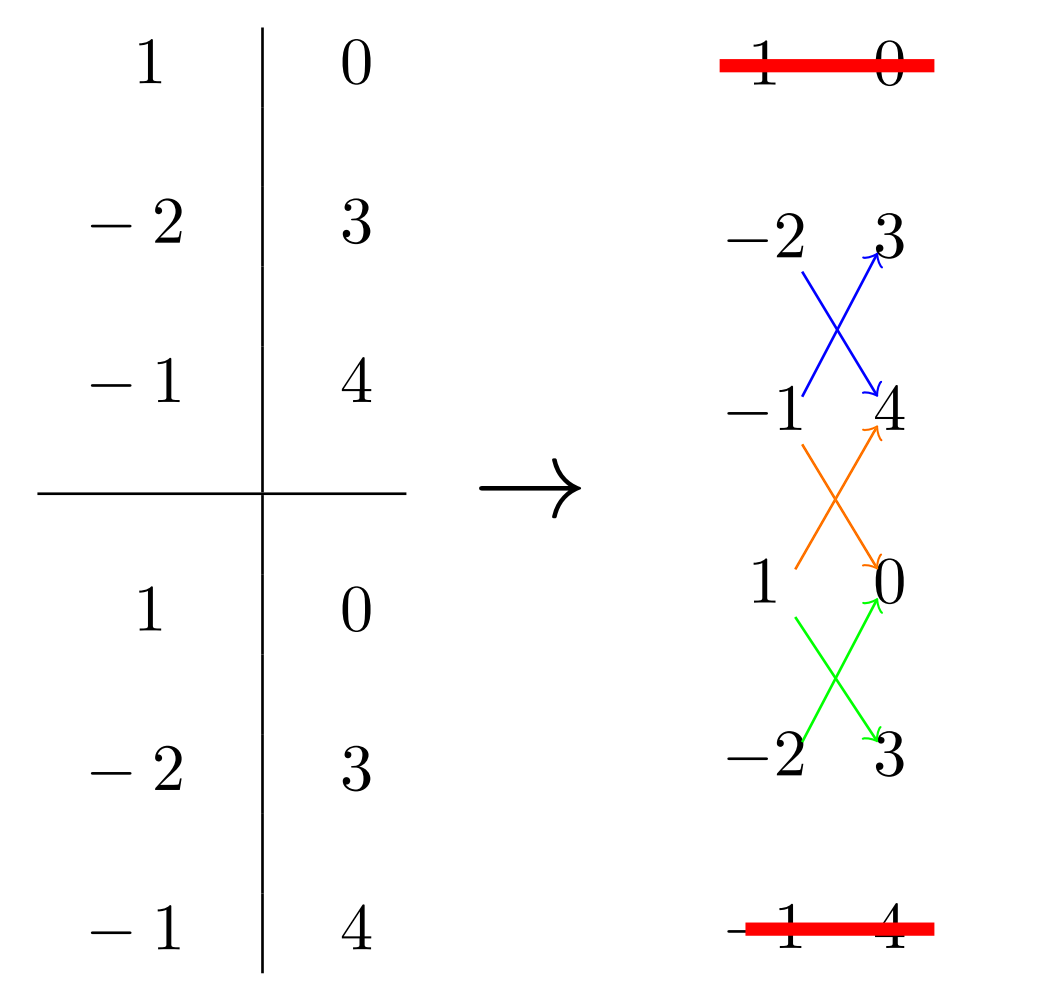
Image illustrating Example


u⃗×v⃗=[(−2)(4)  −  (−1)(3)(−1)(0) −   (1)(4)(1)(3)   −  (−2)(0)]=[−5−43]\begin{aligned} \vec{u} × \vec{v} &= \begin{bmatrix} (−2)(4) \ \ − \ \ (−1)(3)\\[0.5em] (−1)(0)\ − \ \ \ (1)(4)\\[0.5em] (1)(3) \ \ \ −\ \ (−2)(0)\\ \end{bmatrix}\\[2.5em] &= \boxed{ \begin{bmatrix} -5\\ -4\\ 3\\ \end{bmatrix} } \end{aligned}


Check that this is orthogonal to u⃗\vec u and v⃗\vec v by making sure each dot product is 0:

u⃗⋅(u⃗×v⃗)=[1−2−1]⋅[−5−43]=(1)(−5)+(−2)(−4)+(−1)(3)=−5+8−3=0\begin{aligned} \vec u \cdot (\vec u \times \vec v) &= \begin{bmatrix} 1\\ -2\\ -1\\ \end{bmatrix} \cdot \begin{bmatrix} -5\\ -4\\ 3\\ \end{bmatrix}\\[1.5em] &= (1)(-5) + (-2)(-4) + (-1)(3)\\ &= -5+8-3\\ &= 0 \end{aligned} v⃗⋅(u⃗×v⃗)=[034]⋅[−5−43]=(0)(−5)+(3)(−4)+(4)(3)=0−12+12=0\begin{aligned} \vec v \cdot (\vec u \times \vec v) &= \begin{bmatrix} 0\\ 3\\ 4\\ \end{bmatrix} \cdot \begin{bmatrix} -5\\ -4\\ 3\\ \end{bmatrix}\\[1.5em] &= (0)(-5) + (3)(-4) + (4)(3)\\ &= 0-12+12\\ &= 0 \end{aligned}

Practice: Orthogonal Vectors

Find a vector orthogonal to both u⃗=[2−13]\vec u = \begin{bmatrix} 2\\ -1\\ 3 \end{bmatrix} and v⃗=[0−1−1]\vec{v} = \begin{bmatrix} 0\\ -1\\ -1\\ \end{bmatrix}.


For extra practice, check your answer!


Choose an answer

Create a free account to get started

Unlock full course notes by signing up

  • Video lessons taught by top educators
  • Practice questions with guided solutions
  • Written review notes for reference
  • Expert answers anytime from course tutors

Extra Practice