Wize University Linear Algebra Textbook > Products of Vectors
Cross Product Properties
Popular Courses
MATH 211
University of Calgary
MATH 1229A/B
Western University
Linear Algebra
University Study Guides
MATH 1ZC3
McMaster University
MATH 152
University of British Columbia
MATH 1600A/B
Western University
Linear Algebra
General Course
MAT188H1
University of Toronto
Linear Algebra
University Study Guides
MATH 115
University of Waterloo
MATH 1B03
McMaster University
MATH-1270
University of Windsor
MATH 1210
University of Manitoba
MA122
Wilfrid Laurier University
MATH 1104
Carleton University
MATH 136
University of Waterloo
MATH 1300
University of Manitoba
SC/MATH 1021 3.00
York University
MATH 1107
Carleton University
MATH 114
University of Waterloo
0:00 / 0:00
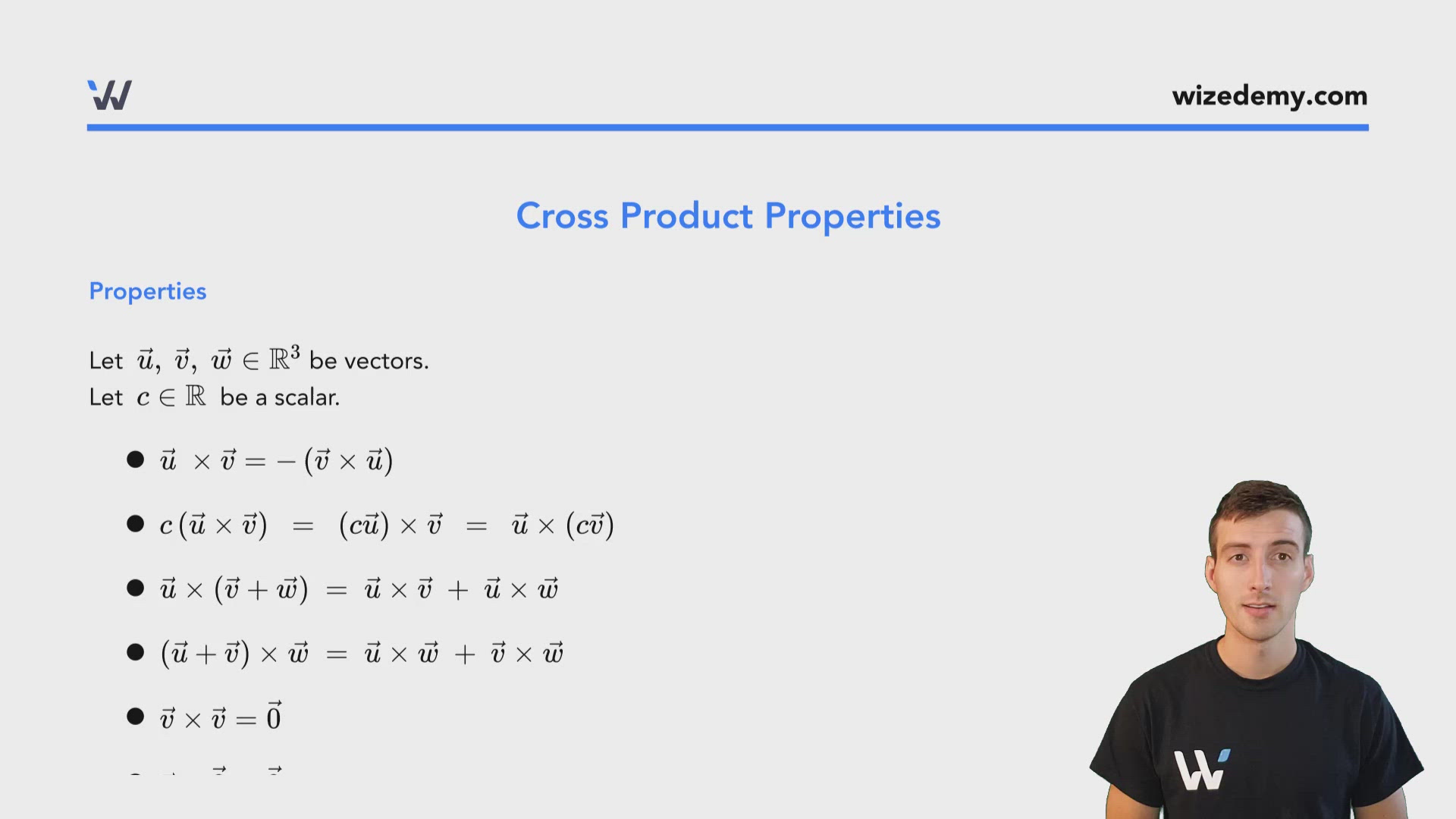
Cross Product Properties
Properties
Let be vectors.
Let be a scalar.
Cross Product and Angles
Like the dot product, there is another formula for the cross product involving the angle between vectors.
For vectors and angle between and :
Watch Out!
Don't forget to take the norm on the LHS!
This is a scalar equation, just like the similar dot product formula:
Note
If then and are parallel (or one of the vectors is )
0:00 / 0:00
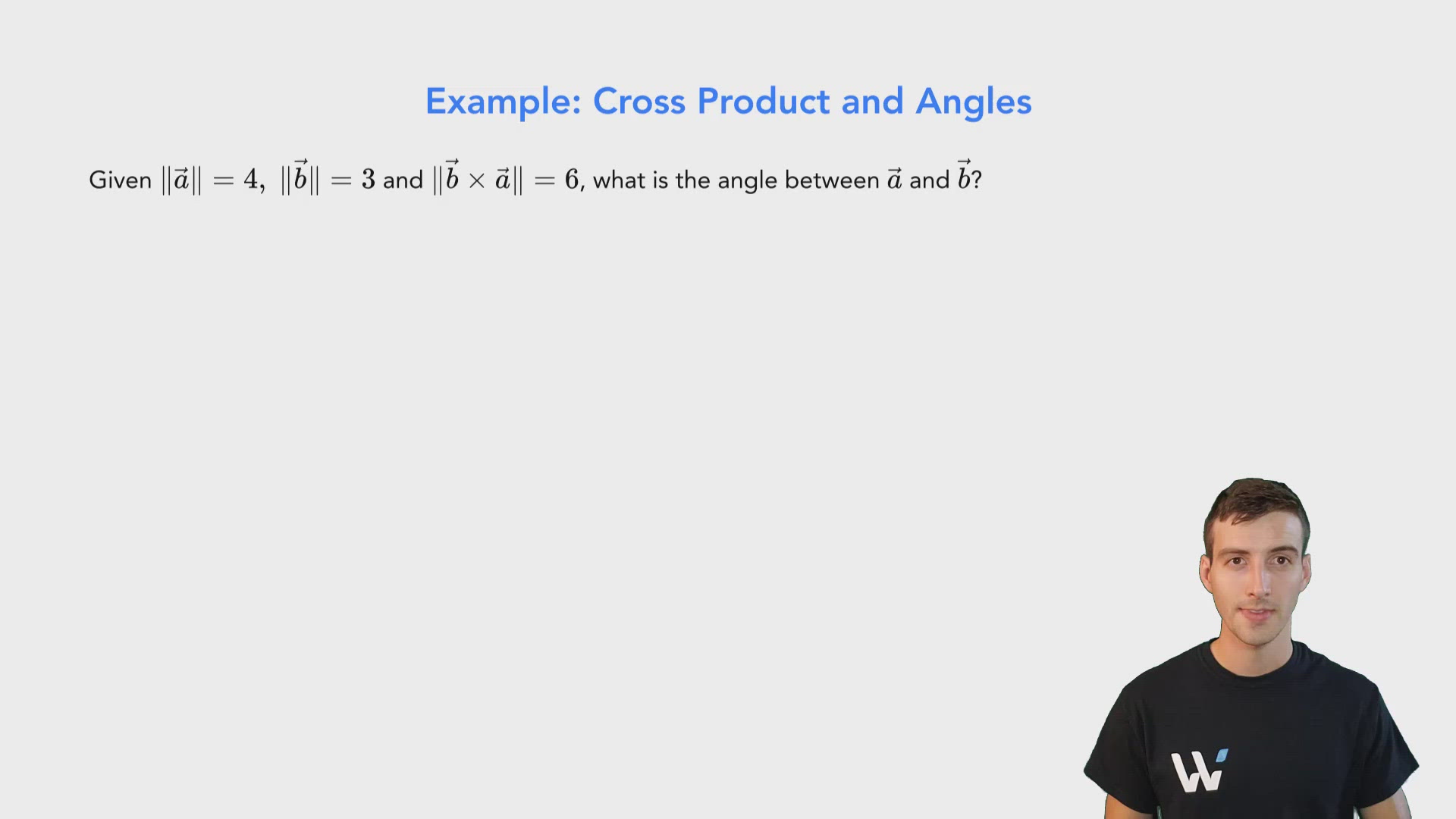
Example: Cross Product and Angles
Given and , what is the angle between and ?
Recall the formula involving the cross product and angle and rearrange:

Based on the special triangle:
Note: By the CAST rule, is also positive in the 2nd quadrant (top-left), so there is another possible answer found there.
Quadrant 2 contains angles between and . Take our "basic" solution and subtract it from to get the alternative answer:
0:00 / 0:00
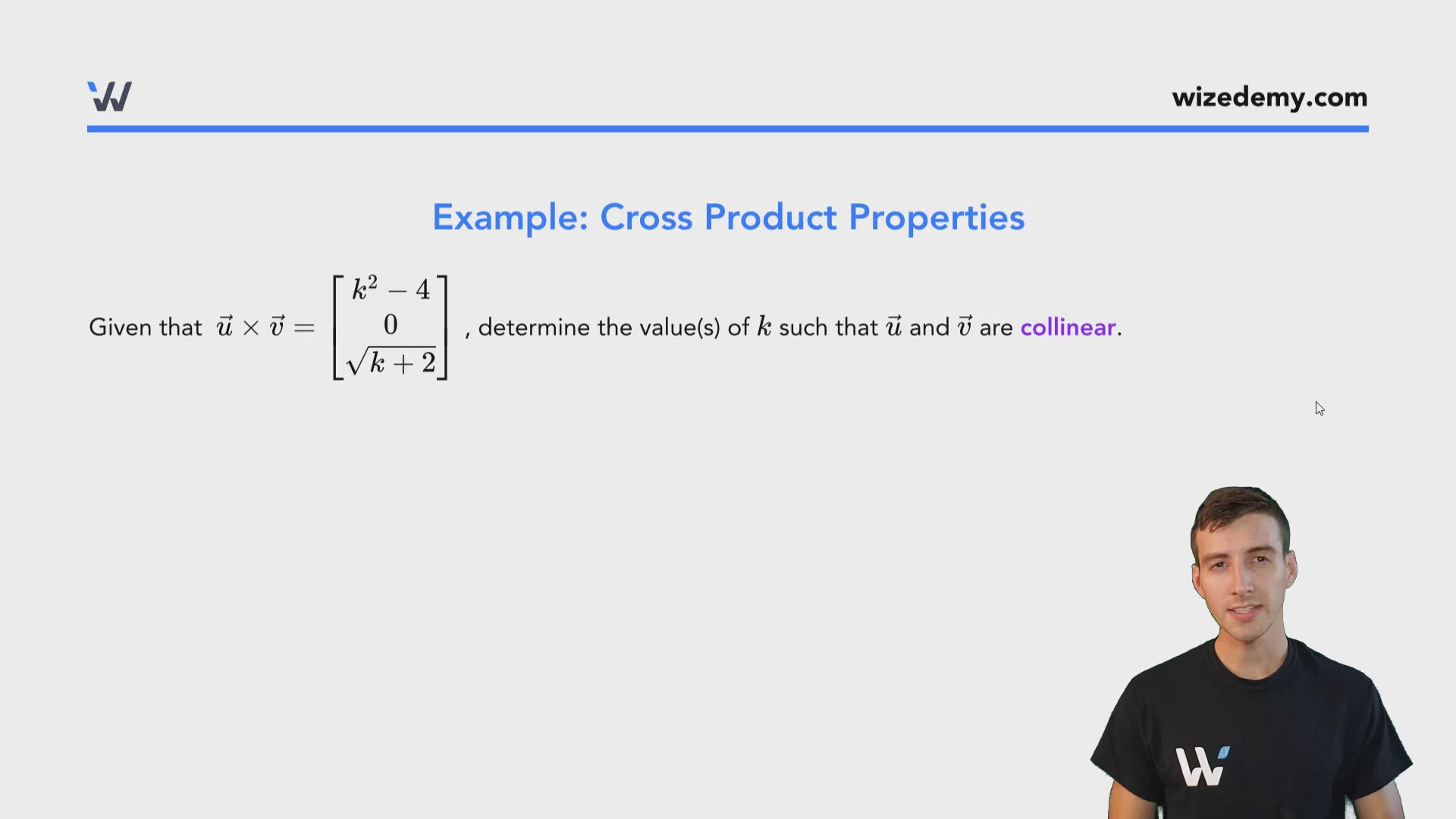
Example: Cross Product Properties
Given that , determine the value(s) of such that and are collinear.
The vectors are collinear/parallel if the cross product is the zero vector:
Equation 1:
Equation 2:
(no new information)
Equation 3:
Therefore only will ensure that all components are zero.

Mark Yourself Question
- Grab a piece of paper and try this problem yourself.
- When you're done, check the "I have answered this question" box below.
- View the solution and report whether you got it right or wrong.
Practice: Cross Product Properties
Use the cross product and dot product properties to prove:
Practice: Cross Product Properties
Let be vectors.
Let be scalars.
Select all of the following that produce a vector.