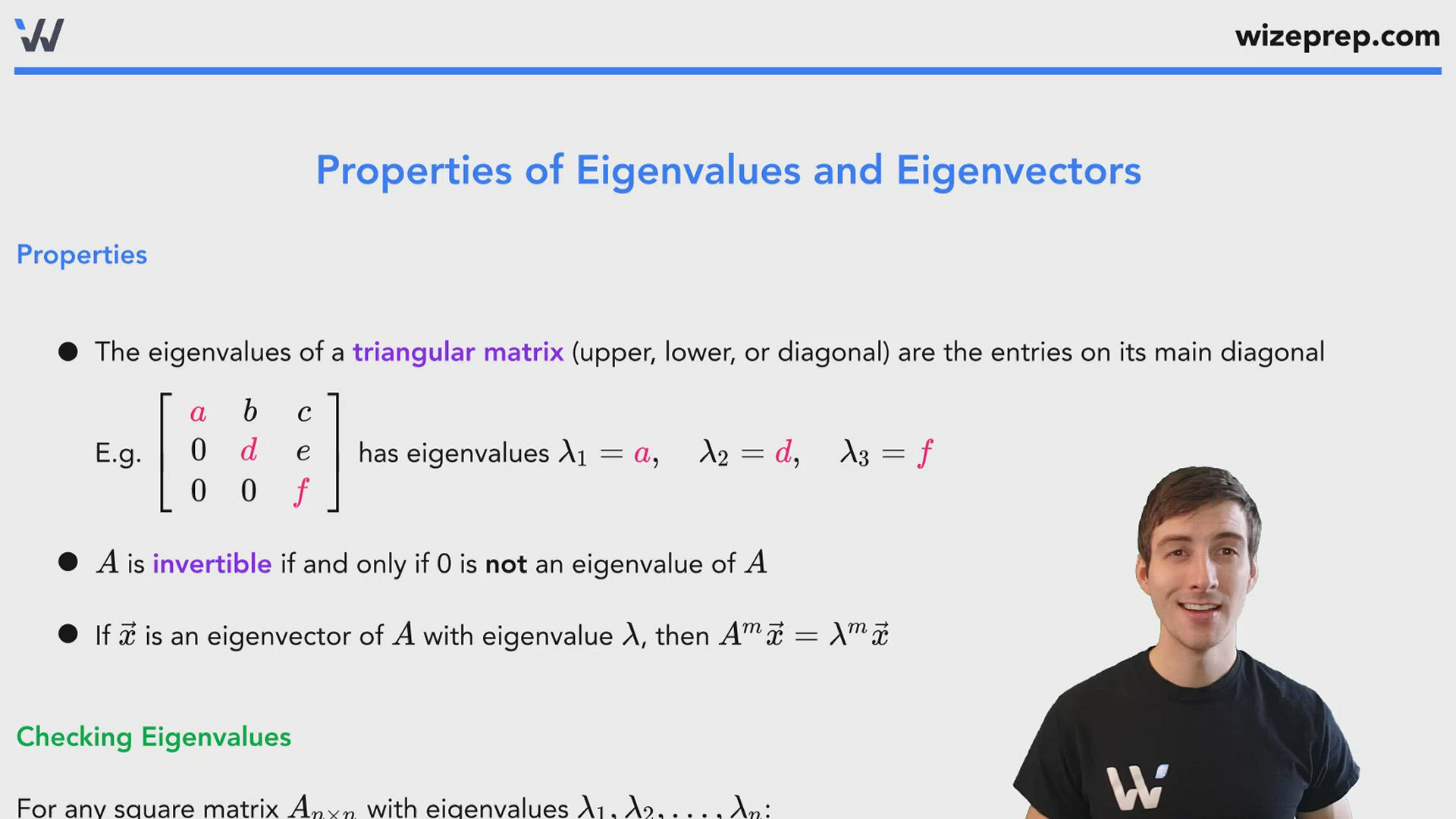
Properties of Eigenvalues and Eigenvectors
Properties
- The eigenvalues of a triangular matrix (upper, lower, or diagonal) are the entries on its main diagonal E.g. has eigenvalues
- is invertible if and only if 0 is not an eigenvalue of
- If is an eigenvector of with eigenvalue , then
Checking Eigenvalues
For any square matrix with eigenvalues :
Similar Matrices
Given and any invertible matrix , then we say is similar to .
Letting , then is similar to which we denote .
Similar matrices have the same eigenvalues!
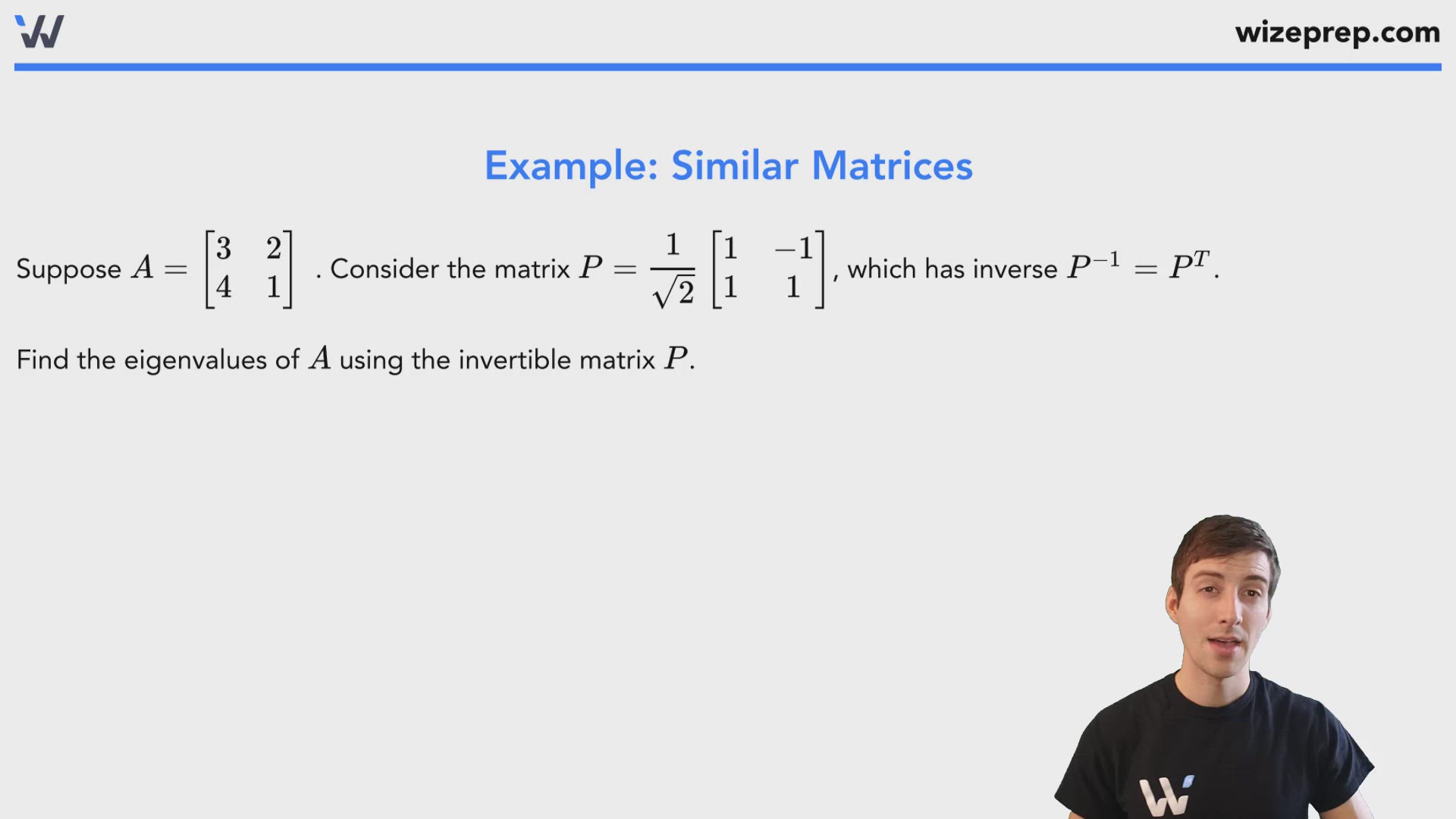
Example: Similar Matrices
Suppose . Consider the matrix , which has inverse .
Find the eigenvalues of using the invertible matrix .
We want to use the formula for similar matrices: .
First, find :
Now we can find a similar matrix using the formula:
Since is upper triangular, its eigenvalues are on the main diagonal.
Therefore, the eigenvalues of are and . Since , these are also the eigenvalues of .

Example: Eigenvectors and Linear Transformations
Let be the linear transformation defined by:
Part A)
If it is known that is an eigenvector of the transformation , find the vector .
Since is linear, it can be represented by a matrix such that .
Let's start by finding the matrix that induces this transformation:
Since is an eigenvector of , it must also be an eigenvector of . Let's find its eigenvalue:
So is an eigenvector with associated eigenvalue .
Then notice that the vector is equivalent to , since applying five times is equivalent to multiplying by five times.
and by a property of eigenvalues:
Therefore:
Part B)
Given that two eigenvalues of are and , determine whether is invertible.
is invertible if is invertible, and is invertible if and only if 0 is not one of its eigenvalues.
The question tells us has eigenvalues and (since and must have the same eigenvalues).
From the properties of eigenvalues, the sum of the eigenvalues must equal the trace of matrix . In other words:
The third eigenvalue of is 0, so is not invertible, therefore is not invertible.