0:00 / 0:00

Diagonalization

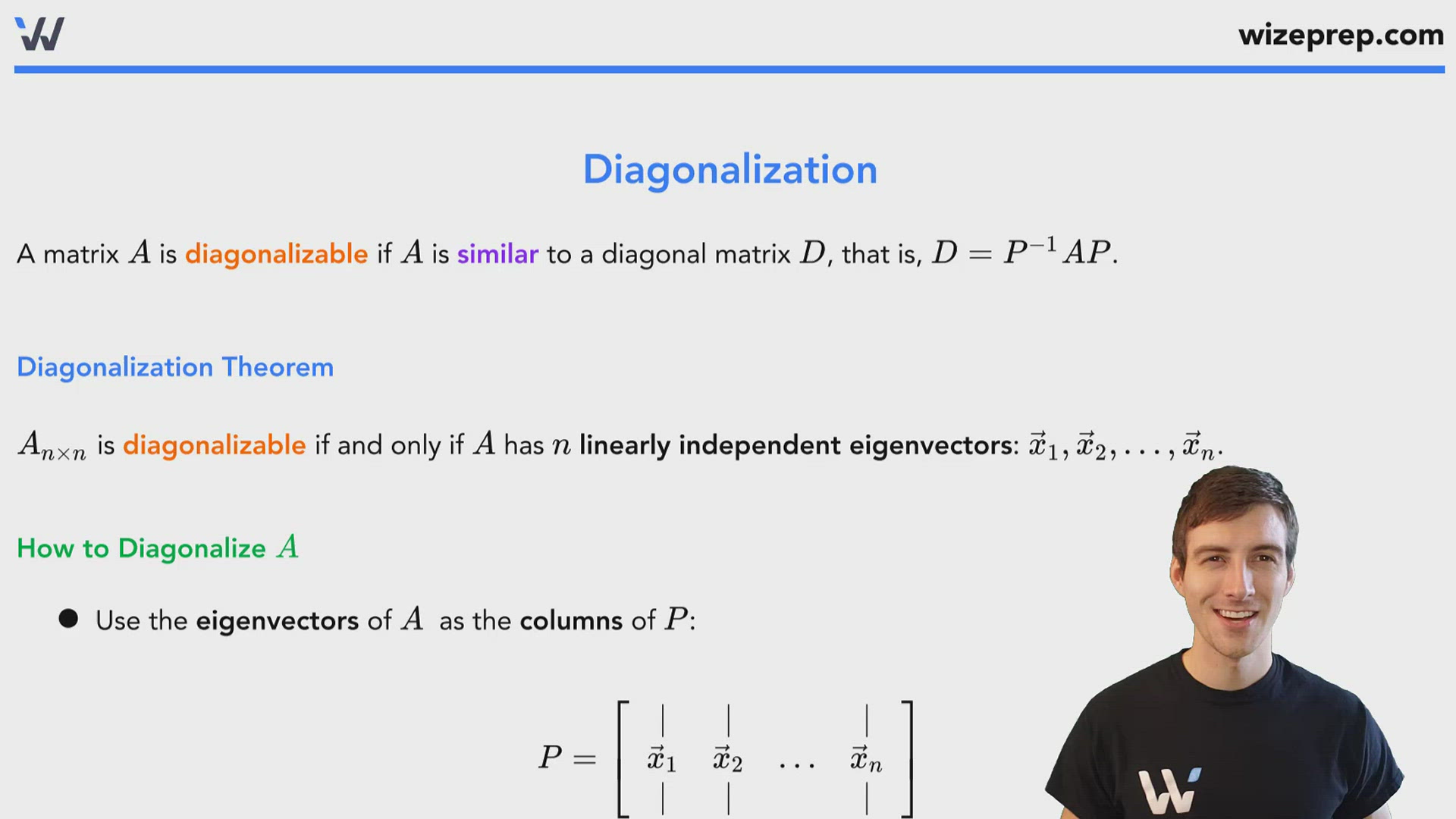
A matrix AA is diagonalizable if AA is similar to a diagonal matrix DD, that is, D=P1APD=P^{-1}AP.

Diagonalization Theorem

An×nA_{n\times n} is diagonalizable if and only if AA has nn linearly independent eigenvectors: x1,x2,,xn\vec x_1, \vec x_2, \dots, \vec x_n.
How to Diagonalize A\colorThree A
  • Use the eigenvectors of AA as the columns of PP:
P=[x1x2xn]P = \left[\begin{array}{ccc} | & | & & |\\ \vec x_1 & \vec x_2 & \dots & \vec x_n\\ | & | & & |\\ \end{array} \right]
  • The diagonal entries of DD are the eigenvalues of AA (in the same order as the eigenvectors in PP):
D=[λ10000λ200000000λn]D = \left[ \begin{array}{rrr} \lambda_1 & 0 & 0 & 0\\ 0 & \lambda_2 & 0& 0\\ 0 & 0 & \ddots & 0\\ 0 & 0 & 0 & \lambda_n\\ \end{array} \right]

Wize Tip
AA is diagonalizable if the algebraic multiplicity matches the geometric multiplicity for all eigenvalues.
In particular, if AA has nn distinct eigenvalues, then AA is diagonalizable.

PAGE BREAK

Powers of Matrices

Diagonal Matrices
If DD is a diagonal matrix, then DkD^k can be found by raising every diagonal entry to the power of kk.
D=[d1000d2000dn]    Dk=[d1k000d2k000dnk]D=\left[\begin{array}{ccccc} d_1&0&\cdots&0\\[0.5em] 0&d_2&\cdots&0\\[0.5em] \vdots&\vdots&\ddots&\vdots\\[0.5em] 0&0&\cdots&d_n \end{array}\right] \quad \implies \quad D^{\colorTwo{k}}=\left[\begin{array}{ccccc} \colorTwo{d_1^k}&0&\cdots&0\\[0.5em] 0&\colorTwo{d_2^k}&\cdots&0\\[0.5em] \vdots&\vdots&\ddots&\vdots\\[0.5em] 0&0&\cdots&\colorTwo{d_n^k} \end{array}\right]
Other Matrices
We can use diagonalizability to compute large powers of any diagonalizable matrix AA.
Since AA is similar to a diagonal matrix DD, we can write D=P1APD = P^{-1}AP. Solve for AA:
P1AP=DPP1APP1=PDP1A=PDP1\begin{aligned} P^{-1}AP &= D\\ \colorOne{P}P^{-1}AP\colorTwo{P^{-1}} &= \colorOne{P}D\colorTwo{P^{-1}}\\ A &= \colorOne{P}D\colorTwo{P^{-1}} \end{aligned}
We can use this expression for AA to compute AkA^k:
Ak=(PDP1)k=(PDP1)(PDP1)(PDP1)=PD  P1P  D  P1P  P1P  DP1=PDDDP1=PDkP1\begin{array}{rcl} A^k&=&(PDP^{-1})^k\\[1em] &=& (PDP^{-1})(PDP^{-1})\cdots(PDP^{-1})\\[1em] &=& PD\;\colorTwo{P^{-1}P}\;D\;\colorTwo{P^{-1}P}\;\cdots \colorTwo{P^{-1}P}\;DP^{-1}\\[1em] &=& PDD\cdots DP^{-1}\\[1em] &=& PD^kP^{-1} \end{array}

Ak=PDkP1\boxed{\quad A^k = PD^kP^{-1} \quad}

0:00 / 0:00

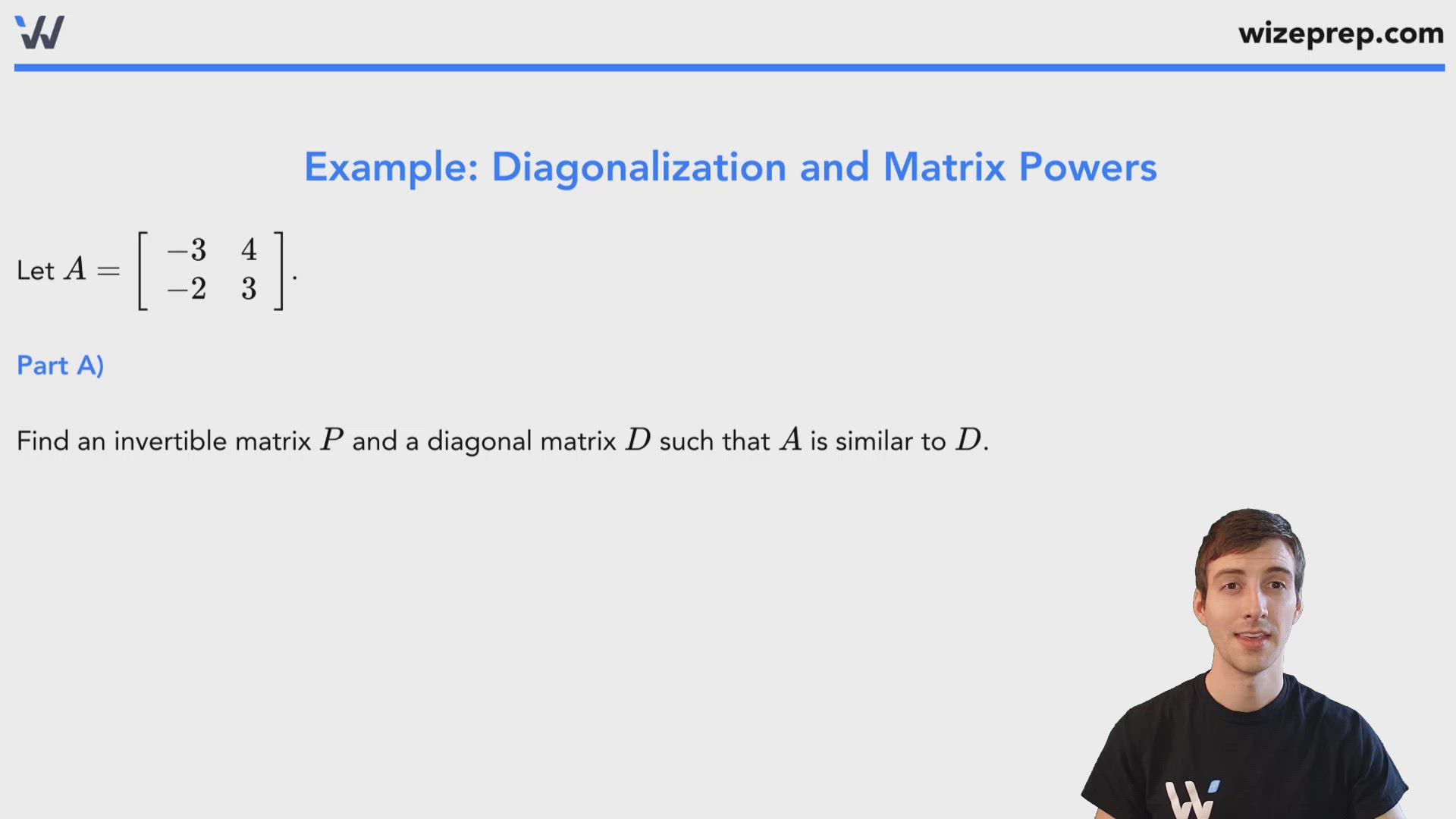
Example: Diagonalization and Matrix Powers

Let A=[3423]A=\left[\begin{array}{rr} -3&4\\-2&3\end{array}\right].

Part A)

Find an invertible matrix PP and a diagonal matrix DD such that AA is similar to DD.
Eigenvalues
det(AλI)=0    3λ423λ=0(3λ)(3λ)4(2)=0λ21=0\begin{array}{rcr} \text{det}(A-\lambda I)=0 &\implies& \left|\begin{array}{cc} -3-\lambda&4\\-2&3-\lambda\end{array}\right|=0\\[1.5em] && (-3-\lambda)(3-\lambda)-4(-2)=0\\[1em] &&\lambda^2-1=0 \end{array}
The eigenvalues are λ1=1\colorOne{\lambda_1=-1} and λ2=1\colorTwo{\lambda_2=1}.
Note that since AA is 2×22\times 2 and has 22 distinct eigenvalues, AA is diagonalizable.
Eigenvectors
When λ1=1\colorOne{\lambda_1=-1}, we solve the linear system: (A(1)I)x1=0(A-(-1)I) \colorOne{\vec x_1} = \vec 0 whose augmented matrix is:
[3(1)4023(1)0]=[240240]    [120000]\left[\begin{array}{cc|r} -3-(-1)&4&0\\-2&3-(-1)&0\end{array}\right] = \left[\begin{array}{cc|r} -2&4&0\\-2&4&0\end{array}\right] \implies \left[\begin{array}{rr|r} 1&-2&0\\0&0&0\end{array}\right]
The solution to this system is any vector of the form:
[2tt]=t[21]\left[\begin{array}{r} 2t\\t\end{array}\right] = t\left[\begin{array}{r} 2\\1\end{array}\right]
So the eigenvector is: x1=[21]\colorOne{\vec x_1 = \left[\begin{array}{r} 2\\1\end{array}\right]}
When λ2=1\colorTwo{\lambda_2=1}, we solve the linear system: (A1I)x2=0(A-1I)\colorTwo{\vec x_2} = \vec 0 whose augmented matrix is:
[31402310]=[440220]    [110000]\left[\begin{array}{cc|r} -3-1&4&0\\-2&3-1&0\end{array}\right] = \left[\begin{array}{cc|r} -4&4&0\\-2&2&0\end{array}\right] \implies \left[\begin{array}{rr|r} 1&-1&0\\0&0&0\end{array}\right]
The solution to this system is any vector of the form: [tt]=t[11]\left[\begin{array}{r} t\\t\end{array}\right] = t\left[\begin{array}{r} 1\\1\end{array}\right]
So the eigenvector is: x2=[11]\colorTwo{\vec x_2 = \left[\begin{array}{r} 1\\1\end{array}\right]}
Then:
P=[2111]P=\left[\begin{array}{rr} \colorOne{2}&\colorTwo{1}\\ \colorOne{1}&\colorTwo{1} \end{array}\right] which means P1=[1112]P^{-1}=\left[\begin{array}{rr} 1&-1\\-1&2\end{array}\right], and AA is similar to D=[1001]D=\left[\begin{array}{rr} \colorOne{-1}&0\\ 0&\colorTwo{1} \end{array}\right].
Note the order of the eigenvectors in PP and their associated eigenvalues in DD.

Part B)

Compute A100A^{100}.
Using the diagonalization of AA:
A100=(PDP1)100=PD100P1=[2111][1001]100[1112]=[2111][(1)100001100][1112]=[2111][1001][1112]=[2111][1112]=[1001]\begin{array}{rcl} A^{100}&=&(PDP^{-1})^{100}\\[1em] &=&PD^{100}P^{-1}\\[1em] &=& \left[\begin{array}{rr} 2&1\\1&1\end{array}\right] \left[\begin{array}{rr} -1&0\\0&1\end{array}\right]^{100} \left[\begin{array}{rr} 1&-1\\-1&2\end{array}\right]\\[2em] &=& \left[\begin{array}{rr} 2&1\\1&1\end{array}\right] \left[\begin{array}{cc} (-1)^{100}&0\\0&1^{100}\end{array}\right] \left[\begin{array}{rr} 1&-1\\-1&2\end{array}\right]\\[2em] &=& \underbrace{ \left[\begin{array}{rr} 2&1\\1&1\end{array}\right] \left[\begin{array}{cc} 1&0\\0&1\end{array}\right]} \left[\begin{array}{rr} 1&-1\\-1&2\end{array}\right]\\[2em] &=& \left[\begin{array}{rr} 2&1\\1&1\end{array}\right] \left[\begin{array}{rr} 1&-1\\-1&2\end{array}\right]\\[2em] &=& \boxed{ \left[\begin{array}{rr} 1&0\\0&1\end{array}\right]} \end{array}

Practice: Determining Diagonalizability

Let A=[7935]A=\left[\begin{array}{rr}-7&9\\-3&5\end{array}\right]. Is AA diagonalizable?

Practice: Diagonalization

Let A=[2601]A=\left[\begin{array}{rr} 2&6\\ 0&-1\end{array}\right].
First, convince yourself (without calculation) that AA is diagonalizable.
Then, compute A50A^{50}.
Extra Practice