Popular Courses
MATH 211
University of Calgary
Linear Algebra
University Study Guides
MATH 1ZC3
McMaster University
MATH 152
University of British Columbia
MATH 1600A/B
Western University
Linear Algebra
General Course
MAT188H1
University of Toronto
MATH 125
University of Alberta
Linear Algebra
University Study Guides
APSC 174
Queen's University
MATH 115
University of Waterloo
MATH 1B03
McMaster University
MAT223H1
University of Toronto
MATH-1270
University of Windsor
MATH 1210
University of Manitoba
MATH-1250
University of Windsor
MATH 223
McGill University
MATH 111
Queen's University
MATH 1104
Carleton University
MATH 136
University of Waterloo
0:00 / 0:00
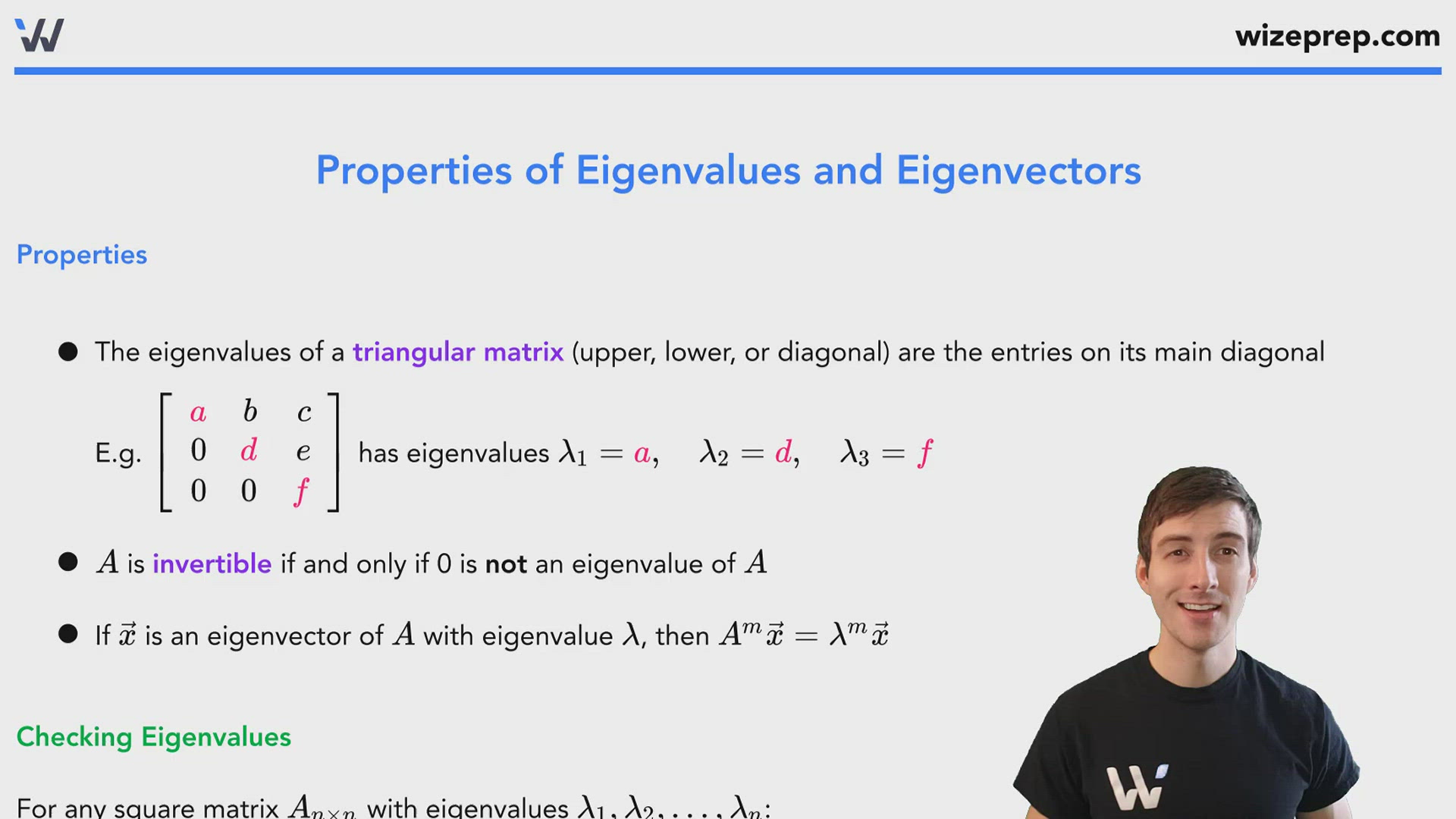
Properties of Eigenvalues and Eigenvectors
Properties
- The eigenvalues of a triangular matrix (upper, lower, or diagonal) are the entries on its main diagonal E.g. has eigenvalues
- is invertible if and only if 0 is not an eigenvalue of
- If is an eigenvector of with eigenvalue , then
Checking Eigenvalues
For any square matrix with eigenvalues :
Wize Concept
is the trace of a matrix , which is defined as the sum of the entries on the main diagonal.
Similar Matrices
Given and any invertible matrix , then we say is similar to .
Letting , then is similar to which we denote .
Similar matrices have the same eigenvalues!
0:00 / 0:00
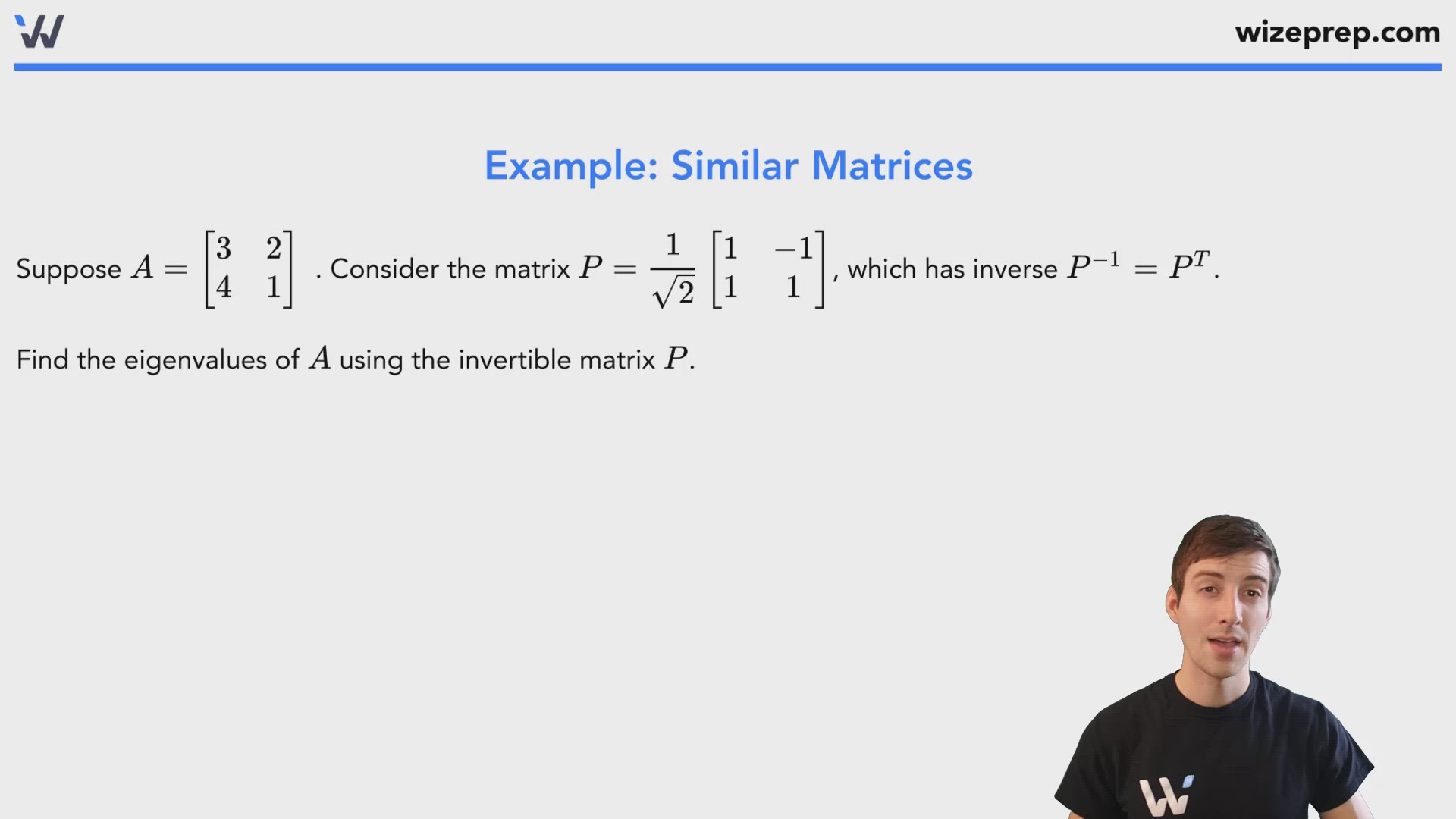
Example: Similar Matrices
Suppose . Consider the matrix , which has inverse .
Find the eigenvalues of using the invertible matrix .
We want to use the formula for similar matrices: .
First, find :
Now we can find a similar matrix using the formula:
Since is upper triangular, its eigenvalues are on the main diagonal.
Therefore, the eigenvalues of are and . Since , these are also the eigenvalues of .

0:00 / 0:00
Example: Eigenvectors and Linear Transformations
Let be the linear transformation defined by:
Part A)
If it is known that is an eigenvector of the transformation , find the vector .
Since is linear, it can be represented by a matrix such that .
Let's start by finding the matrix that induces this transformation:
Since is an eigenvector of , it must also be an eigenvector of . Let's find its eigenvalue:
So is an eigenvector with associated eigenvalue .
Then notice that the vector is equivalent to , since applying five times is equivalent to multiplying by five times.
and by a property of eigenvalues:
Therefore:
Part B)
Given that two eigenvalues of are and , determine whether is invertible.
is invertible if is invertible, and is invertible if and only if 0 is not one of its eigenvalues.
The question tells us has eigenvalues and (since and must have the same eigenvalues).
From the properties of eigenvalues, the sum of the eigenvalues must equal the trace of matrix . In other words:
The third eigenvalue of is 0, so is not invertible, therefore is not invertible.
Practice: Similar Matrices
Consider the matrix .
Use the invertible matrix to find a matrix similar to .