Wize University Linear Algebra Textbook > Eigenvalues and Eigenvectors (Spectral Theory)
Markov Chains (Random Walks)
Popular Courses
MATH 211
University of Calgary
Linear Algebra
University Study Guides
MATH 133
McGill University
MATH 1ZC3
McMaster University
MATH 152
University of British Columbia
Linear Algebra
General Course
MAT188H1
University of Toronto
Linear Algebra
University Study Guides
SC/MATH 1025 3.00
York University
APSC 174
Queen's University
MATH 151
University of Victoria
MATH 115
University of Waterloo
MAT133Y1
University of Toronto
MATH 1B03
McMaster University
ADM 1305
University of Ottawa
MATH-1270
University of Windsor
MATH 1210
University of Manitoba
MATH 223
McGill University
MATH 111
Queen's University
MATH 1104
Carleton University
0:00 / 0:00
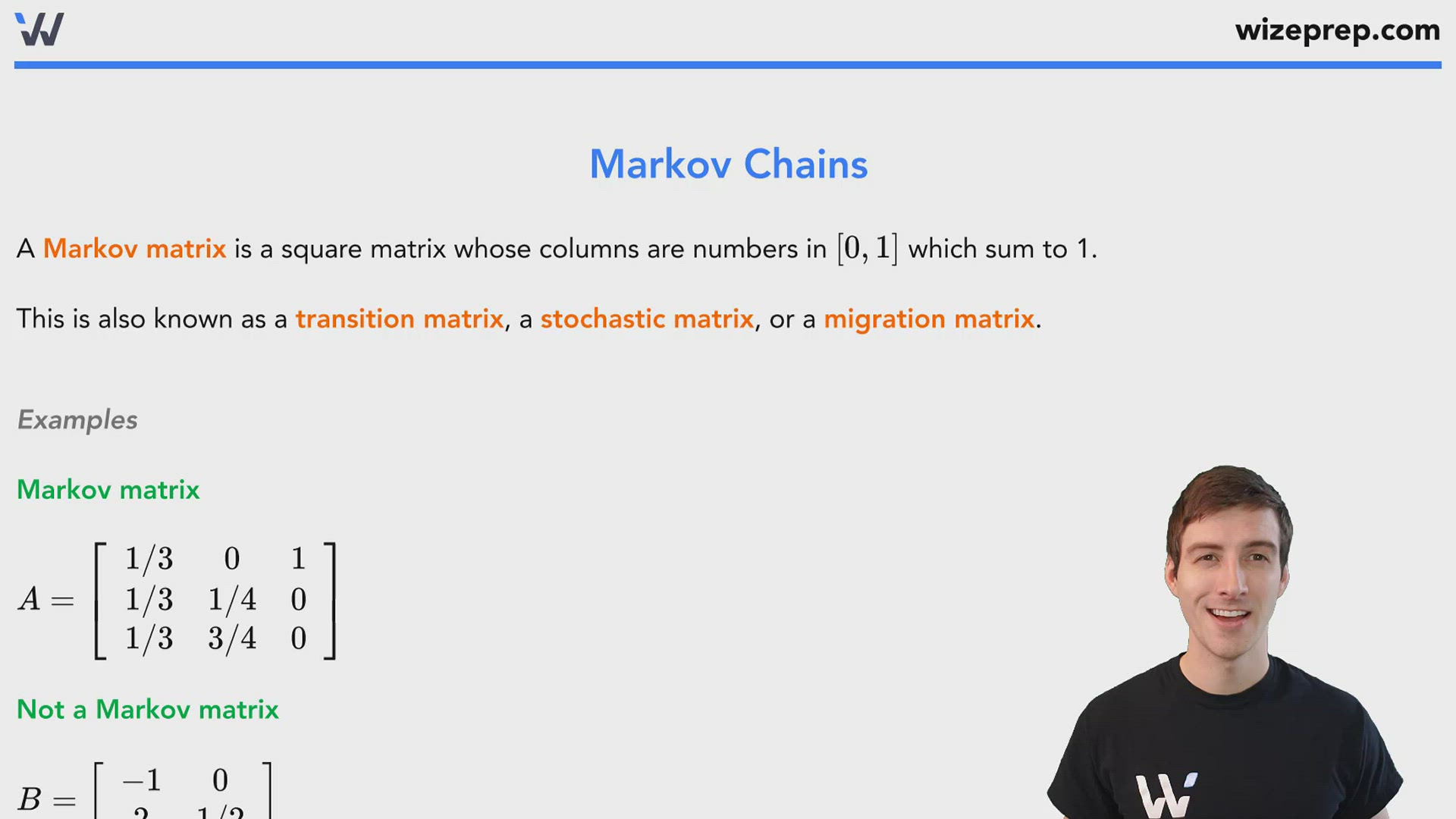
Markov Chains
A Markov matrix is a square matrix whose columns are numbers in which sum to 1.
This is also known as a transition matrix, a stochastic matrix, or a migration matrix.
Examples
Markov matrix
Not a Markov matrix
- First column: contains numbers that are not between 0 and 1.
- Second column: the sum of the entries is not 1.
Interpretation
The entries in a Markov matrix represent proportions or probabilities.
For example, entry of a migration matrix is the proportion of the population moving from location to location .
Example
- of the population in location 1 stays in location 1
- of the population in location 1 moves to location 2
- All of the population in location 2 moves to location 1
- None of the population in location 2 stays in location 2
Markov Chain Equation
The state vector at time is given by:
If is a Markov matrix, we can determine the next state vector by computing:
Wize Tip
The sum of the entries in each must be a constant at all time steps. Use this as a check!
Steady State
If is a Markov matrix, then there exists a steady state vector such that .
As increases, the state vectors approach the steady state :
Finding the Steady State Vector
can be found by solving:
We can solve this homogeneous equation using Gauss-Jordan elimination (just like with eigenvectors!)
0:00 / 0:00
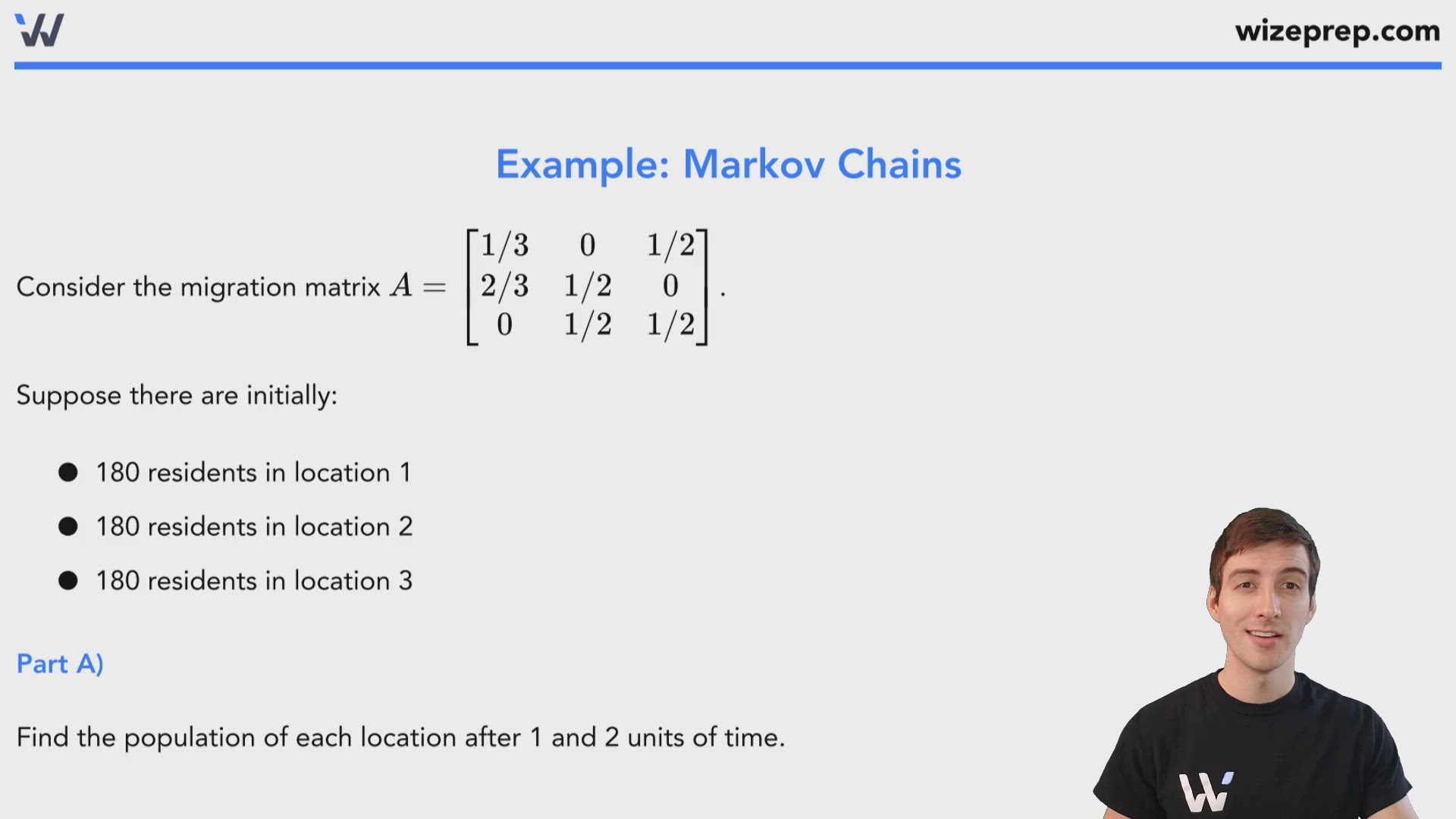
Example: Markov Chains
Consider the migration matrix .
Suppose there are initially:
- 180 residents in location 1
- 180 residents in location 2
- 180 residents in location 3
Part A)
Find the population of each location after 1 and 2 units of time.
Therefore, after one time period, location 1 has 150 residents, location 2 has 210 residents, and location 3 has 180 residents.
Therefore, after two time periods, location 1 has 140 residents, location 2 has 205 residents, and location 3 has 195 residents.
Part B)
Find the population of each location after a very long time.
We must find a solution to , so we will reduce the augmented matrix:
Solving for when this system equals the zero vector, we obtain a general solution .
Now we must find a value of such that this vector has the same sum as (and every state vector).
Therefore, the population in the long run is:
Practice: Markov Chains
Consider the following three temperature scenarios:
- If it is hot today, it will not be hot tomorrow, and there is a 50% it will be mild tomorrow.
- If it is mild today, there is a 2/3 chance it will be hot tomorrow, and a 1/3 chance it will be cold tomorrow.
- If it is cold today, there is a 50% chance it will be hot tomorrow, and it will certainly not be mild tomorrow.
If today is Thursday and it is cold, what temperature scenario is most likely to occur on Saturday? What is its probability?