Markov Chains
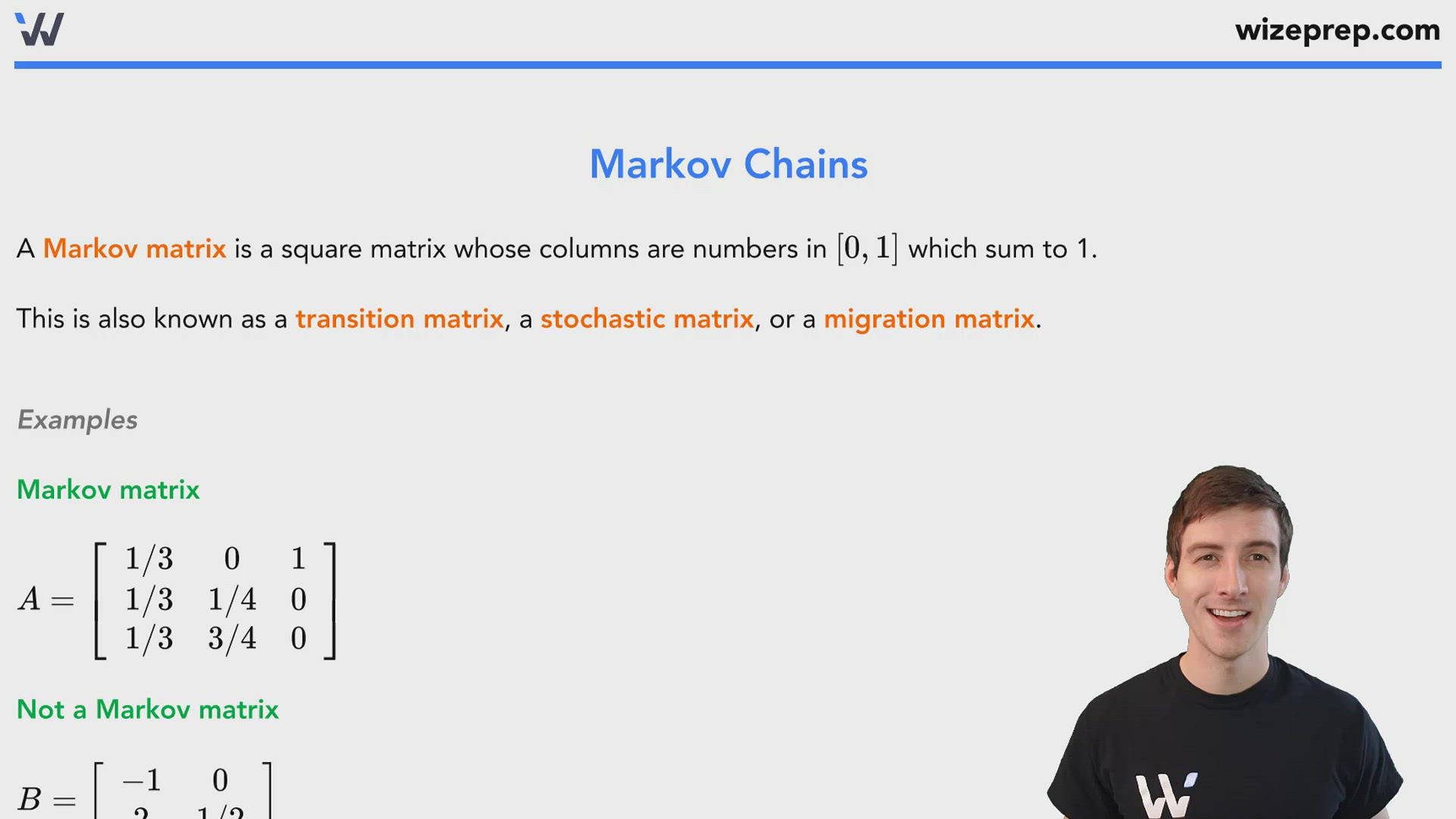
A Markov matrix is a square matrix whose columns are numbers in which sum to 1.
This is also known as a transition matrix, a stochastic matrix, or a migration matrix.
Examples
Markov matrix
Not a Markov matrix
- First column: contains numbers that are not between 0 and 1.
- Second column: the sum of the entries is not 1.
Interpretation
The entries in a Markov matrix represent proportions or probabilities.
For example, entry of a migration matrix is the proportion of the population moving from location to location .
Example
- of the population in location 1 stays in location 1
- of the population in location 1 moves to location 2
- All of the population in location 2 moves to location 1
- None of the population in location 2 stays in location 2
Markov Chain Equation
The state vector at time is given by:
If is a Markov matrix, we can determine the next state vector by computing:
Steady State
If is a Markov matrix, then there exists a steady state vector such that .
As increases, the state vectors approach the steady state :
Finding the Steady State Vector
can be found by solving:
We can solve this homogeneous equation using Gauss-Jordan elimination (just like with eigenvectors!)
Example: Markov Chains
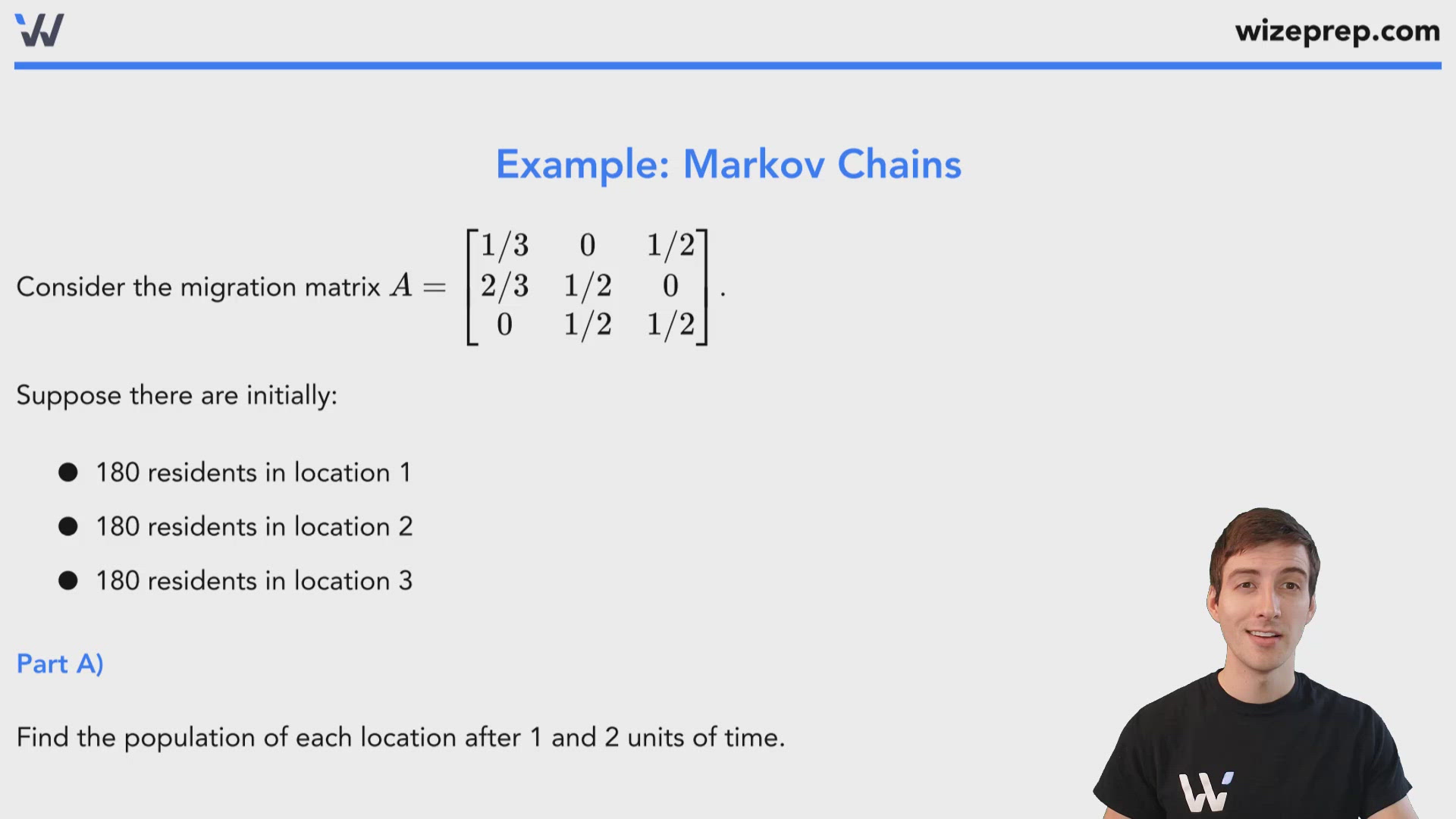
Consider the migration matrix .
Suppose there are initially:
- 180 residents in location 1
- 180 residents in location 2
- 180 residents in location 3
Part A)
Find the population of each location after 1 and 2 units of time.
Therefore, after one time period, location 1 has 150 residents, location 2 has 210 residents, and location 3 has 180 residents.
Therefore, after two time periods, location 1 has 140 residents, location 2 has 205 residents, and location 3 has 195 residents.
Part B)
Find the population of each location after a very long time.
We must find a solution to , so we will reduce the augmented matrix:
Solving for when this system equals the zero vector, we obtain a general solution .
Now we must find a value of such that this vector has the same sum as (and every state vector).
Therefore, the population in the long run is: