Wize University Linear Algebra Textbook > Determinants
Determinants of Large Matrices
Popular Courses
MATH 211
University of Calgary
MATH 1229A/B
Western University
Linear Algebra
University Study Guides
MATH 1ZC3
McMaster University
MATH 152
University of British Columbia
MATH 1600A/B
Western University
Linear Algebra
General Course
MATH 204
Concordia University
MAT188H1
University of Toronto
Linear Algebra
University Study Guides
NMM 1411A/B
Western University
APSC 174
Queen's University
MATH 102
University of Alberta
MATH 115
University of Waterloo
MATH 1B03
McMaster University
ADM 1305
University of Ottawa
MAT223H1
University of Toronto
MATH-1270
University of Windsor
MATH 1210
University of Manitoba
MATH-1250
University of Windsor

0:00 / 0:00
Minors and Cofactors
Minor of a Matrix Entry
Let be a square matrix. The minor of entry , denoted , is the determinant of the submatrix that remains after removing row and column from .
Example
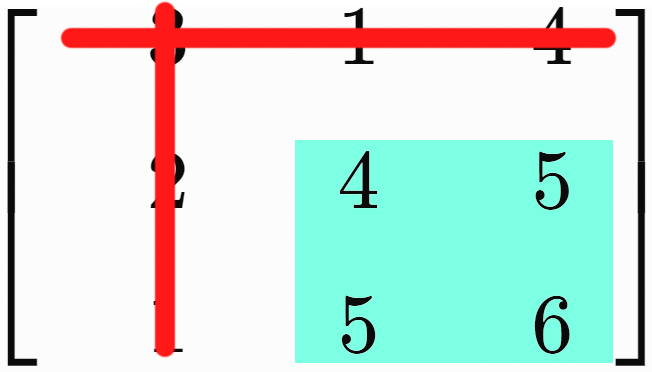
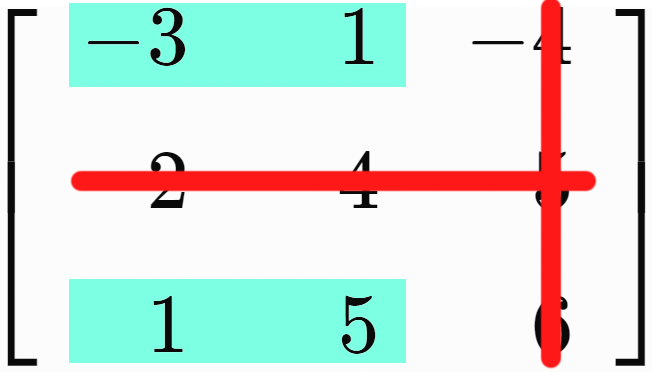
Given , find the minors and :
For , we need to cross out row 1 and column 1, then find the determinant of what remains:
For , we need to cross out row 2 and column 3:
Cofactor of a Matrix Entry
Let be a square matrix. The cofactor of entry , denoted , is given as:
Wize Tip
Imagine a checkerboard pattern over the given matrix to decide whether you should write or :
Example
Given , find cofactors and .
Using the checkerboard pattern, we can see whether we need to negate when computing :
Note: just means multiply by positive 1 (no change), it does not mean "make it positive".
Alternatively, you can use the formula:
0:00 / 0:00
Determinants of Large Matrices
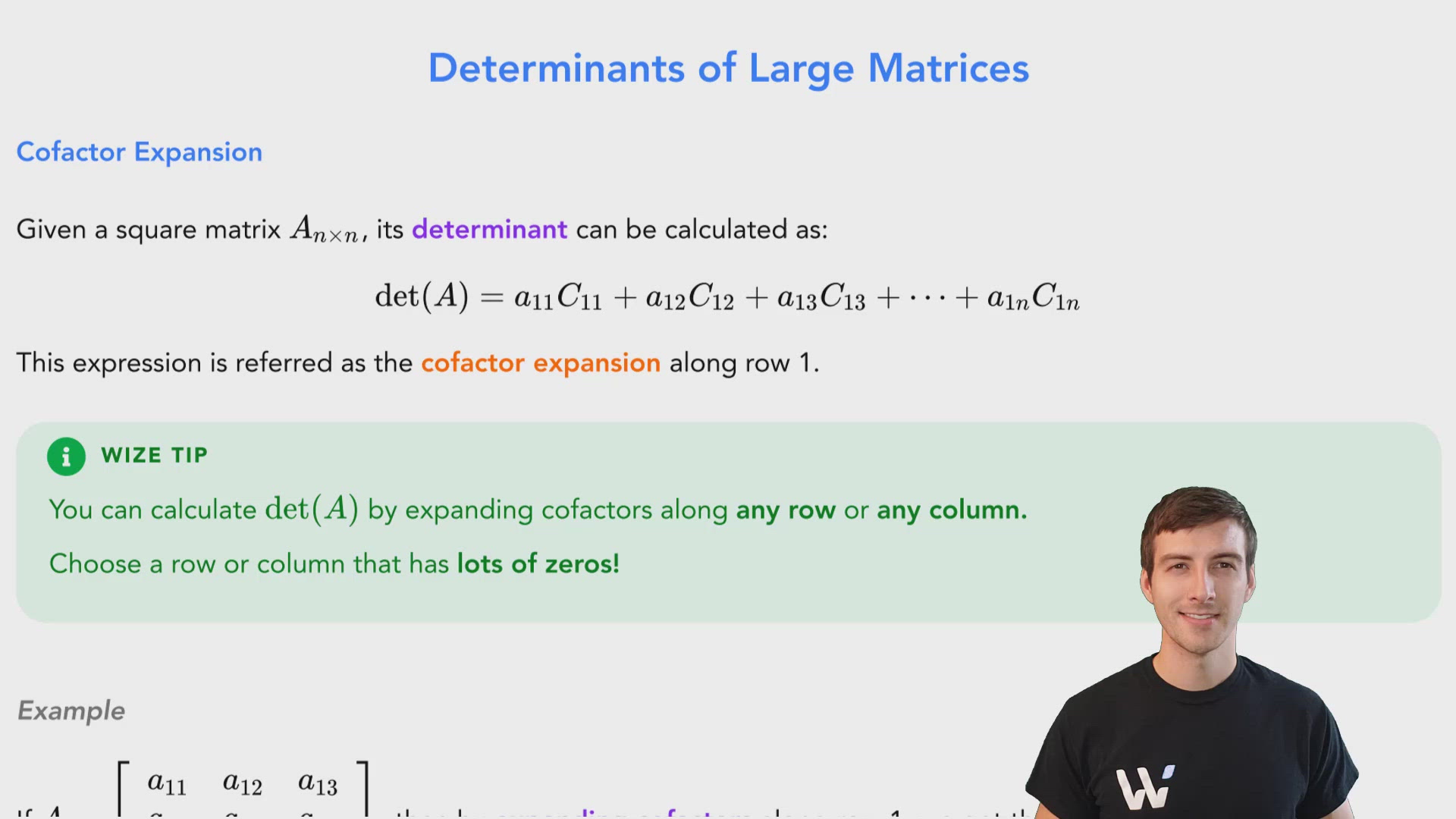
Cofactor Expansion
Given a square matrix , its determinant can be calculated as:
This expression is referred as the cofactor expansion along row 1.
Wize Tip
You can calculate by expanding cofactors along any row or any column.
Choose a row or column that has lots of zeros!
Example
If , then by expanding cofactors along row 1, we get the result:
Note: Finding the determinant of a matrix becomes finding determinants matrices.
Example
If then by expanding cofactors along row 1 we get the result:
Exercise: To compute a determinant, we must compute up to
12
determinants.Steps
- Choose a row or column with lots of 0s
- Assign or signs to each entry in that row or column (top left corner starts with , continue checkerboard pattern)
- Set up the determinant equation with these signs:
- Write the entries of your chosen row or column:
- Multiply by the determinants of the sub-matrices (matrix minors):
0:00 / 0:00
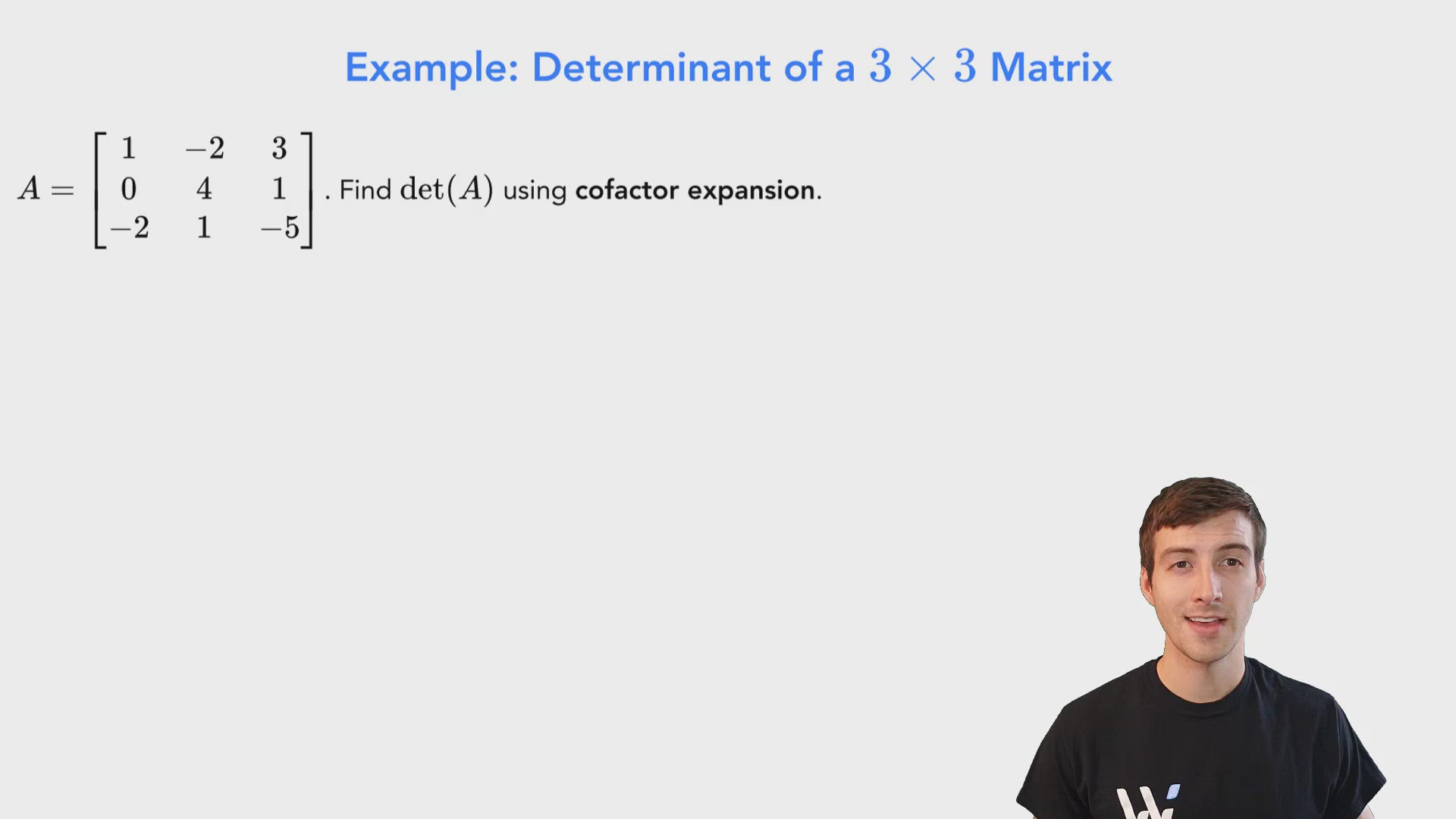
Example: Determinant of a Matrix
. Find using cofactor expansion.
- Choose a row or column with lots of 0s Column 1 contains a 0 (as well as Row 2). Let's choose Column 1.
- Assign or signs to each entry in that row or column (top left corner starts with , continue checkerboard pattern)
- Set up the determinant equation with these signs
- Write the entries of your chosen row or column
- Multiply by the determinants of the sub-matrices (matrix minors)
Find .
Compute the determinant of .