Wize University Calculus 1 Textbook > Derivatives

The Limit Definition of a Derivative

Create a free account to get started

Unlock full course notes by signing up

  • Video lessons taught by top educators
  • Practice questions with guided solutions
  • Written review notes for reference
  • Expert answers anytime from course tutors

The Limit Definition of the Derivative

The derivative is one of the most important and fundamental concepts in calculus. The process of differentiation tells us the rate of change of a function.
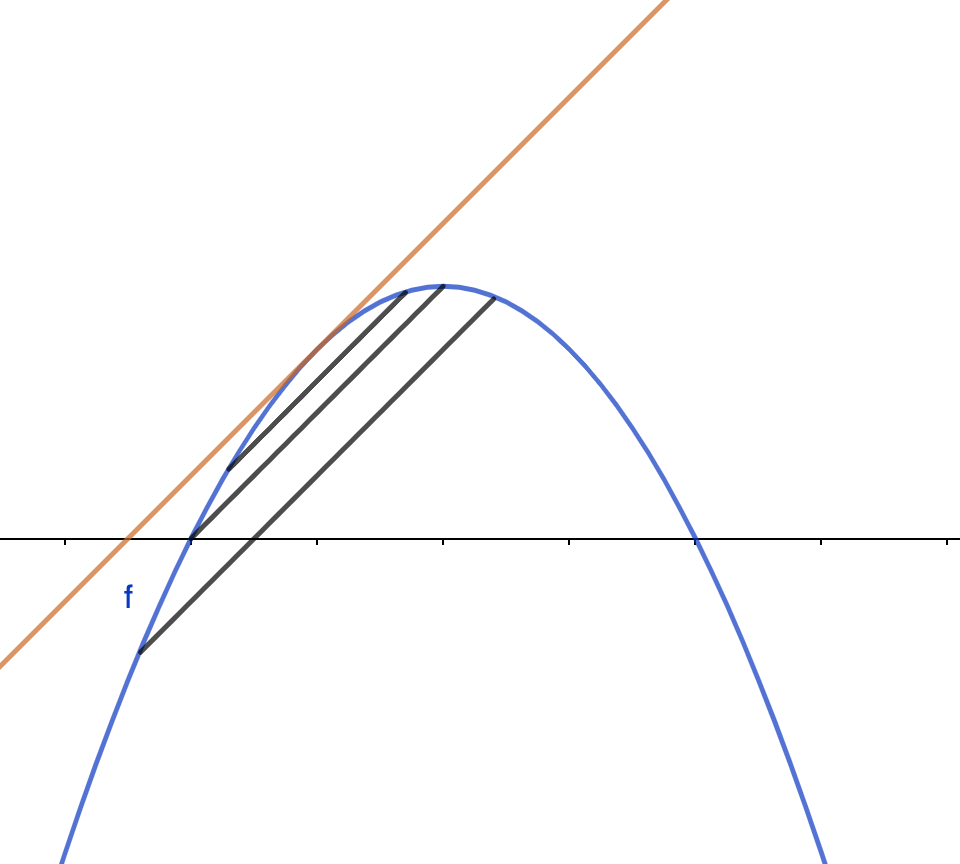

Image illustrating The Limit Definition of a Derivative


The Derivative (At a Point)

The derivative of a function f(x)f(x) at a point x=a,x=a, denoted f′(a)f'(a), is

f′(a)=lim⁡h→0f(a+h)−f(a)h\boxed{f'(a)=\displaystyle\lim_{h\rightarrow0}\frac{f(a+h)-f(a)}{h}}


When this limit exists, we say that the function is differentiable at x=a.x=a.


Note: The derivative f′(a)f'(a) is also denoted dfdx∣x=a\frac{df}{dx}\Bigg|_{x=a}


Create a free account to get started

Unlock full course notes by signing up

  • Video lessons taught by top educators
  • Practice questions with guided solutions
  • Written review notes for reference
  • Expert answers anytime from course tutors

Example: Definition of a Derivative


Using the definition of a derivative, find the derivative of f(x)=x.f(x)=\sqrt{x}.


f′(x)=lim⁡h→0x+h−xh⋅x+h+xx+h+x=lim⁡h→0x+h−xh(x+h+x)=lim⁡h→01x+h+x=12x\begin{array}{ll} f'(x) & =\displaystyle \lim_{h \to 0}\dfrac{\sqrt{x+h}-\sqrt{x}}{h}\cdot\dfrac{\sqrt{x+h}+\sqrt{x}}{\sqrt{x+h}+\sqrt{x}}\\ & =\displaystyle \lim_{h \to 0}\dfrac{x+h-x}{h(\sqrt{x+h}+\sqrt{x})}\\ & =\displaystyle \lim_{h \to 0}\dfrac{1}{\sqrt{x+h}+\sqrt{x}}\\ & =\displaystyle \bf \dfrac{1}{2\sqrt{x}} \end{array}


Using the definition of the derivative, find the derivative of f(x)=(x+2)2+xf(x)=(x+2)^2+x


Create a free account to get started

Unlock full course notes by signing up

  • Video lessons taught by top educators
  • Practice questions with guided solutions
  • Written review notes for reference
  • Expert answers anytime from course tutors

When is Function Not Differentiable?

Here are the 4 cases where a function is not differentiable (i.e. the limit lim⁡h→0f(a+h)−f(a)h\displaystyle\lim_{h\rightarrow0}\frac{f(a+h)-f(a)}{h} does not exist)

  1. If a function is discontinuous at a point, then it is not differentiable at that point:
  2. Jump discontinuity: the function is not differentiable at the jump
Image illustrating When is Function Not Differentiable?


  1. Hole (removable discontinuity): the function is not differentiable at the hole
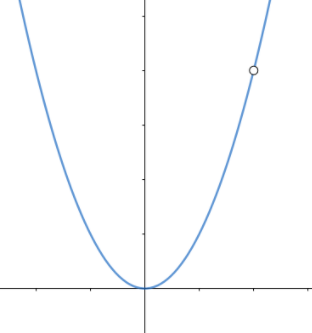
Image illustrating When is Function Not Differentiable?


  1. Vertical asymptote: the function is not differentiable at the x value where the vertical asymptote is
Image illustrating When is Function Not Differentiable?
  1. A function is not differentiable at a corner or cusp: For example, the function f(x)=∣x∣f\left(x\right)=\left|x\right| is not differentiable at x=0x=0
Image illustrating When is Function Not Differentiable?


  1. A function is not differentiable where there is a vertical tangent line: For example, the function f(x)=x13f\left(x\right)=x^{\frac{1}{3}} or x3\sqrt[3]{x} is not differentiable at x=0x=0
Image illustrating When is Function Not Differentiable?


  1. A function is not differentiable if it oscillates back and forth as it approaches a certain point: For example, the function f(x)=sin⁡(1x)f(x)=\sin\left(\dfrac{1}{x}\right) is not differentiable at x=0x=0 because the ff value oscillates back and forth between 1 and -1.
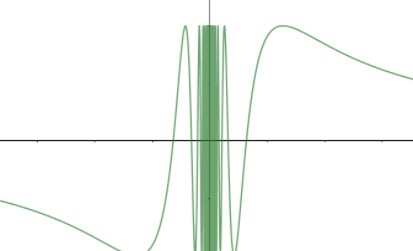
Image illustrating When is Function Not Differentiable?


Checking Differentiability at a Point

A common differentiability question you might see on the exam is that they'll give you a piecewise function f(x)={g(x), x<ah(x), x≥af(x)=\begin{cases} g(x)&,~x<a\\ h(x)&,~x\ge a \end{cases} and ask if the function is differentiable at the connection point x=ax=a. For this function to be differentiable, we need to check that lim⁡h→0−f(a+h)−f(a)h=lim⁡h→0+f(a+h)−f(a)h\displaystyle \lim_{h\to 0^-}\dfrac{f(a+h)-f(a)}{h}=\displaystyle \lim_{h\to 0^+}\dfrac{f(a+h)-f(a)}{h}. However, this can be very time-consuming and hard to do. Instead, we can usually check the two following things:

  1. Check that lim⁡x→a−f(x)=lim⁡x→a+f(x)=f(a)\displaystyle \lim_{x\to a^-}f(x)=\lim_{x\to a^+}f(x)=f(a). Most of the time you can just check if g(a)=h(a)g(a)=h(a) (this is a commonly used trick that only works MOST of the time)
  2. Check that g′(a)=h′(a)g'(a)=h'(a). We can use differentiation rules to find g′(a)g'(a) and h′(a)h'(a) instead of having to evaluate a difficult limit. (See the next few sections to learn about these differentiation rules)

Extra Practice