
F-Test for Equality of Two Variances
Purpose: To test if two population variances are equal.
Assumptions:
- If two populations are normal F-test
- If two populations are not normal Levene’s Test
Hypotheses:
“The two populations variances are equal.”
“The two populations variances are not equal.”
Test Statistic:
Important: The larger sample variance should be put in the numerator, and the smaller sample variance is put in the denominator. This forces the F-test to always be a right-sided test, which makes things a lot easier.
If the variances are equal , then .
The F-test has two degrees of freedom:
P-value method:
- If you are able to solve for the p-value using software, ensure that the p-value is doubled for two-tailed tests.
- In order to reject , the p-value needs to be smaller than the significance level .
Critical value method:
- Without software, use to F-table to find the critical value.
- For two-tailed tests, divide by 2 to find the critical value .
- In order to reject , the test statistic needs to be bigger than the critical value.
Example
“The two populations variances are equal.”
“The two populations variances are not equal.”
Find the critical value.
This is a two-tailed test, so
We will therefore use the 5% F-table.

CV:

Example: F-Test for Equality of Two Variances
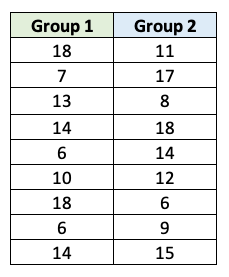
We want to test if the variances in Group 1 and Group 2 are equal or not. Assume both population distributions are normal. The sample standard deviation in Group 1 is and the sample standard deviation in Group 2 is .
Raw data:
(i) State the hypotheses.
“The two populations variances are equal.”
“The two populations variances are not equal.”
(ii) . Find the critical value.
This is a two-tailed test, so
We will therefore use the 5% F-table.
You need the degrees of freedoms first.

Critical value
In order to reject , the test statistic needs to be bigger than the critical value (3.438).
(iii) Find the test statistic.
(iv) Refer to the software output below. Is the evidence that the variances differ?
P-value method:
P-value (0.689) > alpha (0.10) Fail to reject . There is no evidence that the variances differ.
Critical value method:
Test statistic (1.34) < critical value (3.438) Fail to reject . There is no evidence that the variances differ.
Minitab Output:
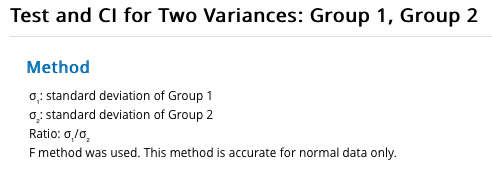
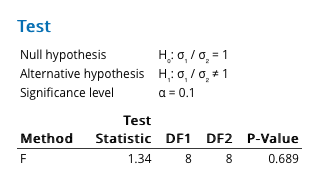
Note: Since this is a two-tailed test, Minitab had doubled the p-value.
Portions of information contained in this publication/book are printed with permission of Minitab, LLC. All such material remains the exclusive property and copyright of Minitab, LLC. All rights reserved.