Wize University Statistics Textbook > Test of Equality of Two Variances
Test of Equality of Two Variances
Popular Courses
Statistics
General Course
Intro to Statistics
University Study Guides
STA 100
University of California - Davis
Intro to Statistics
University Study Guides
STATS 2035
Western University
QMS 210
Toronto Metropolitan University
STAT*2040
University of Guelph
STATS 2B03
McMaster University
COMM 162
Queen's University
ECON 227
McGill University
STA 2391
University of Ottawa
STAT-2910
University of Windsor
Stats 8
Oregon State
STAT 1000
University of Manitoba
STAT 252
University of Victoria
COMM 1503
Dalhousie University
STAT 265
University of Alberta
ADM 2303
University of Ottawa
STAT 202
University of Waterloo
STAT 371
University of Wisconsin - Madison

0:00 / 0:00
Test of Equality of Two Variances
There are many situations when you ask yourself if the two population variances are equal. When comparing two population means, we have to first determine whether to conduct a two-sample pooled/equal variances t-test or a two-sample non-pooled/unequal variances t-test. This depends on whether we can assume equal variances or not.
Inference on Two Means
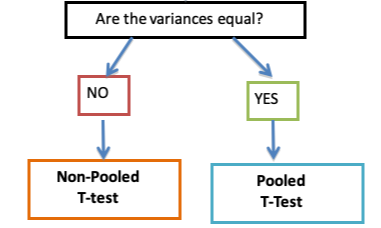
Loosely speaking, it is safe to assume equal variances if the larger sample deviation is no more than twice the smaller standard deviation.
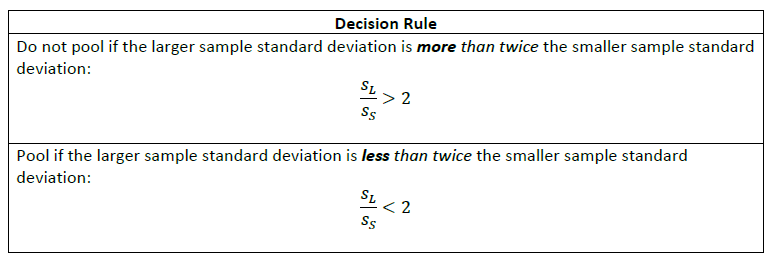
However, there is a formal test to see if the equal variance assumption holds.
Inference on Two Variances
Hypotheses:
(The population variances are equal)
(The population variances are not equal)
After conducting a hypothesis test for the equality of two population variances...
- If you reject conclude that the two population variances are not equal → do the non-pooled/unequal variances t-test
- If you fail to reject conclude that the two population variances are equal → do the pooled/equal variances t-test