Create a free account to get started

Unlock full course notes by signing up

  • Video lessons taught by top educators
  • Practice questions with guided solutions
  • Written review notes for reference
  • Expert answers anytime from course tutors

Energy of An Oscillator


There are two different type of energies related to an oscillation: Kinetic energy and potential energy

  • The kinetic energy is the energy of a moving object:

K =12mv2\boxed{K\ =\frac{1}{2}mv^2}

  • The potential energy is the energy stored in the oscillation. For mass and spring oscillation, it is a potential energy stored inside of the spring due to stretch or compression in the length of the spring:


U =12kx2\boxed{U\ =\frac{1}{2}kx^2}


  • The total energy of the system at any time during SHM is the sum of kinetic energy and potential energy and is constant because of the conservation of energy:


E=K+U=constant\boxed{E=K+U= \text{constant}}


How to Find Total Energy of an Oscillator


We can find total energy of an oscillator using the three following methods:


  1. We can find it directly from its definition if we know position and velocity of the oscillator at any moment.


E=12m(v(t))2+12k(x(t))2\boxed{E=\frac{1}{2}m(v(t))^{2}+\frac{1}{2}k(x(t))^2}


  1. We can find it by looking at the equilibrium point.

At equilibrium: x = 0, and V = Vmax


E=K+U=12mvmax⁡2+0E=K+U=\frac{1}{2}mv_{\max^2}+0


E=12mA2ω2\boxed{E=\frac{1}{2}mA^2\omega^2}

  1. We can find it by looking at turning points.

At turning points: x=±Ax=\pm A and V=0


E =K+U=0+ 12kA2E\ =K+U=0+\ \frac{1}{2}kA^2


E=12kA2\boxed{E=\frac{1}{2}kA^2}


Create a free account to get started

Unlock full course notes by signing up

  • Video lessons taught by top educators
  • Practice questions with guided solutions
  • Written review notes for reference
  • Expert answers anytime from course tutors

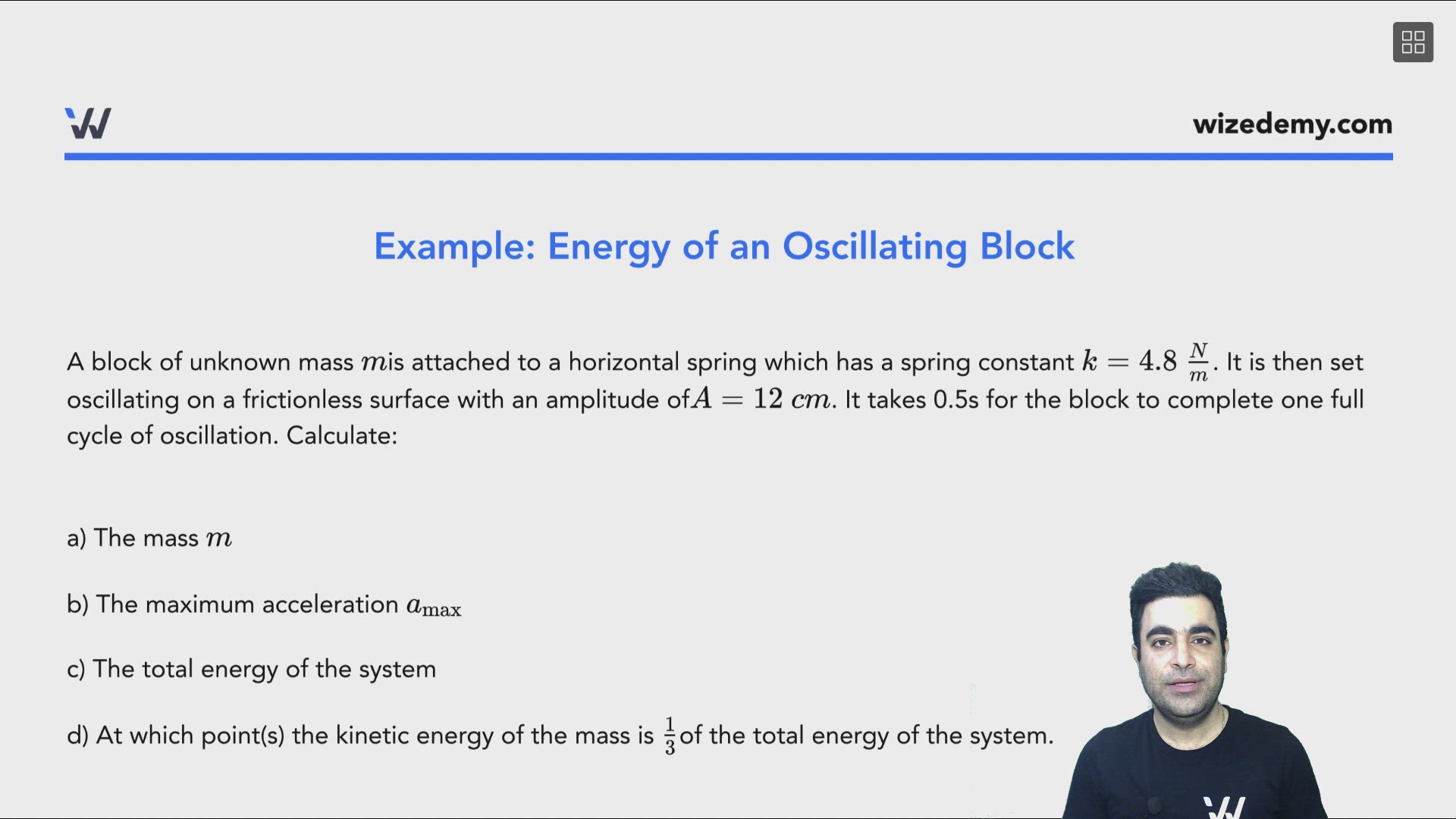
Example: Energy of an Oscillating Block


A block of unknown mass mmis attached to a horizontal spring which has a spring constant k=4.8 Nmk=4.8\ \frac{N}{m}. It is then set oscillating on a frictionless surface with an amplitude ofA=12 cmA=12\ cm. It takes 0.5s for the block to complete one full cycle of oscillation. Calculate:


a) The mass mm

b) The maximum acceleration amax⁡a_{\max}

c) The total energy of the system

d) At which point(s) the kinetic energy of the mass is 13\frac{1}{3}of the total energy of the system.


Solution:


Part a)


ω=2πT=2π0.5=12.567  rads\omega=\dfrac{2\pi}{T}=\dfrac{2\pi}{0.5}=12.567 \ \ \frac{rad}{s}


ω=km⇒m=kω2=0.0304 kg\omega=\sqrt{\frac{k}{m}}\Rightarrow m=\dfrac{k}{\omega^2}=0.0304\ kg


Part b)


amax⁡=Aω2=0.12(12.567)2=18.95 m/s2a_{\max}=A\omega^2=0.12\left(12.567\right)^2=18.95\ m/s^2


Part c)


E=12kA2=12(4.8)(0.12)2=0.0346 JE=\frac{1}{2}kA^2=\frac{1}{2}(4.8)(0.12)^2=0.0346 \ J


Part d)


{K=13E⇒23E=U=12kx2K+U=E\left\{\begin{array}{l}K=\frac{1}{3}E\Rightarrow\frac{2}{3}E=U=\frac{1}{2}kx^2\\K+U=E\end{array}\right.


⇒x2=43Ek=0.0096⇒x=±0.098 m \Rightarrow x^2=\dfrac{4}{3}\dfrac{E}{k}=0.0096\Rightarrow x=\pm0.098\ m\


A simple mass mm on a spring with spring constant kk oscillates about its equilibrium with amplitude AA. If the energy of the system suddenly decreases to half of the initial value, what will be the mass' new maximum speed?

Choose an answer

Create a free account to get started

Unlock full course notes by signing up

  • Video lessons taught by top educators
  • Practice questions with guided solutions
  • Written review notes for reference
  • Expert answers anytime from course tutors

Extra Practice