Wize University Physics Textbook (Master) > Periodic Motion: Oscillations
Finding the Phase Constant
Popular Courses
Intro to Physics
University Study Guides
PHYSICS 1D03
McMaster University
AP Physics C: Mechanics Exam Prep Course
AP Exam Prep
Physics
General Course
PHYS 157
University of British Columbia
PHYS 131
University of British Columbia
PHYS 204
Concordia University
PHYS*1300
University of Guelph
Intro to Physics
University Study Guides
PHYS 131
McGill University
PHYSICS 1402A/B
Western University
LE/PHYS 1800 3.00
York University
PHYS-1400
University of Windsor
PHYS 142
McGill University
PHYS 117
University of British Columbia
PHYC 1190
Dalhousie University
ENGG 212
University of Calgary
PHYS 111
University of Victoria
PHYS 1050
University of Manitoba
PHYS 101
Simon Fraser University

0:00 / 0:00
Finding the Phase Constant
It is sometimes tricky to find the phase constant of an oscillation. There are many different ways to find the phase constant. Here we will see how we can use the information given to us in a problem to find the phase constant.
As a reference, let's consider the following formulas for displacement, velocity and acceleration of an oscillator:
Wize Concept
Here is the general recipe to find the phase constant from position, velocity or acceleration graphs:
- Use the information at time equal to zero to find two possible solutions for the phase constant by using the above equations.
- Use the slope of tangent line to the curve at the same moment to pick the right angle.
To understand above recipe let's look at three different situations. But before that we need a quick review of trigonometric circle (unit circle):
Quick Review of Trigonometry
In the unit circle, and


Finding the Phase Constant from graph
Example:
Finding the Phase Constant from graph
Example:
Finding the Phase Constant from graph
Example:

0:00 / 0:00
Example: Drawing Position Graph From Velocity Graph
The velocity () vs. time () of a mass-spring on a SHM is shown in the graph.
Find the equation representing position against time, and draw that graph.

Solution:
from the plot!
(for example from to )
The last thing we need to find is the phase constant:
This gives us two possible answers (61 degrees or 119 degrees). Which is it?
To figure that out, we will look at the acceleration function:
We know the acceleration at t=0 is negative from the graph (slope of the tangent tine to at is negative!)
Only the 61 degree answer satisfies this condition.
So, we can now plot
Note: We need to convert the 61 degrees to 1.06 radians because the "2t" is also in radians. (The 2 is in radians per second.)
The plot below is in seconds on the horizontal axis.
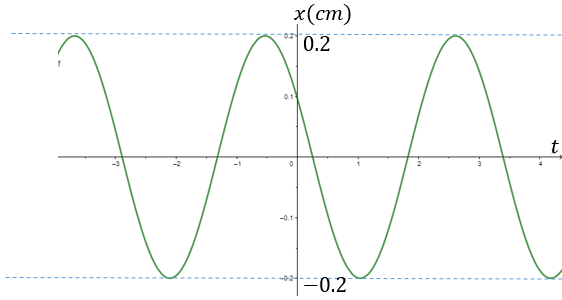
The displacement graph of a simple harmonic motion over time is shown below. Write the equation for displacement as a function of time.
