Create a free account to get started

Unlock full course notes by signing up

  • Video lessons taught by top educators
  • Practice questions with guided solutions
  • Written review notes for reference
  • Expert answers anytime from course tutors

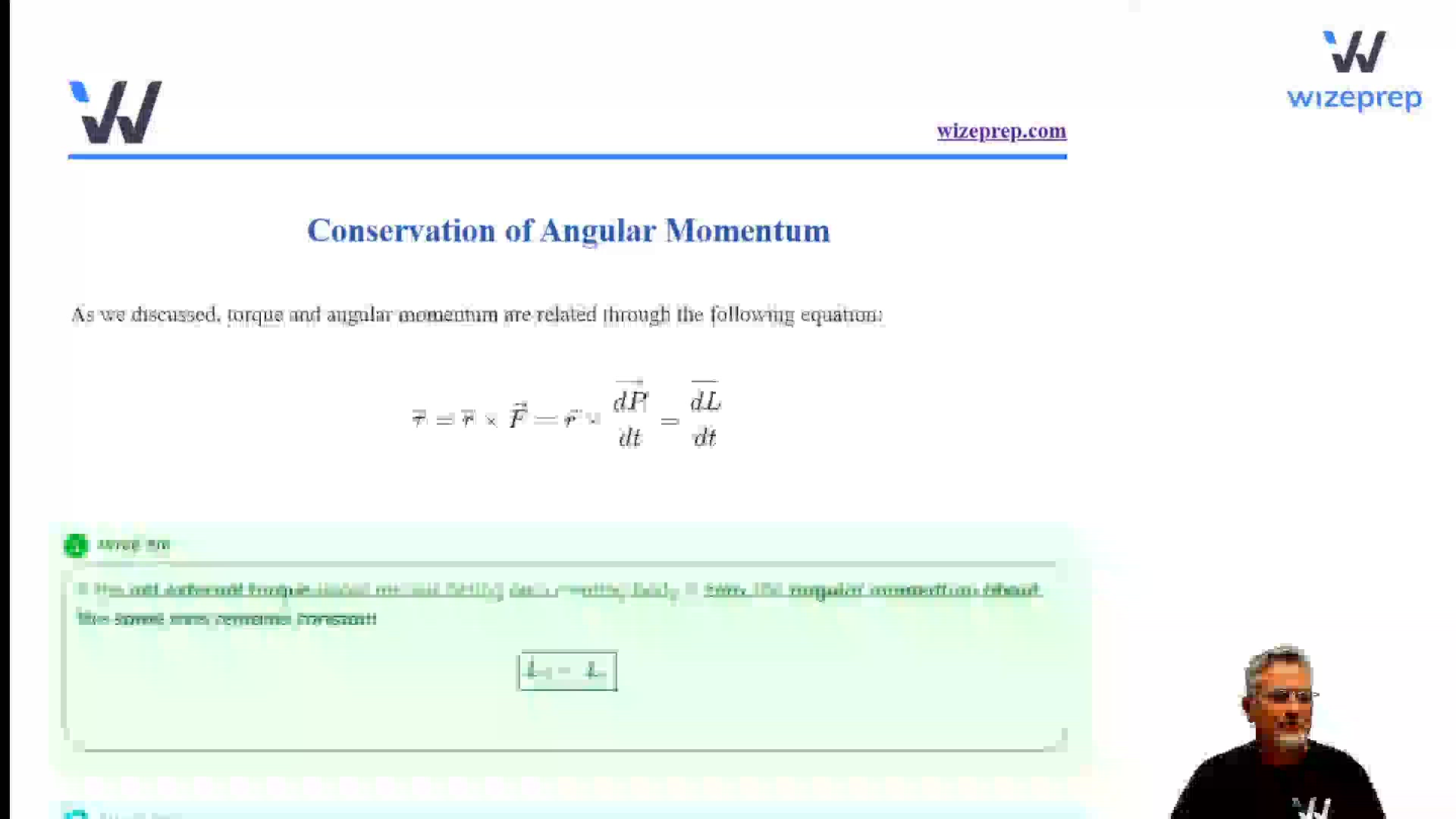
Conservation of Angular Momentum


As we discussed, torque and angular momentum are related through the following equation:


τ⃗=r⃗×F⃗=r⃗×dP⟶dt=dL⟶dt\vec\tau=\vec r\times \vec F=\vec r\times\frac{\stackrel{\longrightarrow}{dP}}{dt}=\frac{\stackrel{\longrightarrow}{dL}}{dt}


Example: Angular Momentum Conservation


In an isolated system, the moment of inertia of a rotating object is halved. What happens to the angular velocity of the object?

A. It is quartered.

B. It is halved.

C. It remains the same.

D. It is doubled.

E.It is quadrupled.


Solution: In an isolated system, there is no net torque. If there is no net torque on the system, then the total angular momentum of the system remains the same.

L=Iω


Therefore, if the moment of inertia, I, is halved, then for the angular momentum, L, to remain constant, the angular velocity, ω, must be doubled.


You're sitting on a rotating stool, initially rotating at 3.0 radians per second. You're holding a 5.0 kg dumbbell very close to you, 0.05 meters away from your center of rotation. You then extend your arms 1.0 meters away from you with the dumbbell. The moment of inertia of you and the stool is 4.0 kg m2. Neglect the mass of your arms and any rotational friction in the seat. What is your new angular velocity?


Choose an answer

Create a free account to get started

Unlock full course notes by signing up

  • Video lessons taught by top educators
  • Practice questions with guided solutions
  • Written review notes for reference
  • Expert answers anytime from course tutors

Extra Practice