Magnetic Force
- An electric charge moving in a magnetic field experiences a force whose direction is perpendicular to its velocity and magnetic field direction.
Where is angle between V and B
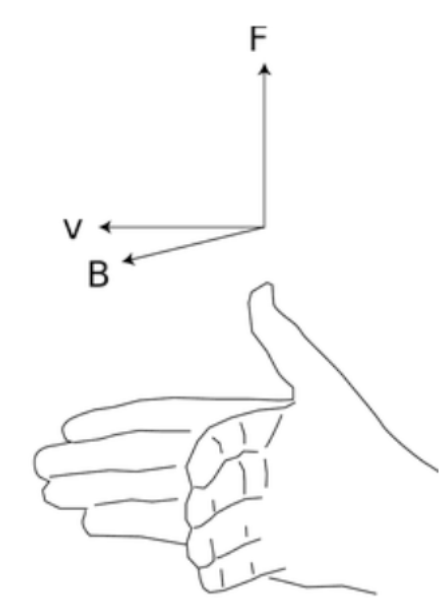
- Direction of force can be found by using right hand rule.
Right Hand Rule is designed for positive charges. If charge is negative, direction of the force will be opposite of what right hand rule gives.
Right Hand Rule for Magnetic Force:
Notes
- If v and B are parallel, then force is ZERO.
- If v and B are perpendicular, then F = qvB.
- Uncharged particles do not deviate in magnetic field
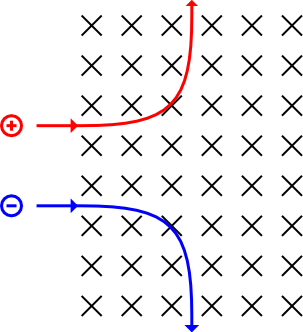
The charged particles are deflected in a curve when entering a region of constant magnetic field.
Acceleration in magnetic field
- Acceleration due to magnetic force is perpendicular to the direction of the velocity. Therefore, it changes the direction of the velocity vector however the speed remains constant.
- The charge particle will undergo uniform circular motion in a uniform magnetic field.
- The centripetal acceleration is: ac = v2/R
- The radius of rotation is: R = mv/qB
- If there is both electric field and magnetic fields present in space, the force on the particle could be found using Lorentz force:
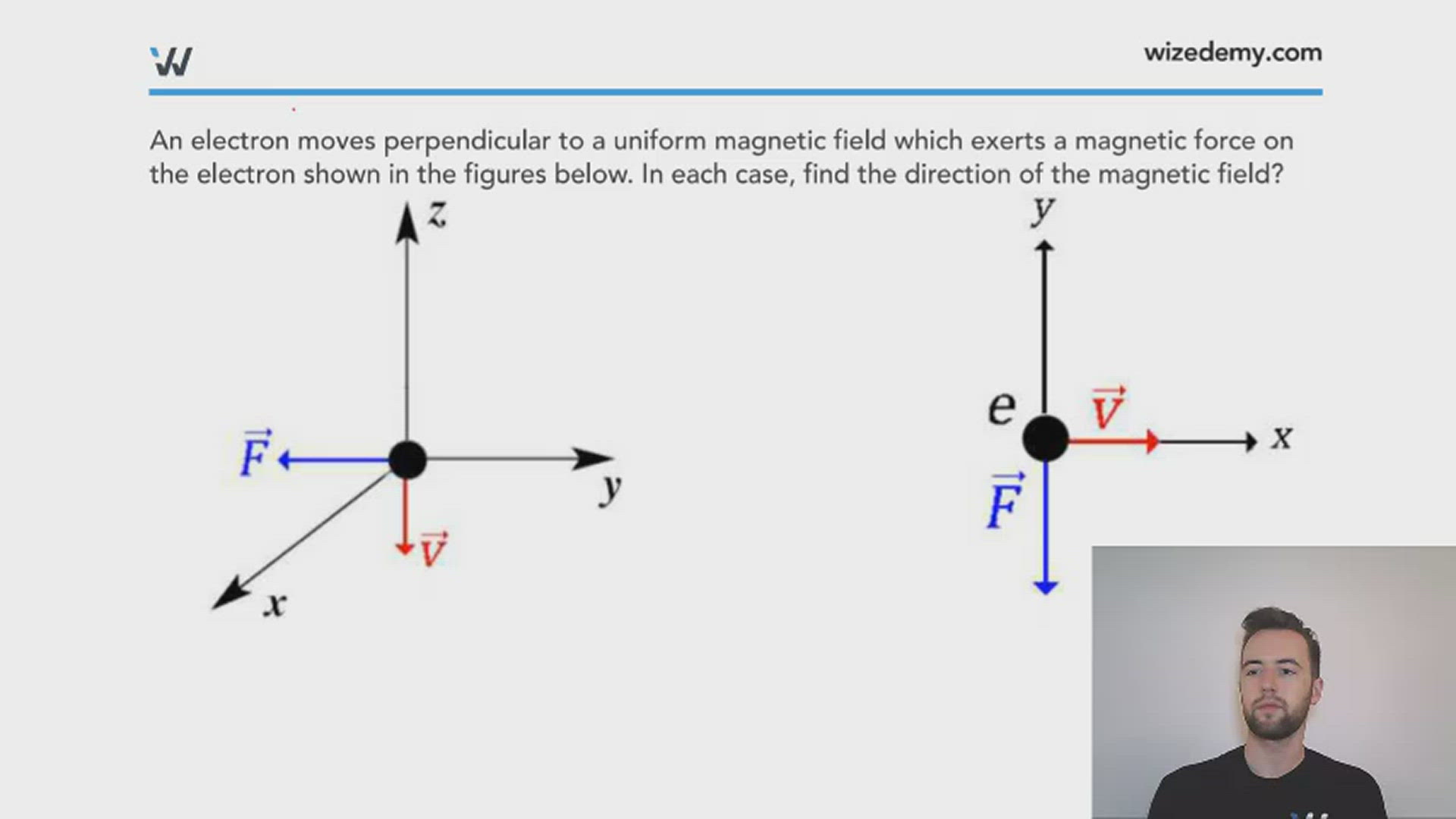
An electron moves perpendicular to a uniform magnetic field which exerts a magnetic force on the electron shown in the figures below. In each case, find the direction of the magnetic field?
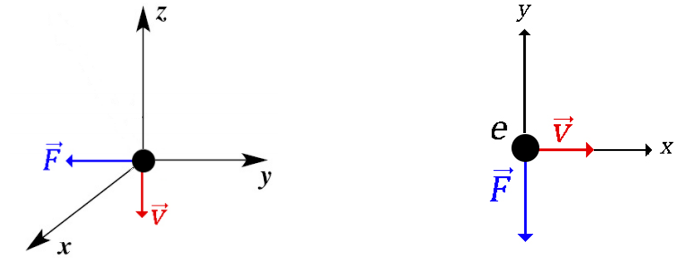
For the diagram on left side:
Right hand rule (RHR) for positive charge is
If the charge is negative, the final answer should be flipped.
Thus, if this was a positive charge, the F would have been along +Y axis. This mean, RHR indicated that B must be into the page or -X axis.
For the diagram on right side:
Right hand rule (RHR) for positive charge is
If the charge is negative, the final answer should be flipped.
Thus, if this was a positive charge, the F would have been along +Y axis. This mean, RHR indicated that B must be into the page or -Z axis.
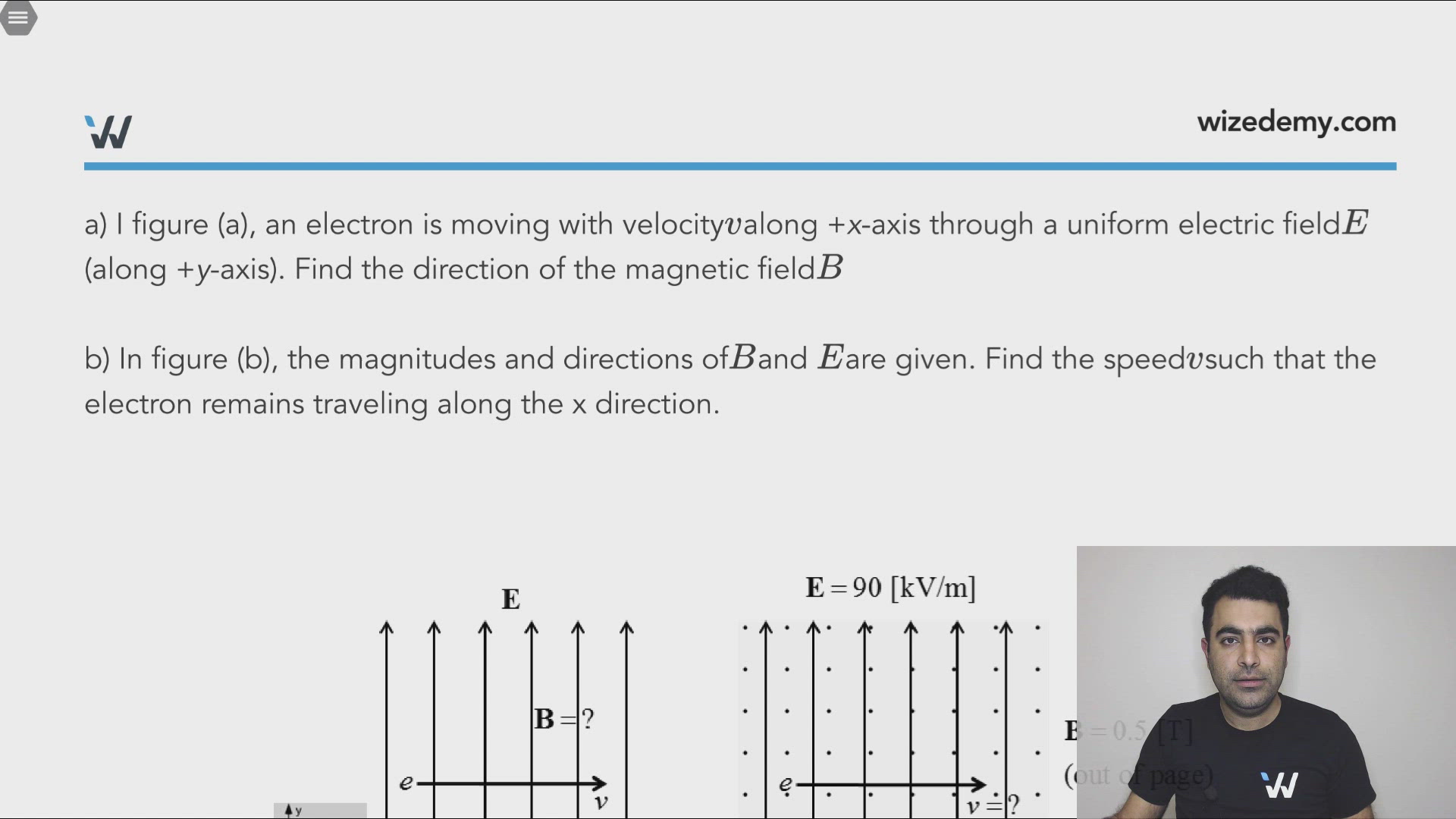
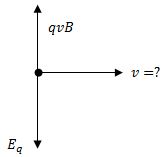
a) I figure (a), an electron is moving with velocityalong +x-axis through a uniform electric field(along +y-axis). Find the direction of the magnetic field
b) In figure (b), the magnitudes and directions ofand are given. Find the speedsuch that the electron remains traveling along the x direction.
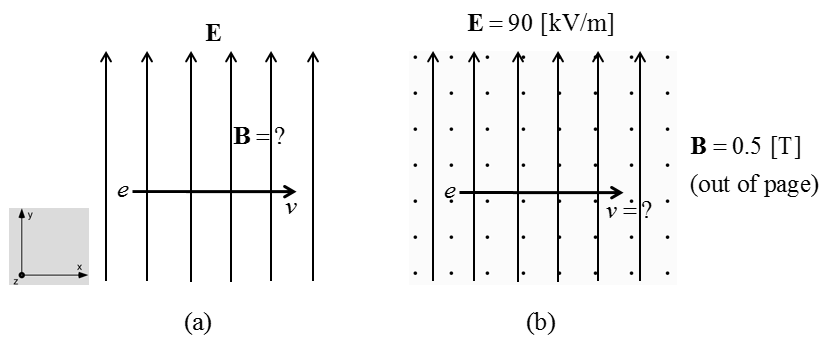
Solution:
a) is downward
should be upward to have is outward!
b)