Popular Courses
MCAT
General Course
Intro to Physics
University Study Guides
Physics
General Course
PHYS 211
University of Calgary
PHYS*1300
University of Guelph
Intro to Physics
University Study Guides
PHY 1321
University of Ottawa
PCS 120
Toronto Metropolitan University
PHYS 110
University of Victoria
LE/PHYS 1800 3.00
York University
PHY 1331
University of Ottawa
PHYS 142
McGill University
PHYS 117
University of British Columbia
ENGG 212
University of Calgary
PHYS 1050
University of Manitoba
PHYS 101
Simon Fraser University
PHYS-1300
University of Windsor
PHY 1121
University of Ottawa
PHYS 121
University of Waterloo
PHYC 1310
Dalhousie University
0:00 / 0:00
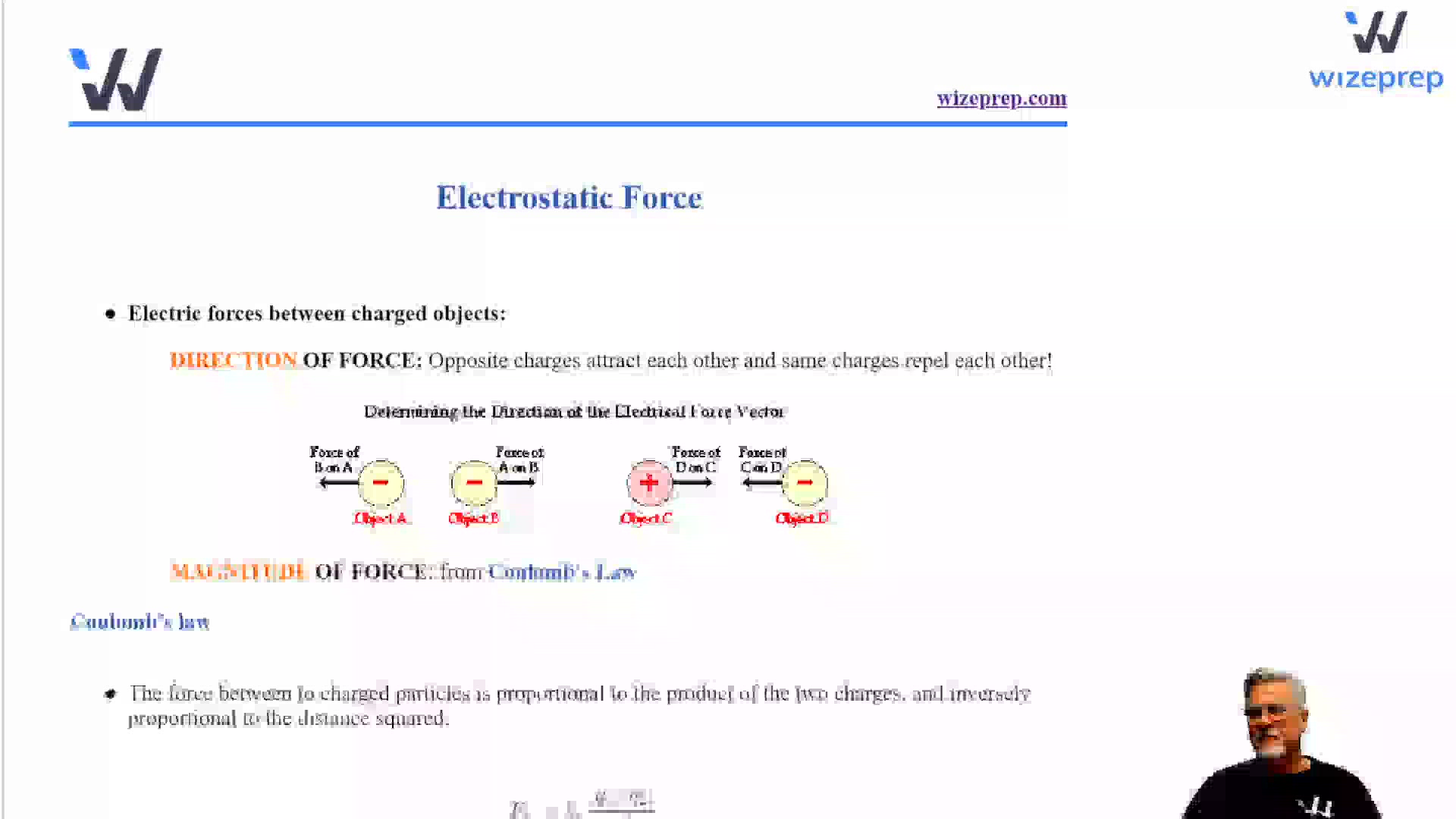
Electrostatic Force
- Electric forces between charged objects:
DIRECTION OF FORCE: Opposite charges attract each other and same charges repel each other!
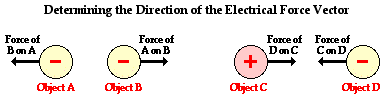
MAGNITUDE OF FORCE: from Coulomb's Law
Coulomb’s law
- The force between to charged particles is proportional to the product of the two charges, and inversely proportional to the distance squared.
where q1 and q2 correspond to the two charges, and ke is a proportionality constant equal to 8.99 x 10⁹ N*m2*C-2.
- Note that this equation only gives the magnitude of the force, hence the absolute values on the charges (so that the result is positive).
- The direction of the force is determined by drawing a line joining both charges, and then deciding whether the force is attractive or repulsive. Then, the force is drawn accordingly along that line.
- The superposition principle states that if there are more than two charged objects, the total force on one of these is obtained by calculating each individual force on that object (by taking the charges two by two) and then adding all the forces together.
Electric Field
A charged particle with charge q, creates an electric field in their surrounding space.
- The electric field is a vector field: for each point in space, you can define a vector quantity corresponding to that field.
- It will have a magnitude and a direction.
- The magnitude of the electric field created by a single point charge q is given by this formula:
- As for the direction of the electric field, it is radial, but we use the following convention: it comes out of a positive charge, and goes into a negative charge
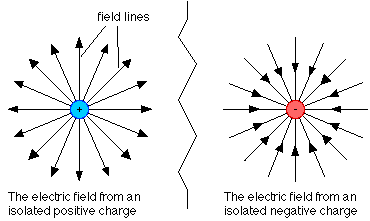
- If we introduce a test charged particle with charge qo in the region with an electric field, an electrostatic force (Fe) will be exerted on the test particle due to the presence of the electric field.
- Electric force is radial, meaning that it acts along the line joining two charges.
- The force on a positive test charge particle is in the same direction of the electric field and the force on a negative charge particle is opposite the electric field direction.
0:00 / 0:00
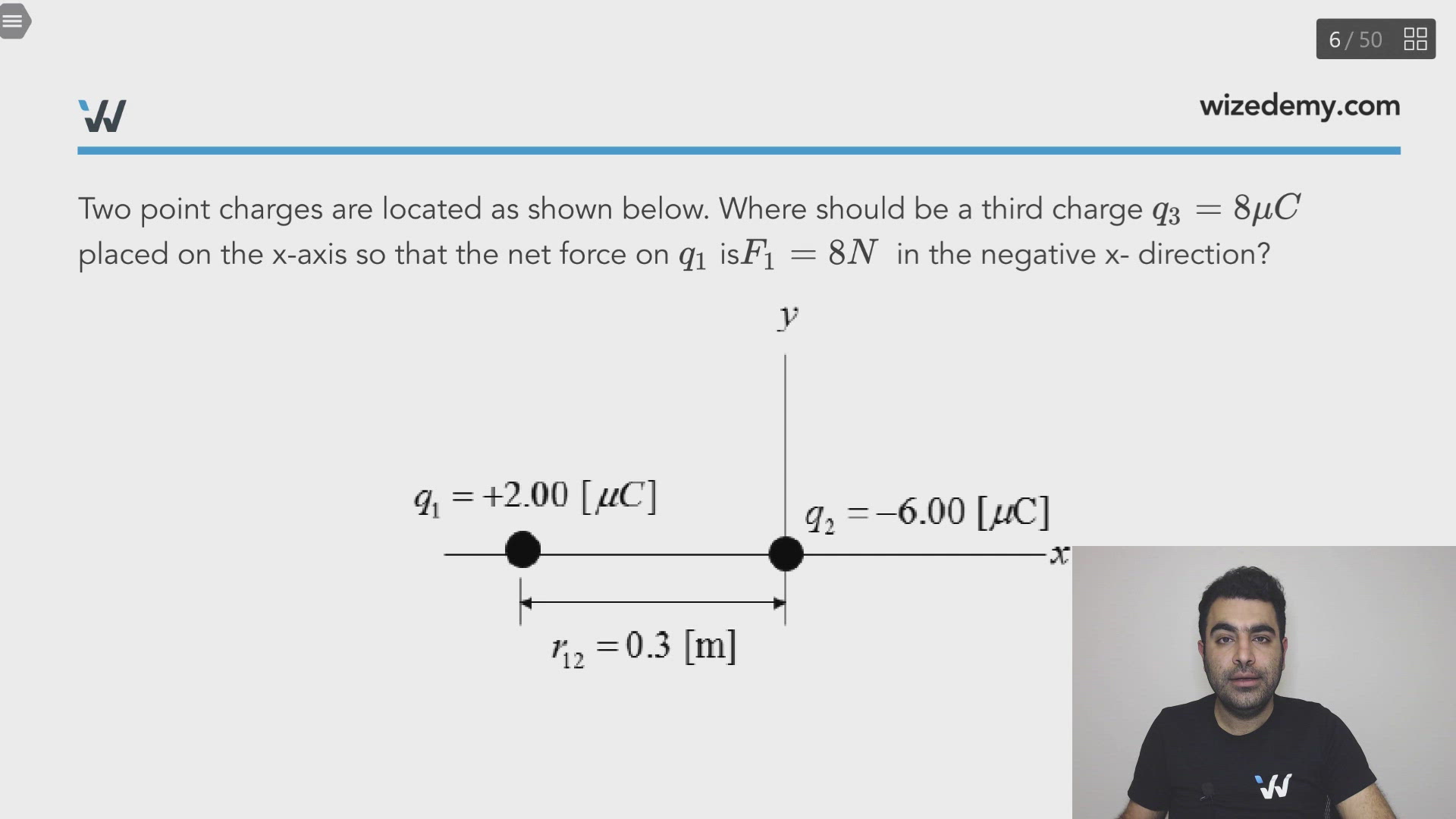
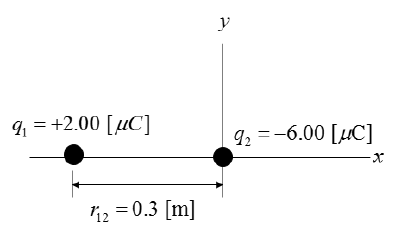
Two point charges are located as shown below. Where should be a third charge placed on the x-axis so that the net force on is in the negative x- direction?
Solution:
Since on , is toward negative x and is a positive charge , should be on the right of !
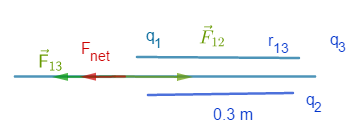
on the right of
A charged ball is placed 1m away from a sphere with a +1nC charge. How far away from a sphere with a +4nC charge would it have to be placed to be subjected to the same force?