Popular Courses
MCAT
General Course
Intro to Physics
University Study Guides
Physics
General Course
PHYS 211
University of Calgary
PHYS*1300
University of Guelph
Intro to Physics
University Study Guides
PHY 1321
University of Ottawa
PHYS 110
University of Victoria
LE/PHYS 1800 3.00
York University
PHY 1331
University of Ottawa
PHYS 142
McGill University
PHYS 117
University of British Columbia
ENGG 212
University of Calgary
PHYS 1050
University of Manitoba
PHYS 101
Simon Fraser University
PHYS-1300
University of Windsor
PHY 1121
University of Ottawa
PHYS 121
University of Waterloo
PHYC 1310
Dalhousie University
PHYS 227
University of Calgary
0:00 / 0:00
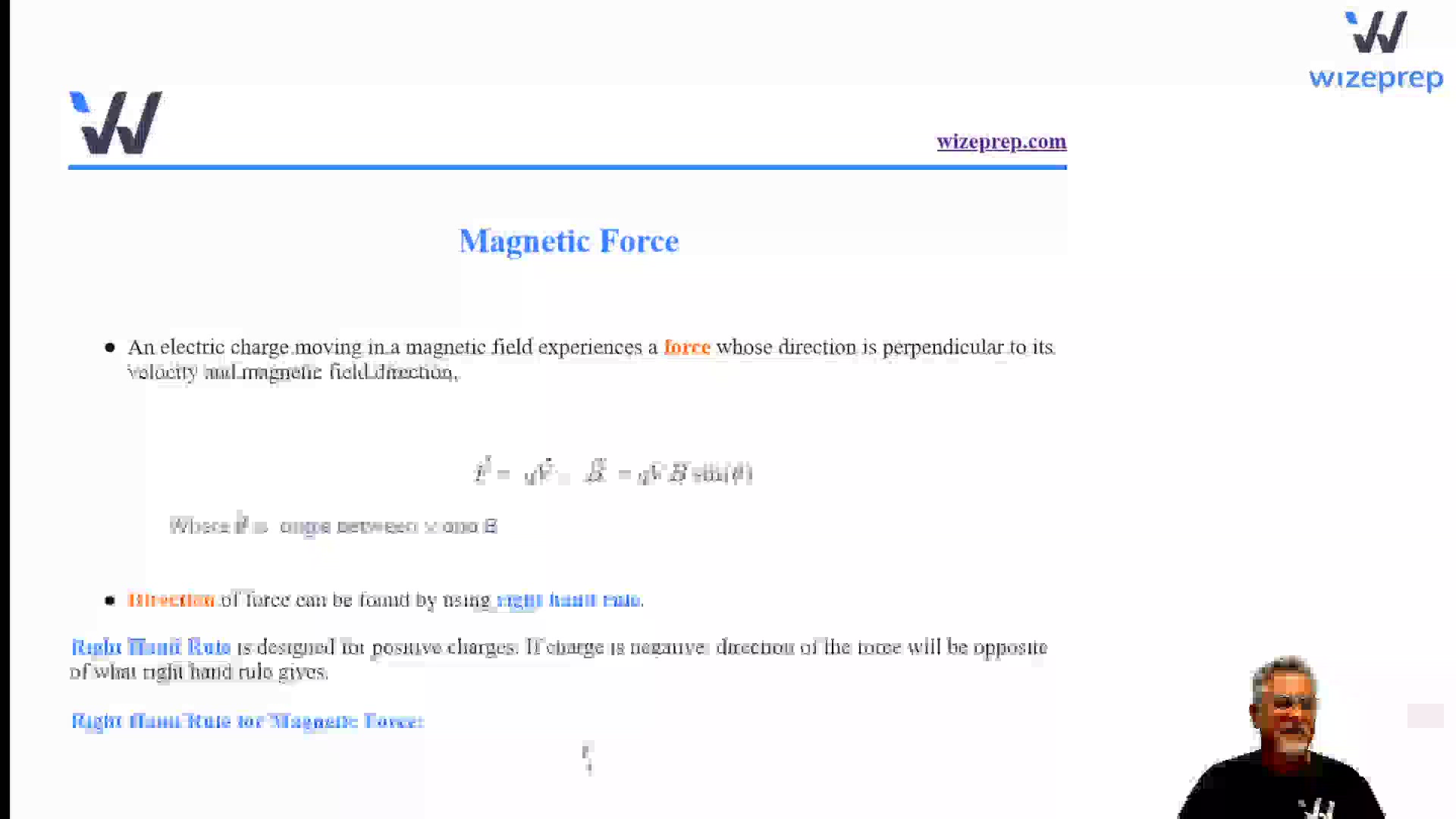
Magnetic Force
- An electric charge moving in a magnetic field experiences a force whose direction is perpendicular to its velocity and magnetic field direction.
Where is angle between V and B
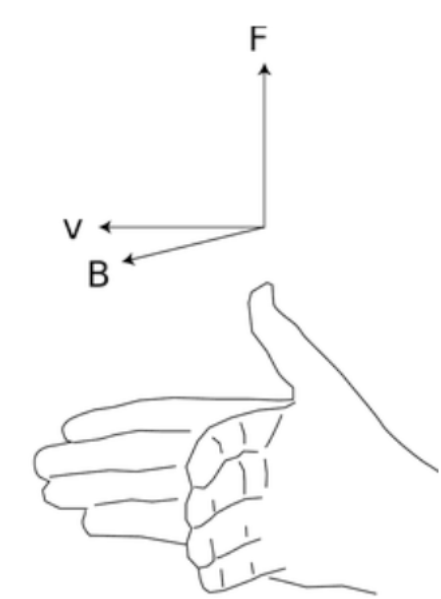
- Direction of force can be found by using right hand rule.
Right Hand Rule is designed for positive charges. If charge is negative, direction of the force will be opposite of what right hand rule gives.
Right Hand Rule for Magnetic Force:
Notes
- If v and B are parallel, then force is ZERO.
- If v and B are perpendicular, then F = qvB.
- Uncharged particles do not deviate in magnetic field
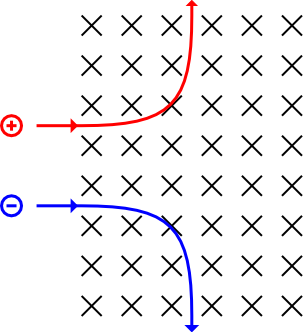
The charged particles are deflected in a curve when entering a region of constant magnetic field.
Acceleration in magnetic field
- Acceleration due to magnetic force is perpendicular to the direction of the velocity. Therefore, it changes the direction of the velocity vector however the speed remains constant.
- The charge particle will undergo uniform circular motion in a uniform magnetic field.
- The centripetal acceleration is: ac = v2/R
- The radius of rotation is: R = mv/qB
- If there is both electric field and magnetic fields present in space, the force on the particle could be found using Lorentz force:
0:00 / 0:00
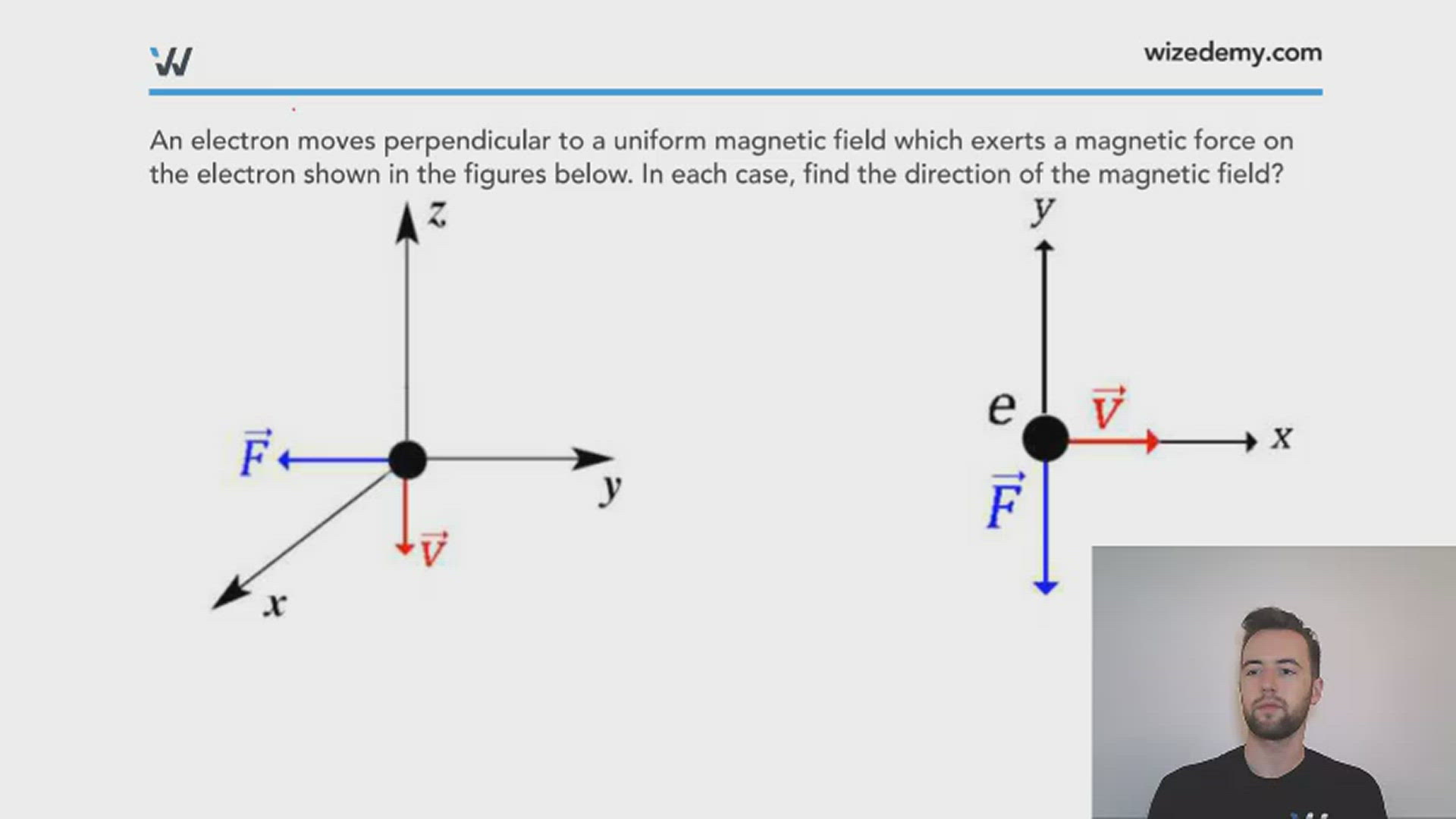
An electron moves perpendicular to a uniform magnetic field which exerts a magnetic force on the electron shown in the figures below. In each case, find the direction of the magnetic field?
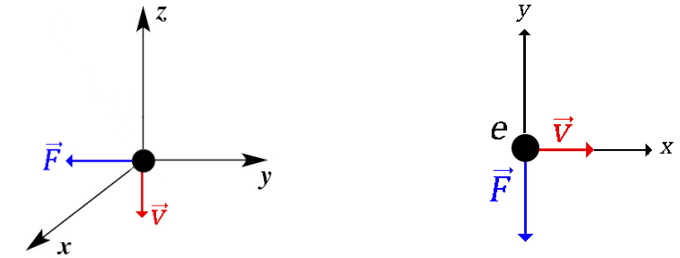
For the diagram on left side:
Right hand rule (RHR) for positive charge is
If the charge is negative, the final answer should be flipped.
Thus, if this was a positive charge, the F would have been along +Y axis. This mean, RHR indicated that B must be into the page or -X axis.
For the diagram on right side:
Right hand rule (RHR) for positive charge is
If the charge is negative, the final answer should be flipped.
Thus, if this was a positive charge, the F would have been along +Y axis. This mean, RHR indicated that B must be into the page or -Z axis.
0:00 / 0:00
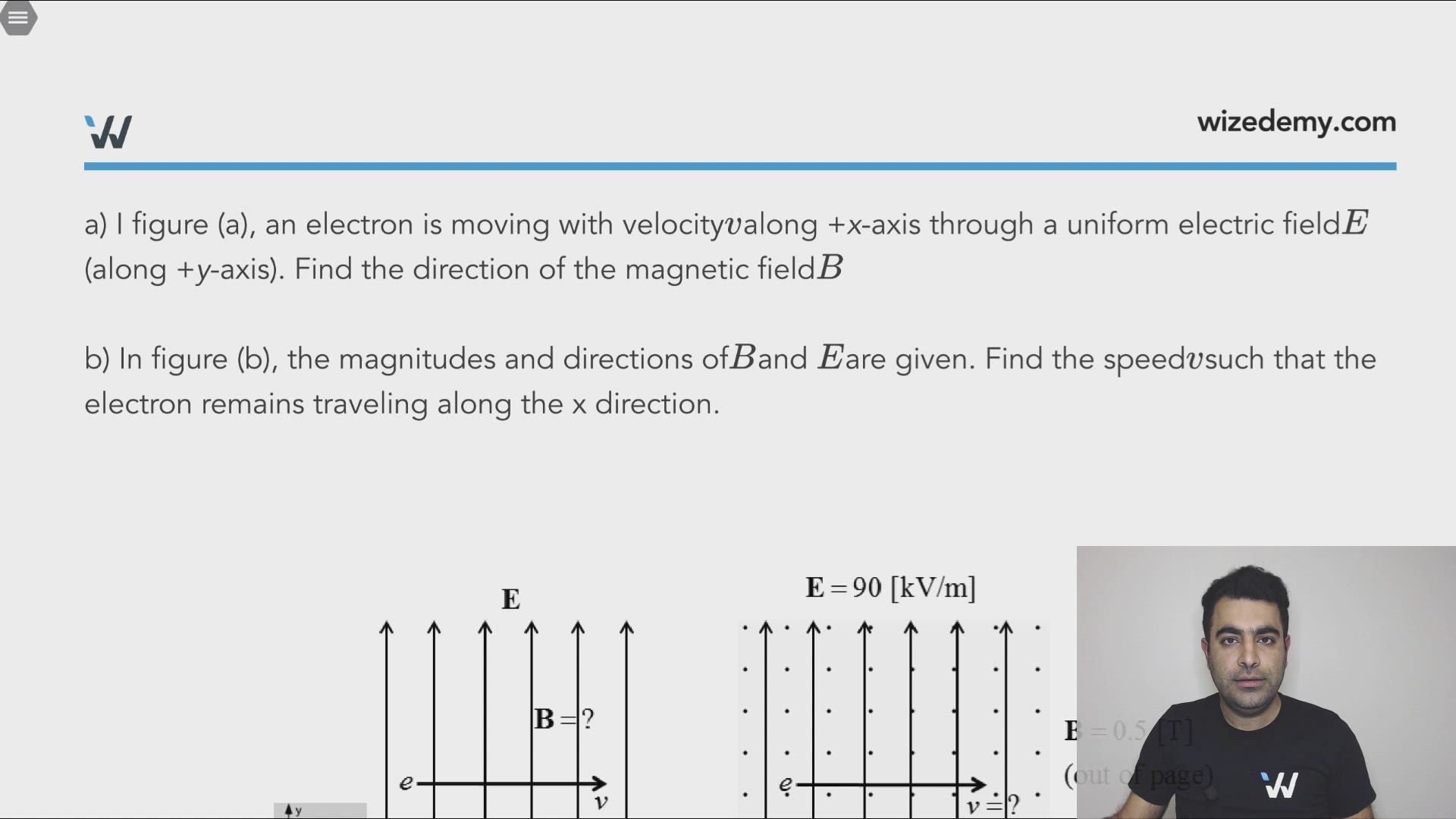
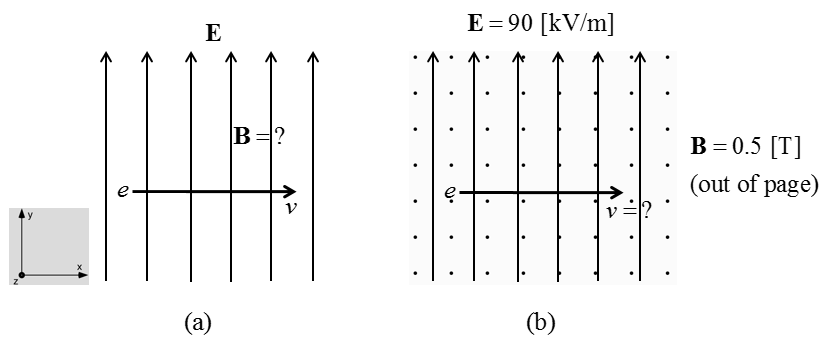
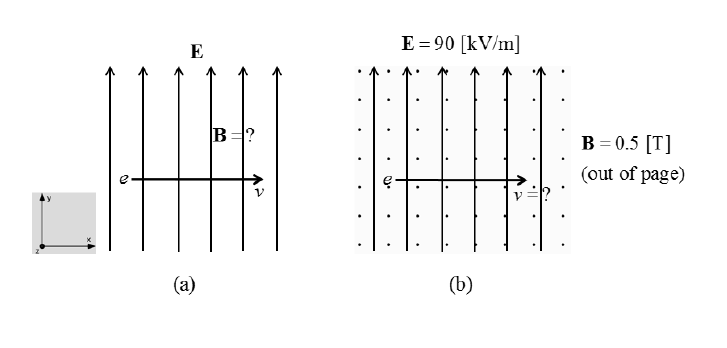
a) I figure (a), an electron is moving with velocityalong +x-axis through a uniform electric field(along +y-axis). Find the direction of the magnetic field
b) In figure (b), the magnitudes and directions ofand are given. Find the speedsuch that the electron remains traveling along the x direction.
Solution:
a) is downward
should be upward to have is outward!
b)
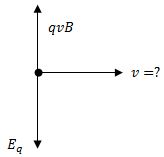
- In figure (a), an electron is moving with velocity along +x-axis through uniform electric and magnetic fields. Find the direction of the magnetic field.
- In figure (b), the magnitudes and directions of are given. Find the speed such that the electron remains traveling along the x direction.
- Now imagine the electric field is turned off. Suppose the electron moves at a speed of and the magnetic field is . What is the radius of the circular path of the electron?
- What happens if there is a proton instead of electron in figure (b)? (Qualitative answer only, no calculations.)
Direction of magnetic field in left figure
Practice: Magnetic Field of Current-Carrying Wires
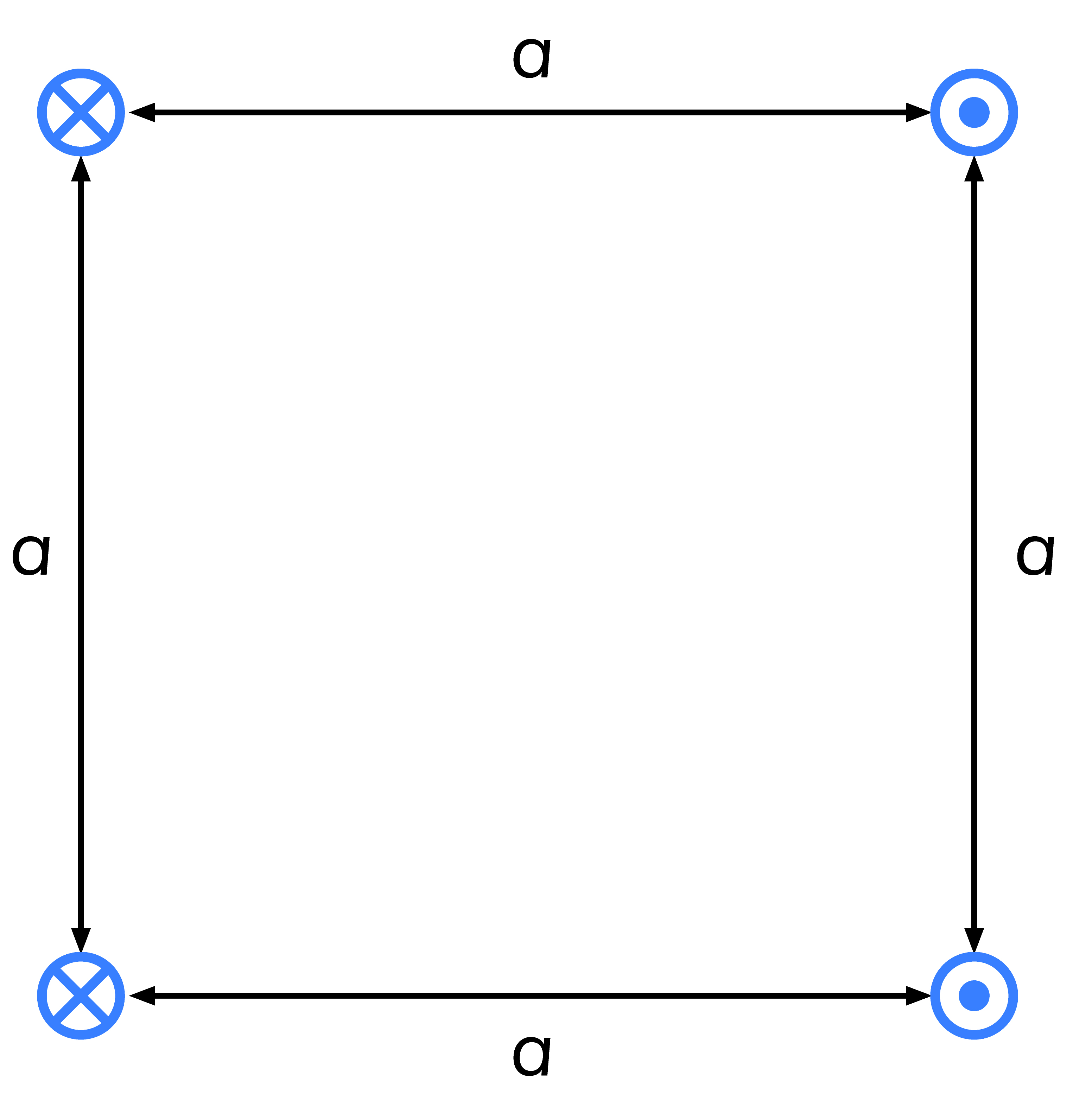
Four straight wires, sitting at each corner of a square, are carrying equal electric currents I perpendicular to the page, as shown below.
a) Find the direction of net magnetic field at the center of square.
b) What is the expression for the magnitude of magnetic field at the center of the square?
Part a)
A positively charged particle of 2.01 x 10⁻⁵ C and mass 7.52 x 10⁻¹⁶ kg is travelling at a velocity of 2.0 x 10² m/s in the positive horizontal direction. It enters a uniform magnetic field of 1.50 T which is pointing upward.
- How much is the force on the particle as it enters the magnetic field?
- The particle starts to move in a circular path. Find the radius of this circular path.