
Magnetic Flux
Magnetic flux measures how many magnetic field lines pass through a surface. It is key to understanding electromagnetic induction.
- Consider a constant magnetic field passing through a flat area .

- The magnetic flux through the surface is given by the following equation, where is the angle between the magnetic field and area vectors:
- The SI unit for magnetic flux is the Weber.

Example: Magnetic Flux
A box is oriented as shown in the diagram below. There is a uniform magnetic field of pointing parallel to the positive z-axis.
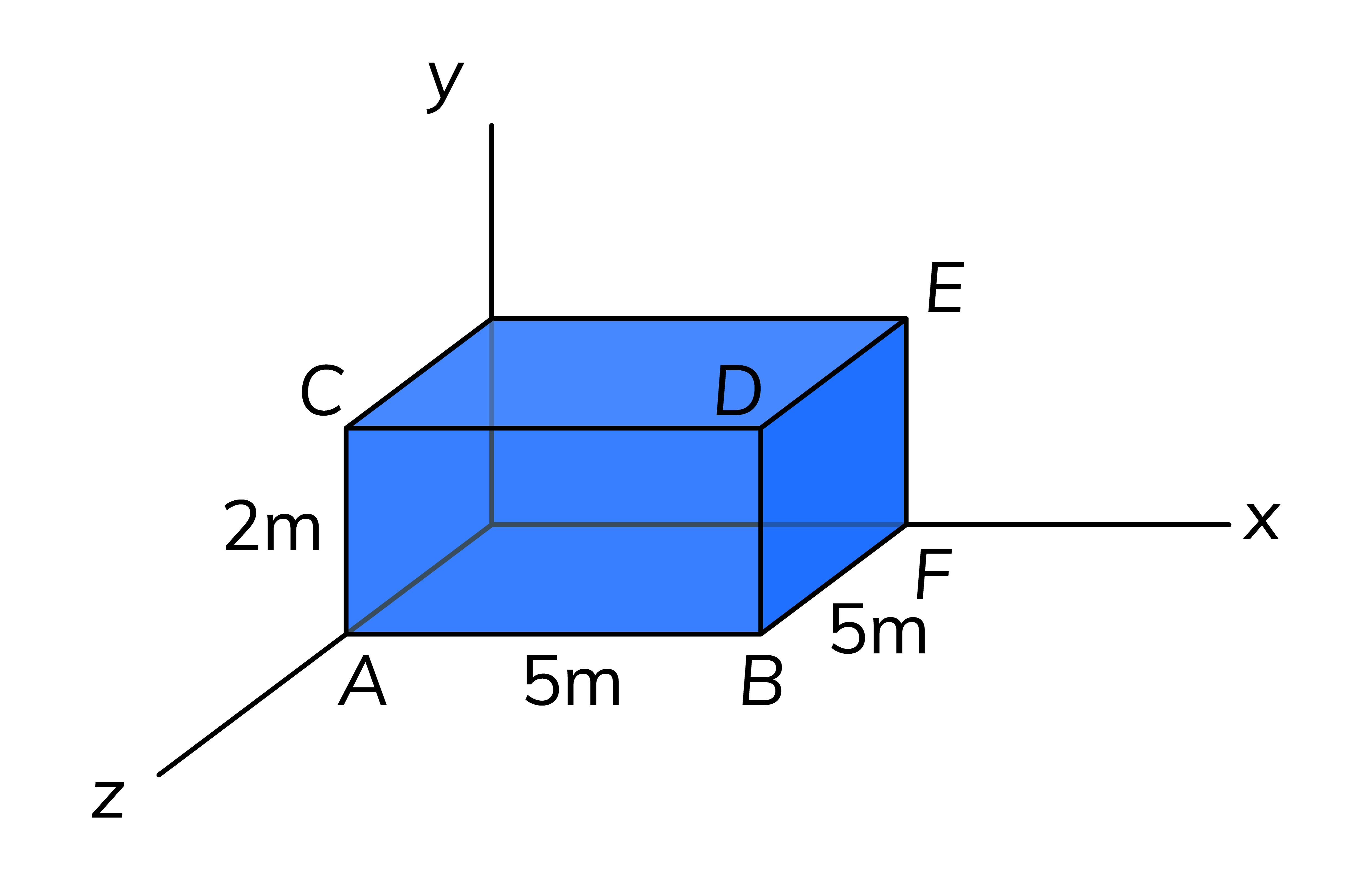
a) Find the magnetic flux across the surface ABDC.
b) Find the magnetic flux across the surface BDEF.
c) Find the total magnetic flux through the box.
Part a)
The surface ABDC has an area vector that points in the positive z-direction, which is the same direction as the magnetic field. Therefore, the dot product reduces to a simple multiplication.
Part b)
The surface BDEF has an area vector that points in the positive y-direction, which is perpendicular to the magnetic field. Therefore, the magnetic flux is zero ().
Part c)
For all closed surfaces (such as this box!), the total magnetic flux passing through it is zero!
If we wanted to be more detailed, we could see that the flux through four of the surfaces is zero (the area vector is perpendicular to the field direction), and the flux passing through the top surface would be equal and opposite to our result from Part (a) (). So the flux would be given as: +3 + 0 + 0 + 0 + 0 - 3 = 0 Wb.

Magnetic Flux (with calculus)
A bit more effort is required to find the magnetic flux in some scenarios.
- The full equation for magnetic flux is given by the following equation:
- For example, this integral must be used if the magnetic field is not uniform, or if the surface is curved.