Satellites and Objects in Orbits
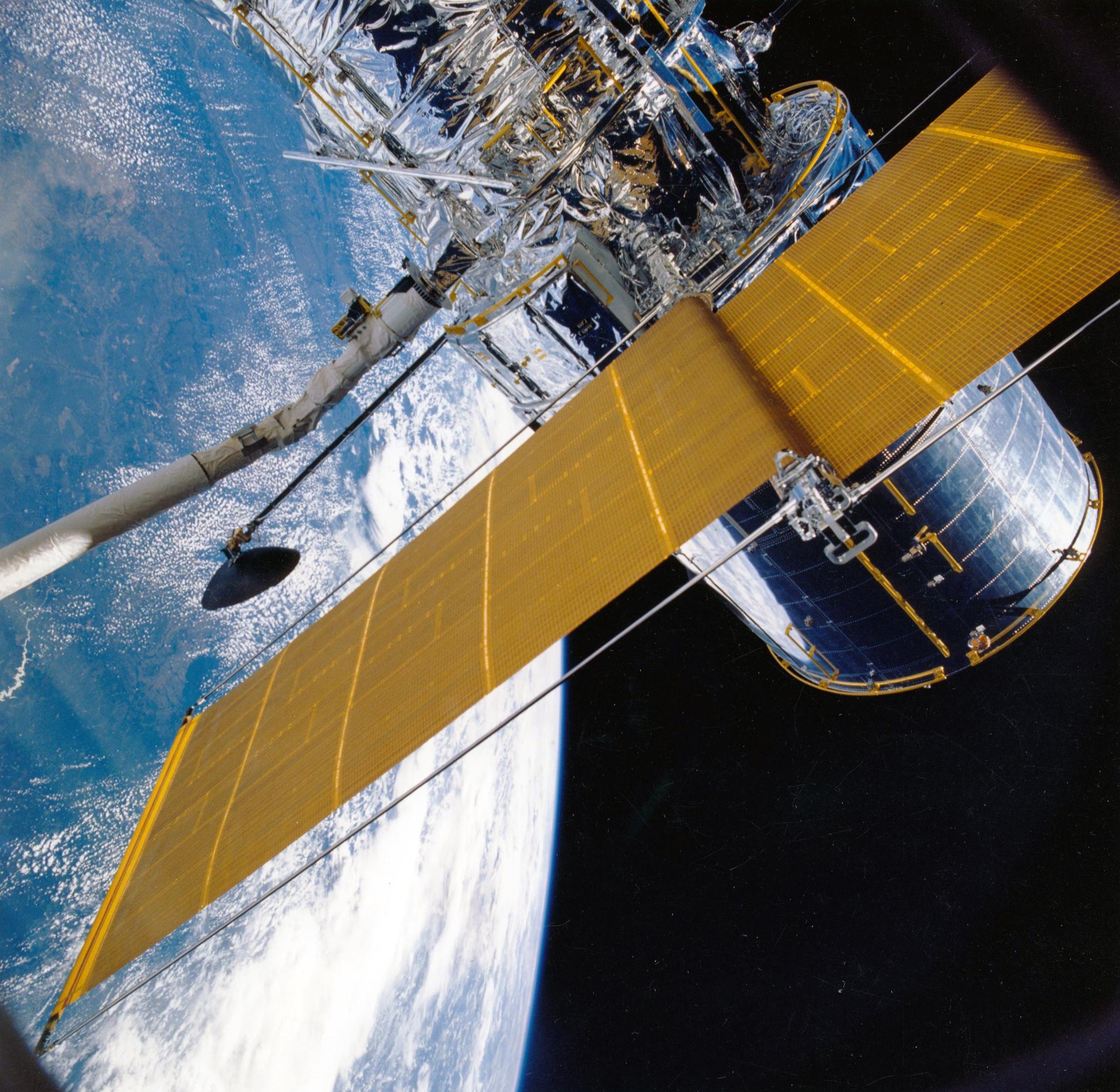
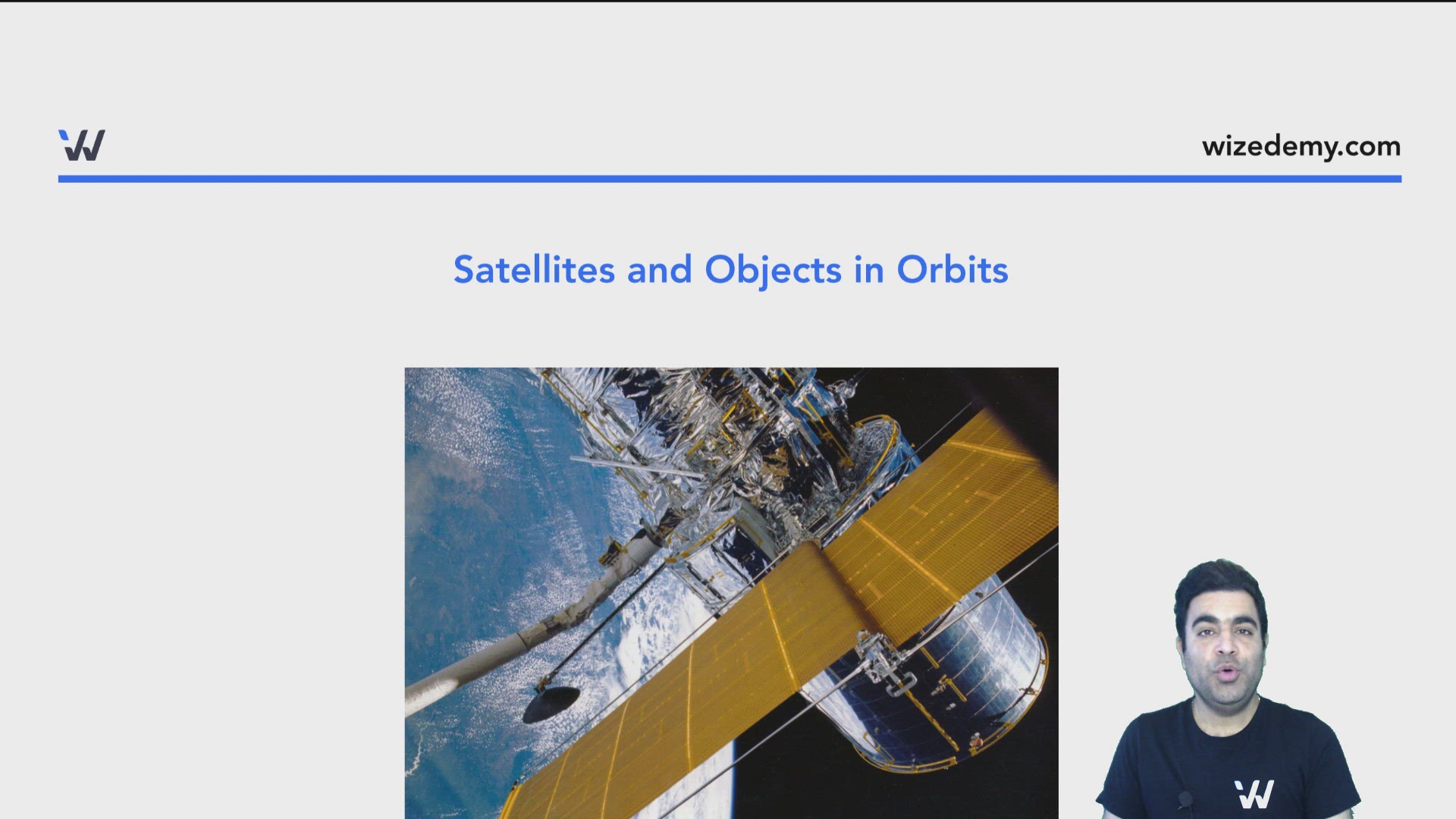
- Objects in orbit, including satellites, move around the planet approximately in a circular motion.
- The gravitational force between the planet and the orbiting object provides the centripetal force in this case:
where is the mass of the orbiting object.
The above equation gives an expression for the orbital speed of the object:
Since this is circular motion, we can relate the orbital speed (tangential) to the angular velocity and period.
Orbital Energies
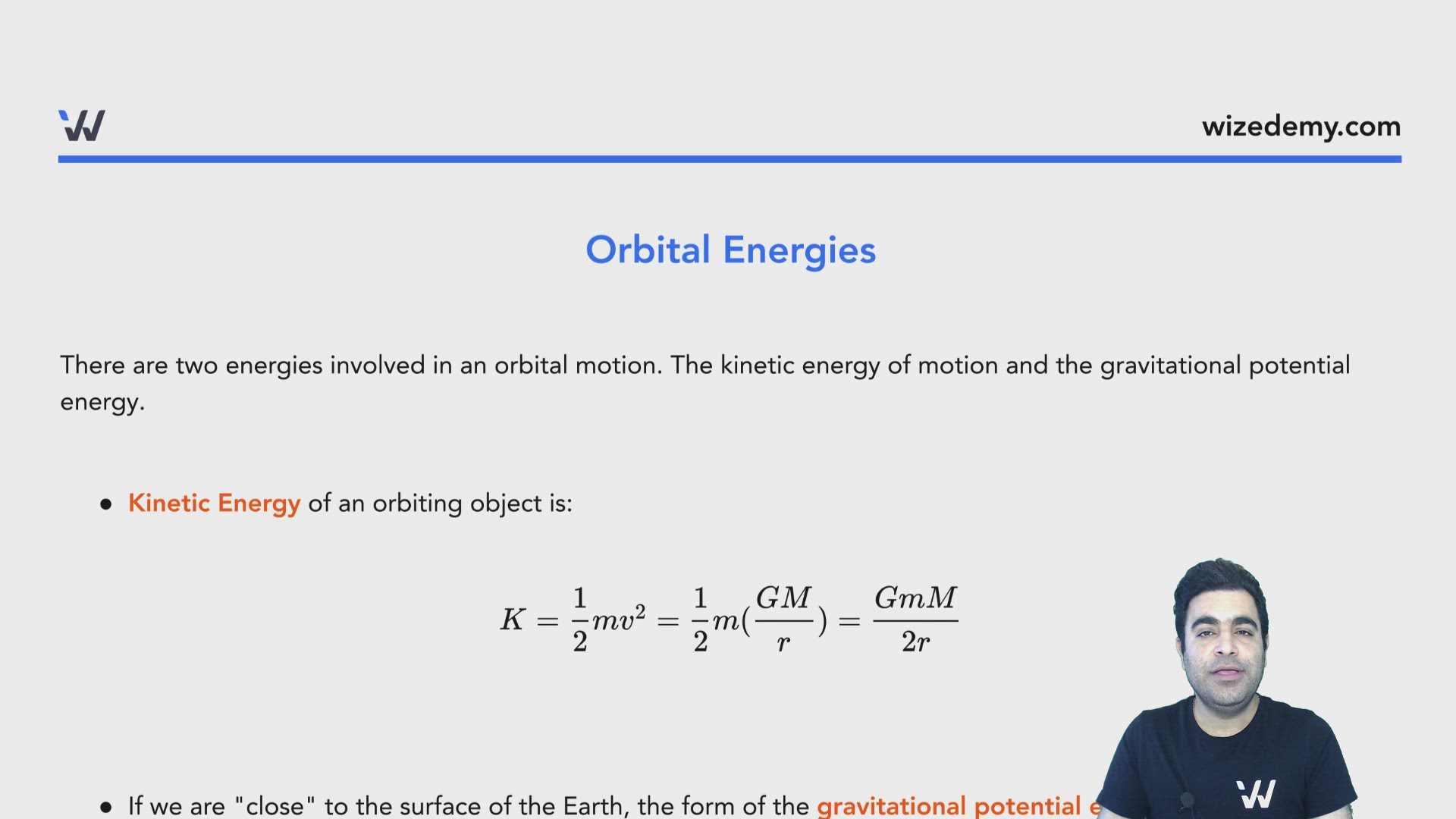
There are two energies involved in an orbital motion. The kinetic energy of motion and the gravitational potential energy.
- Kinetic Energy of an orbiting object is:
- If we are "close" to the surface of the Earth, the form of the gravitational potential energy is
where h is the height above the surface. For the general form, we would have to use the general form of .
- But if we are far away from Earth's surface, we have to use the general form of gravitational potential energy:
where "height" is now denoted as a radius (which is measured from the centre of the masses).
Some notes:
- Why is it negative!? In the mgh form, we used the Earth's surface as a "zero" reference point. But for the more general form, the reference point (zero point) is set where the force is totally gone, which is when . As the objects get closer and closer , we should have less and less energy (more negative), so our expression has a negative sign.
- As per Newton's law of universal gravity, this exists for every pair of massive object, and not just planets and stars!
- As a result, the total mechanical energy is:
The total mechanical energy determines the shape of the orbit:
- E < 0, then the orbit is closed, the object will be bound to the planet.
- E = 0, then the orbit is parabolic. The object will fly away.
- E > 0, then the orbit is hyperbolic. The object will fly away.
Kepler's Laws
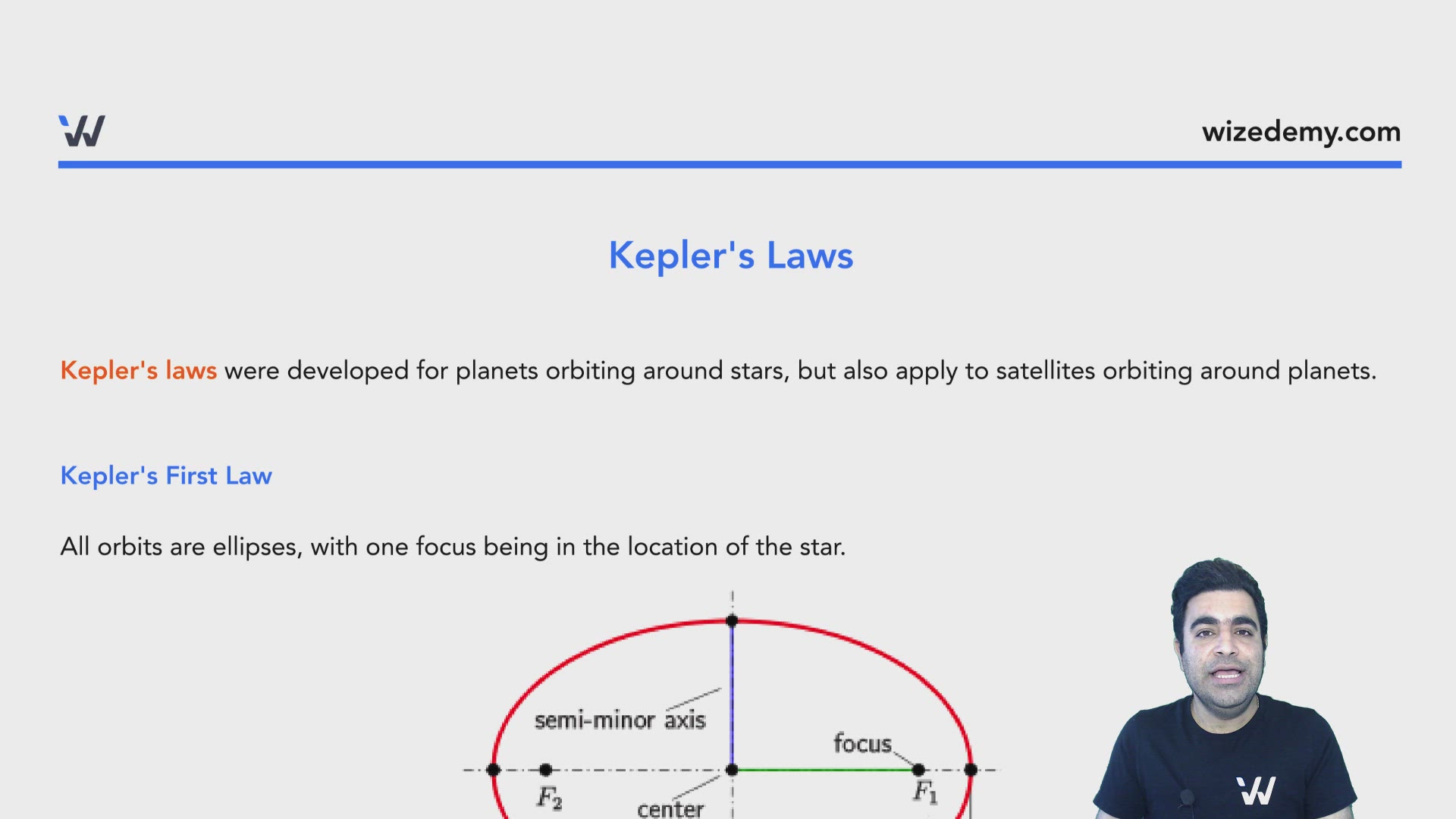
Kepler's laws were developed for planets orbiting around stars, but also apply to satellites orbiting around planets.
Kepler's First Law
All orbits are ellipses, with one focus being in the location of the star.
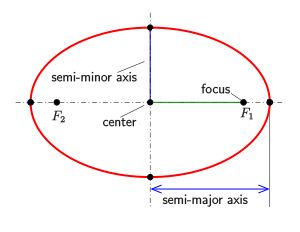
A circle is technically an ellipse with both foci in the same place. The semi-major/minor axis for a circle is just the radius.
Kepler's Second Law
In an orbit, if the planet is closer to the star, it's speed will increase. When further from the star, it's speed will decrease. You can understand this as conservation of energy: closer means you lost gravitational potential energy, which must be compensated by the kinetic energy (speed).
Kepler's Third Law
The square of the period of a planet is proportional to the cube of the semi-major axis of the orbit (or the radius for a circlar orbit). The exact relation is
where M is the mass of the star/planet (not of the satellites).
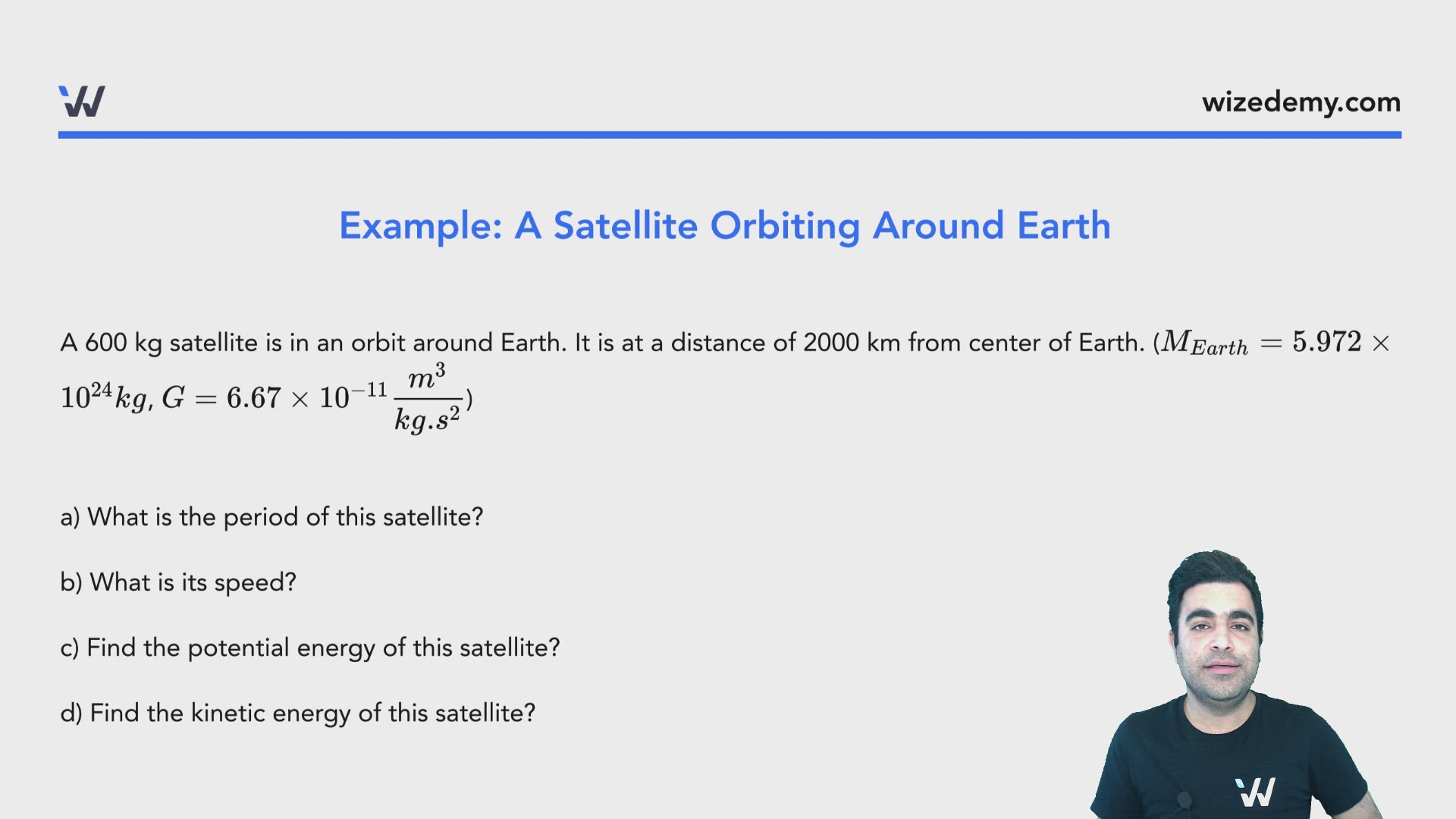
Example: A Satellite Orbiting Around Earth
A 600 kg satellite is in an orbit around Earth. It is at a distance of 2000 km from center of Earth. (, )
a) What is the period of this satellite?
b) What is its speed?
c) Find the potential energy of this satellite?
d) Find the kinetic energy of this satellite?
Solution:
This is the list of informations given to us:
Part a)
The circular motion of satellite is generated by gravitational force between Earth and satellite. So, the centripetal force is equal to . Furthermore, we can write down the speed of the satellite as where itself can be written in terms of period as: . So, we have:
From the first equation we can solve for speed of the satellite to be:
and from second equation:
By putting them equal to each other we have:
After some rearrangement we have:
From this equation we can solve for the period of the satellite to be:
Part b)
From above equations:
Part c)
Potential energy of an orbiting object is equal to:
After plugging numbers we get:
Part d)
Kinetic energy of a moving object is:
From the speed found in part b) we get: