Wize University Physics Textbook (Master) > Work and Energy
Chemical Energy
Popular Courses
MCAT
General Course
PHYSICS 1201A/B
Western University
Intro to Physics
University Study Guides
Physics
General Course
PHYS 115
Queen's University
PHYSICS 1401A/B
Western University
Intro to Physics
University Study Guides
PHYS*1300
University of Guelph
PHY 1321
University of Ottawa
APSC 111
Queen's University
PHYS 111
University of Waterloo
LE/PHYS 1800 3.00
York University
PHY 1331
University of Ottawa
PHYS 142
McGill University
PHYS 117
University of British Columbia
ENGG 212
University of Calgary
PHYS 1050
University of Manitoba
PHYS 101
Simon Fraser University
PHYS-1300
University of Windsor
PHY 1121
University of Ottawa
0:00 / 0:00
Chemical Energy

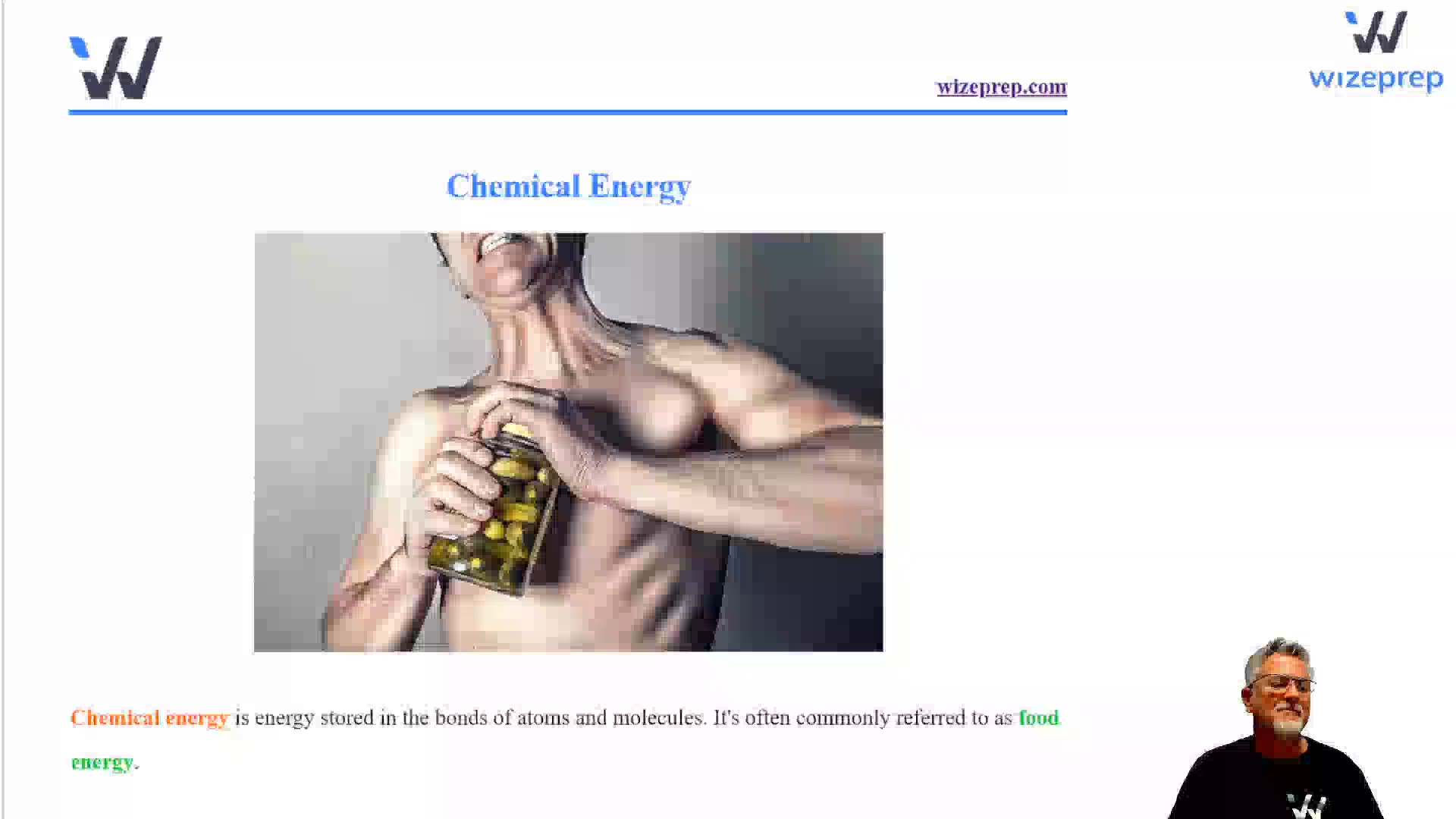
Chemical energy is energy stored in the bonds of atoms and molecules. It's often commonly referred to as food energy.
- Food that we eat is turned into chemical energy by our digestive system and can be expended as mechanical work in our muscles, or released as heat.
- Food energy is often measured in Calories (big "C"), but can be converted into Joules:
Wize Concept
One is the amount of energy required to raise the temperature of of water by .
Watch Out!
The calories you see on a food package are actually kilocalories: calories, or or 1 Cal (again, big "C")
Exam Tip
Human Efficiency is . That is, about 25 percent of the food energy we ingest can be used for mechanical work.
Basal Metabolic Rate is the power required to run our bodies (most of this energy is consumed by the brain and released as heat):
Example: Eating a Doughnut
You buy a doughnut, the package says kcal. Assume that you're really hungry and your body needs all the energy it can get from it (the basal metabolic rate is W). After you eat it, to what height can you climb in minute? Assume a mass of kg and an efficiency of %.
First, let's convert the energy to Joules:
The efficiency in using this energy is only % , which means that the total energy available is:
(J)
Now part of this energy is used up by the body. In s, this metabolic energy is:
(J)
The rest of the energy is used to climb to a maximum height related to the potential energy gained.
(m)

Mark Yourself Question
- Grab a piece of paper and try this problem yourself.
- When you're done, check the "I have answered this question" box below.
- View the solution and report whether you got it right or wrong.
An average candy bar contains 250 Calories, according do the nutrition facts on the wrapper. If we assume 25% of the food we eat is available to do work (ie. 25% efficiency, then rest going to heat, etc), how fast could a 100kg person theoretically run? Note: a big C calorie on food wrappers is: 1 Cal = 1 kcal = 1000 calories (small 'c'). Also, there is a LOT more involved in this, like 'how long' this could be sustained, etc, but we are simply doing a mathematical exercise 'for fun'.