Wize University Physics Textbook (Master) > Work and Energy
Satellites in Orbits
Popular Courses
MCAT
General Course
PHYSICS 1201A/B
Western University
Intro to Physics
University Study Guides
Physics
General Course
PHYSICS 1401A/B
Western University
PHYS 101
McGill University
PHYS 204
Concordia University
Intro to Physics
University Study Guides
PHYS*1300
University of Guelph
PHYS 124
University of Alberta
PHY 1321
University of Ottawa
PHYS 131
McGill University
APSC 111
Queen's University
PHYS 111
University of Waterloo
PCS 120
Toronto Metropolitan University
LE/PHYS 1800 3.00
York University
PHY 1331
University of Ottawa
PHYS 142
McGill University
PHYS 117
University of British Columbia
ENGG 212
University of Calgary
0:00 / 0:00
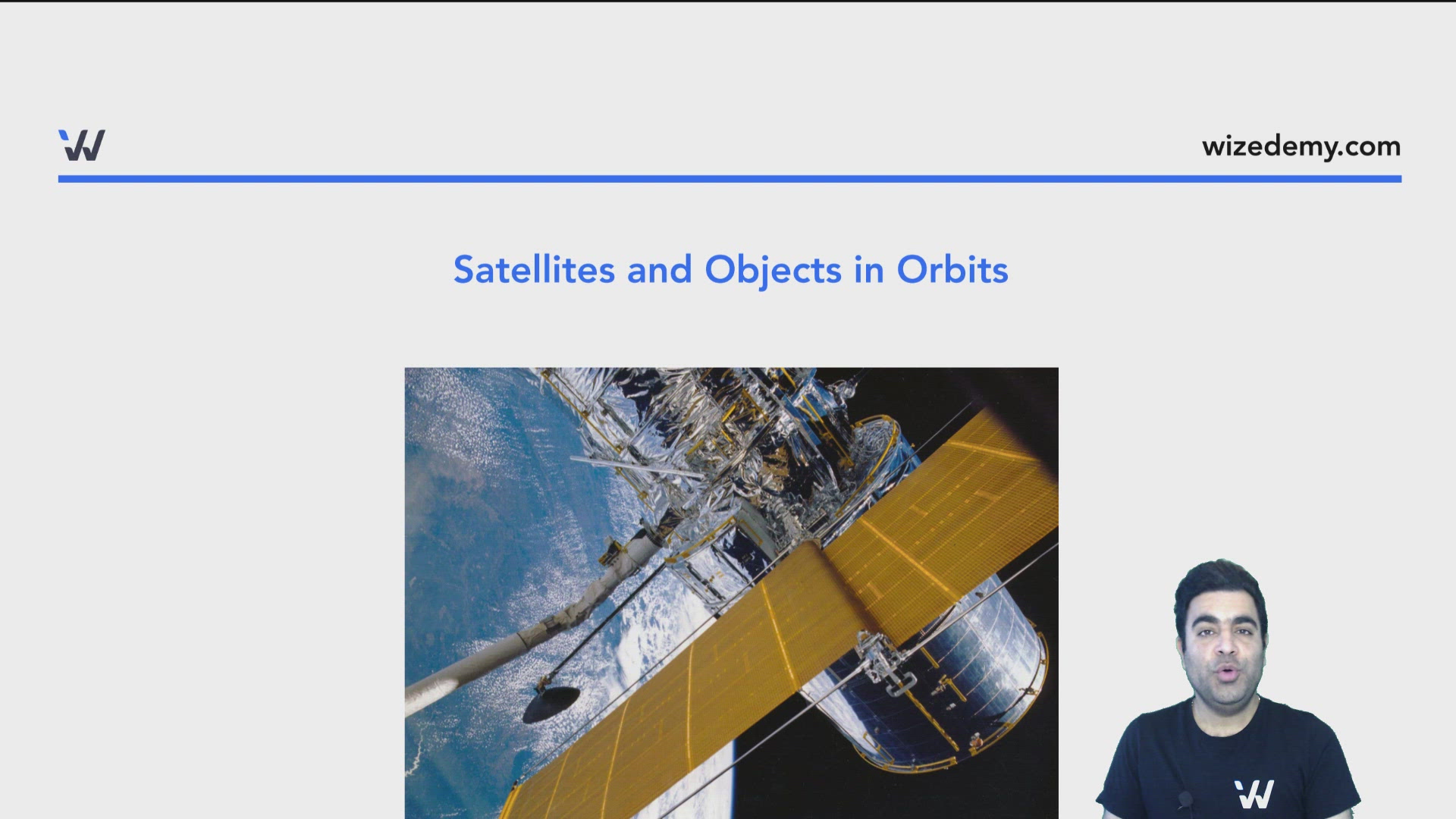
Satellites and Objects in Orbits
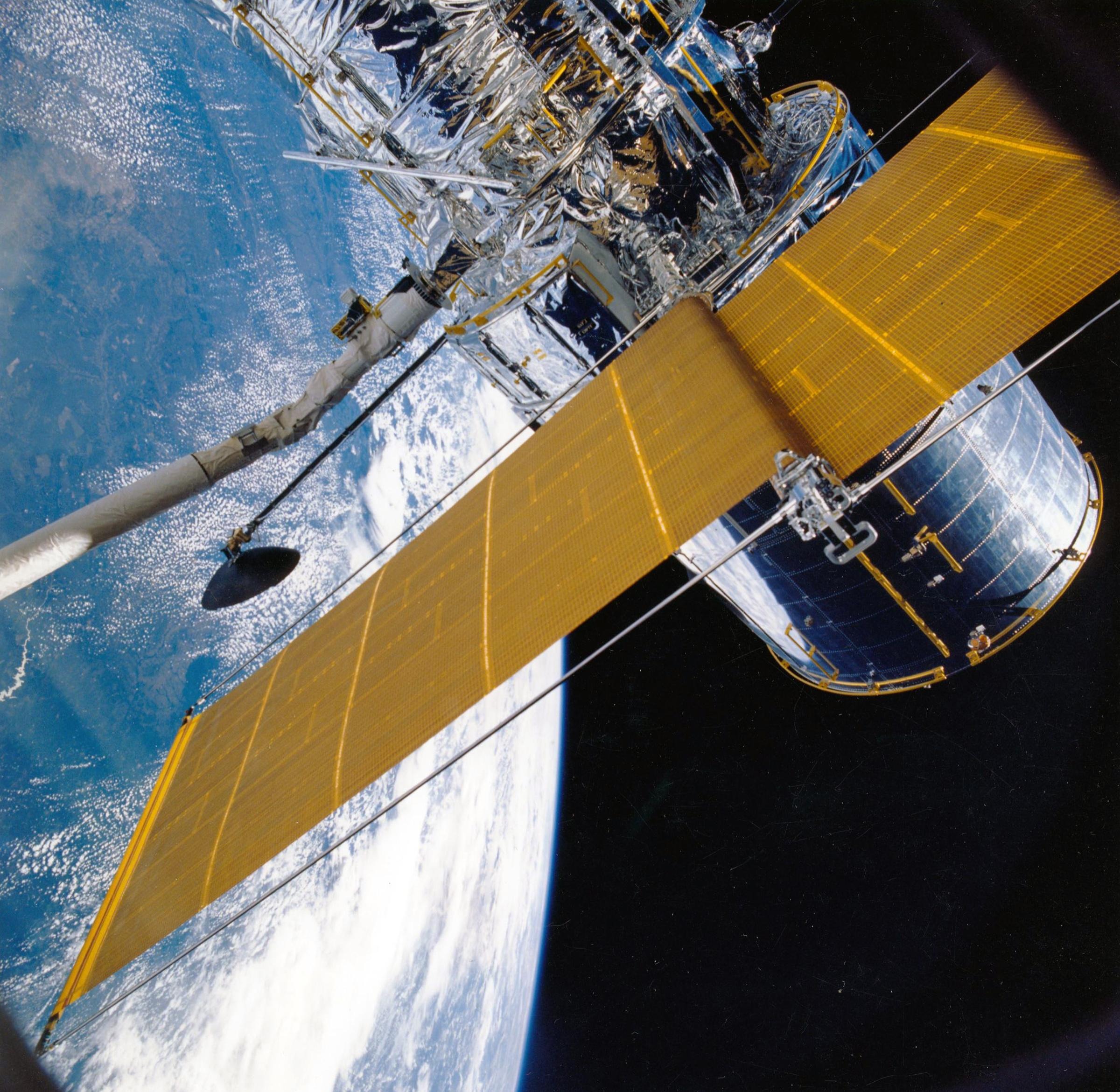
- Objects in orbit, including satellites, move around the planet approximately in a circular motion.
- The gravitational force between the planet and the orbiting object provides the centripetal force in this case:
where is the mass of the orbiting object.
The above equation gives an expression for the orbital speed of the object:
Since this is circular motion, we can relate the orbital speed (tangential) to the angular velocity and period.
0:00 / 0:00
Orbital Energies
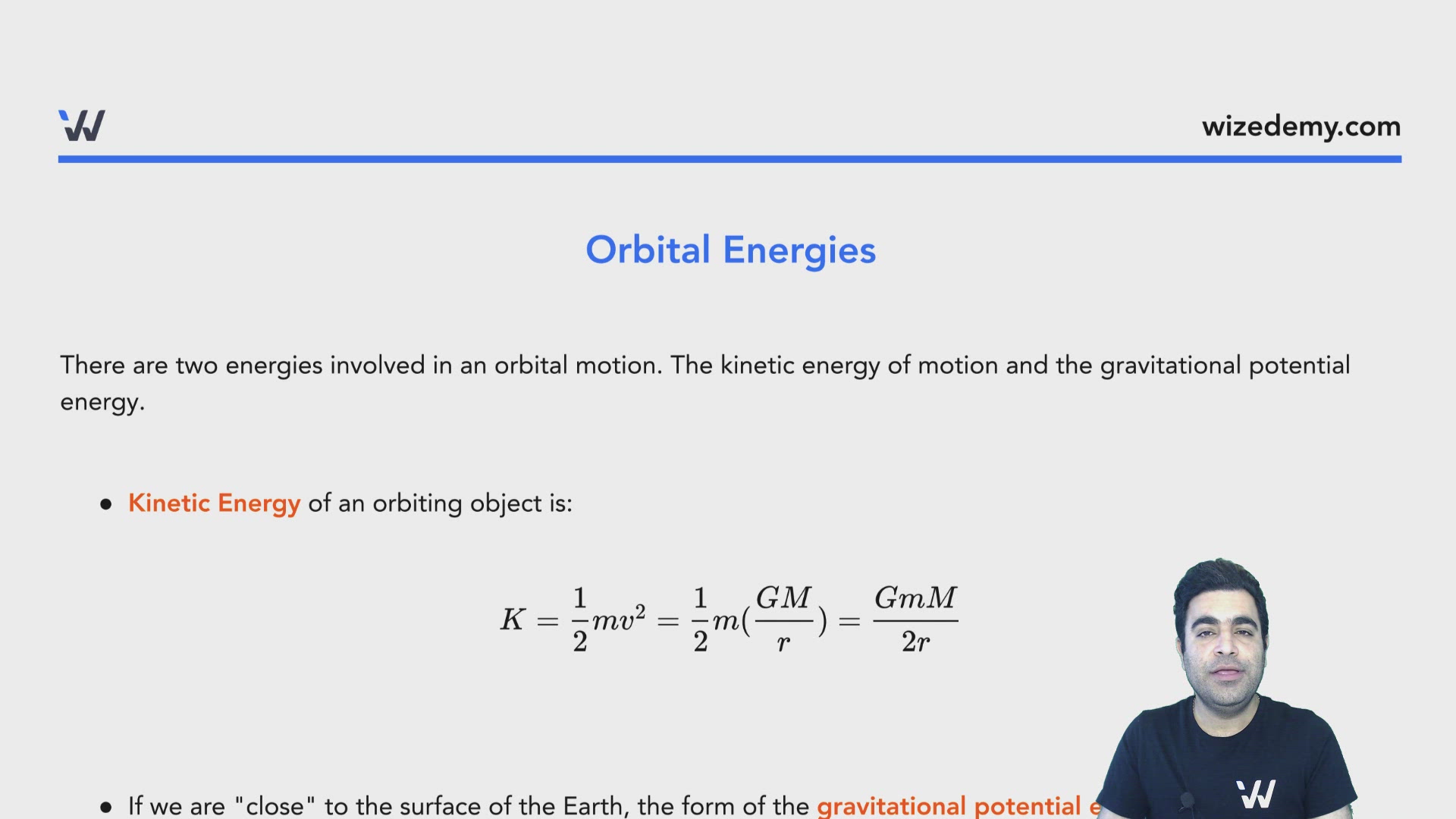
There are two energies involved in an orbital motion. The kinetic energy of motion and the gravitational potential energy.
- Kinetic Energy of an orbiting object is:
- If we are "close" to the surface of the Earth, the form of the gravitational potential energy is
where h is the height above the surface. For the general form, we would have to use the general form of .
- But if we are far away from Earth's surface, we have to use the general form of gravitational potential energy:
where "height" is now denoted as a radius (which is measured from the centre of the masses).
Some notes:
- Why is it negative!? In the mgh form, we used the Earth's surface as a "zero" reference point. But for the more general form, the reference point (zero point) is set where the force is totally gone, which is when . As the objects get closer and closer , we should have less and less energy (more negative), so our expression has a negative sign.
- As per Newton's law of universal gravity, this exists for every pair of massive object, and not just planets and stars!
- As a result, the total mechanical energy is:
The total mechanical energy determines the shape of the orbit:
- E < 0, then the orbit is closed, the object will be bound to the planet.
- E = 0, then the orbit is parabolic. The object will fly away.
- E > 0, then the orbit is hyperbolic. The object will fly away.
Wize Tip
The shape of the orbits comes from much more complicated maths, but you can interpret it like the balancing of kinetic/potential energy (the negative part comes from the potential energy).
At E < 0, the speed and the gravitational pull balances out, and the object will not fling off. At E = 0, this is just when the object is just fast enough to fling away, etc.
0:00 / 0:00
Kepler's Laws
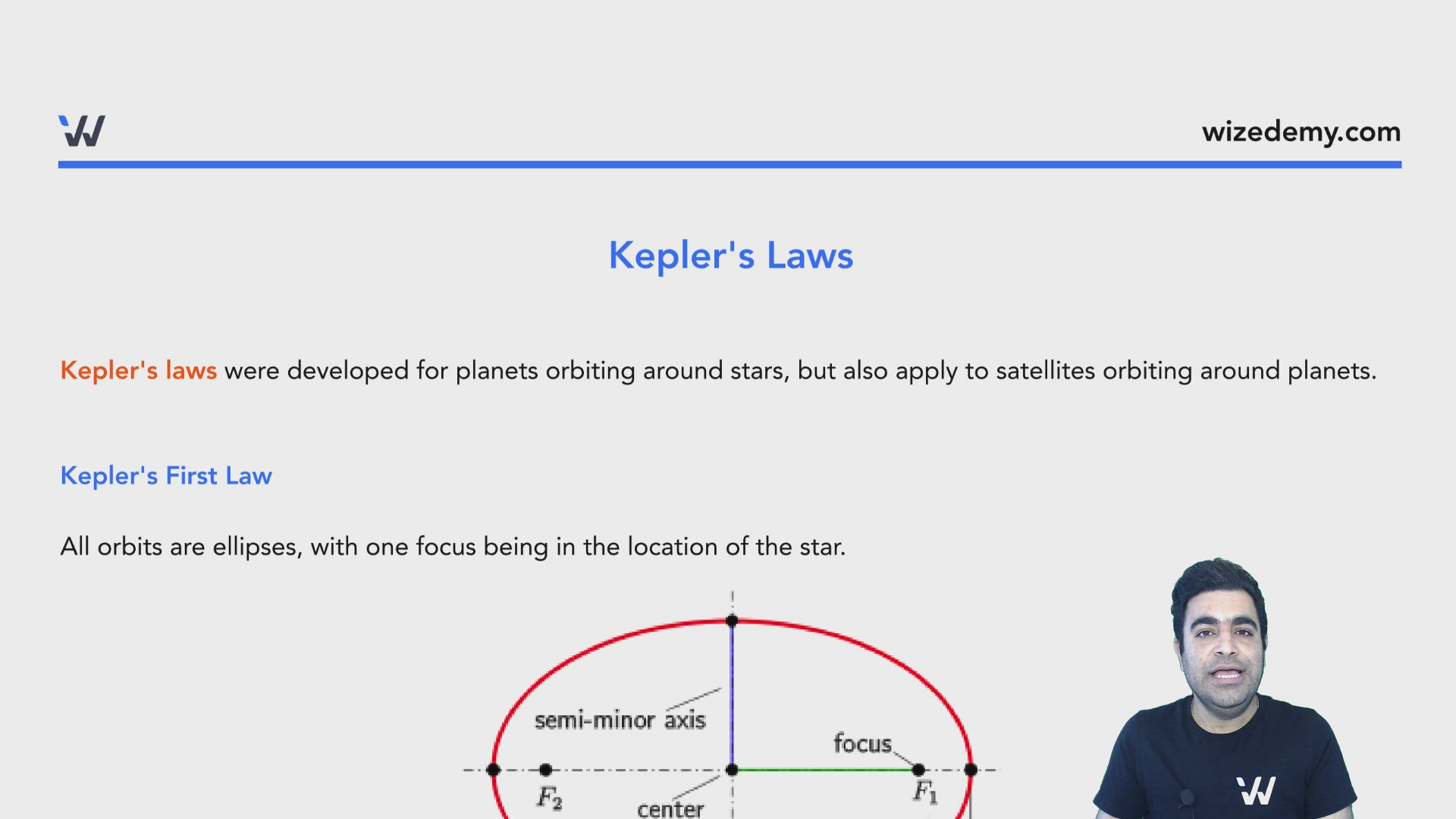
Kepler's laws were developed for planets orbiting around stars, but also apply to satellites orbiting around planets.
Kepler's First Law
All orbits are ellipses, with one focus being in the location of the star.
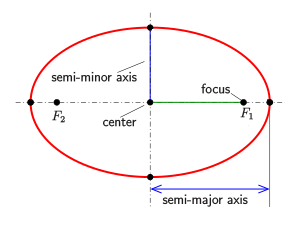
A circle is technically an ellipse with both foci in the same place. The semi-major/minor axis for a circle is just the radius.
Kepler's Second Law
In an orbit, if the planet is closer to the star, it's speed will increase. When further from the star, it's speed will decrease. You can understand this as conservation of energy: closer means you lost gravitational potential energy, which must be compensated by the kinetic energy (speed).
Wize Tip
For circular orbits, this means that the orbital speed of the planet is constant - the planet is always the same distance away from its star.
Kepler's Third Law
The square of the period of a planet is proportional to the cube of the semi-major axis of the orbit (or the radius for a circlar orbit). The exact relation is
where M is the mass of the star/planet (not of the satellites).
Wize Tip
We can simply say , or
Watch Out!
Be careful with these variables:
- If you have a planet orbiting a star, r is the distance between the planet and the star (NOT the radius of the star or planet), and M is the mass of the star.
- If you have a satellite orbiting a planet, r is the distance between the satellite and the center of the planet (NOT the radius of the planet), and M is the mass of the planet (NOT the satellite).
0:00 / 0:00
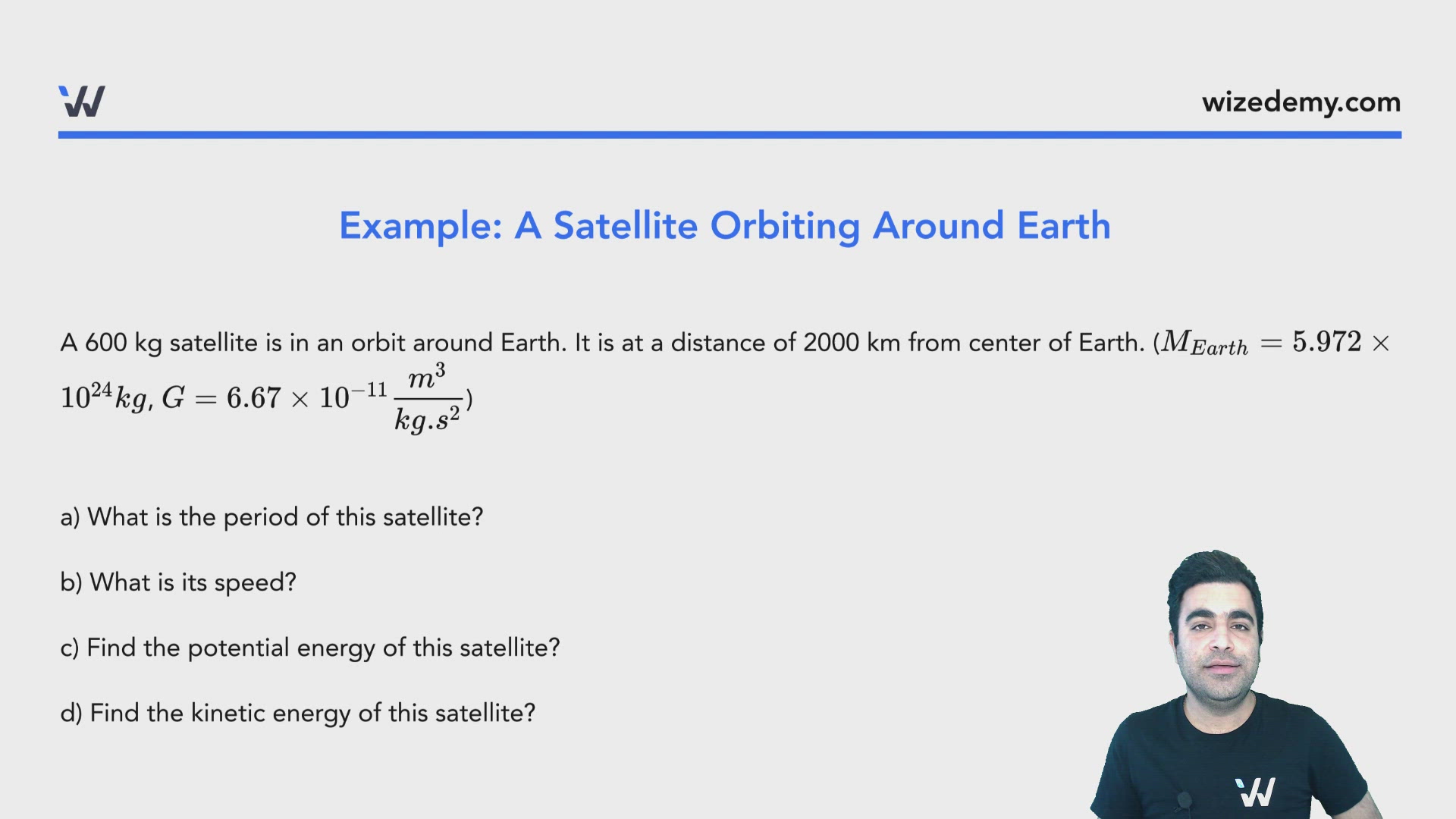
Example: A Satellite Orbiting Around Earth
A 600 kg satellite is in an orbit around Earth. It is at a distance of 2000 km from center of Earth. (, )
a) What is the period of this satellite?
b) What is its speed?
c) Find the potential energy of this satellite?
d) Find the kinetic energy of this satellite?
Solution:
This is the list of informations given to us:
Part a)
The circular motion of satellite is generated by gravitational force between Earth and satellite. So, the centripetal force is equal to . Furthermore, we can write down the speed of the satellite as where itself can be written in terms of period as: . So, we have:
From the first equation we can solve for speed of the satellite to be:
and from second equation:
By putting them equal to each other we have:
After some rearrangement we have:
From this equation we can solve for the period of the satellite to be:
Part b)
From above equations:
Part c)
Potential energy of an orbiting object is equal to:
After plugging numbers we get:
Part d)
Kinetic energy of a moving object is:
From the speed found in part b) we get:
Some bright students at MIT are planning to send a satellite to orbit around the earth at altitude of 4000 km above the surface. What will be the orbital period of this satellite?
(The mass of the earth is , and and radius of Earth is )