Wize University Physics Textbook (Master) > Periodic Motion: Oscillations

SHM as the Projection of a Uniform Circular Morion

Create a free account to get started

Unlock full course notes by signing up

  • Video lessons taught by top educators
  • Practice questions with guided solutions
  • Written review notes for reference
  • Expert answers anytime from course tutors

SHM as the Projection of a Uniform Circular Motion


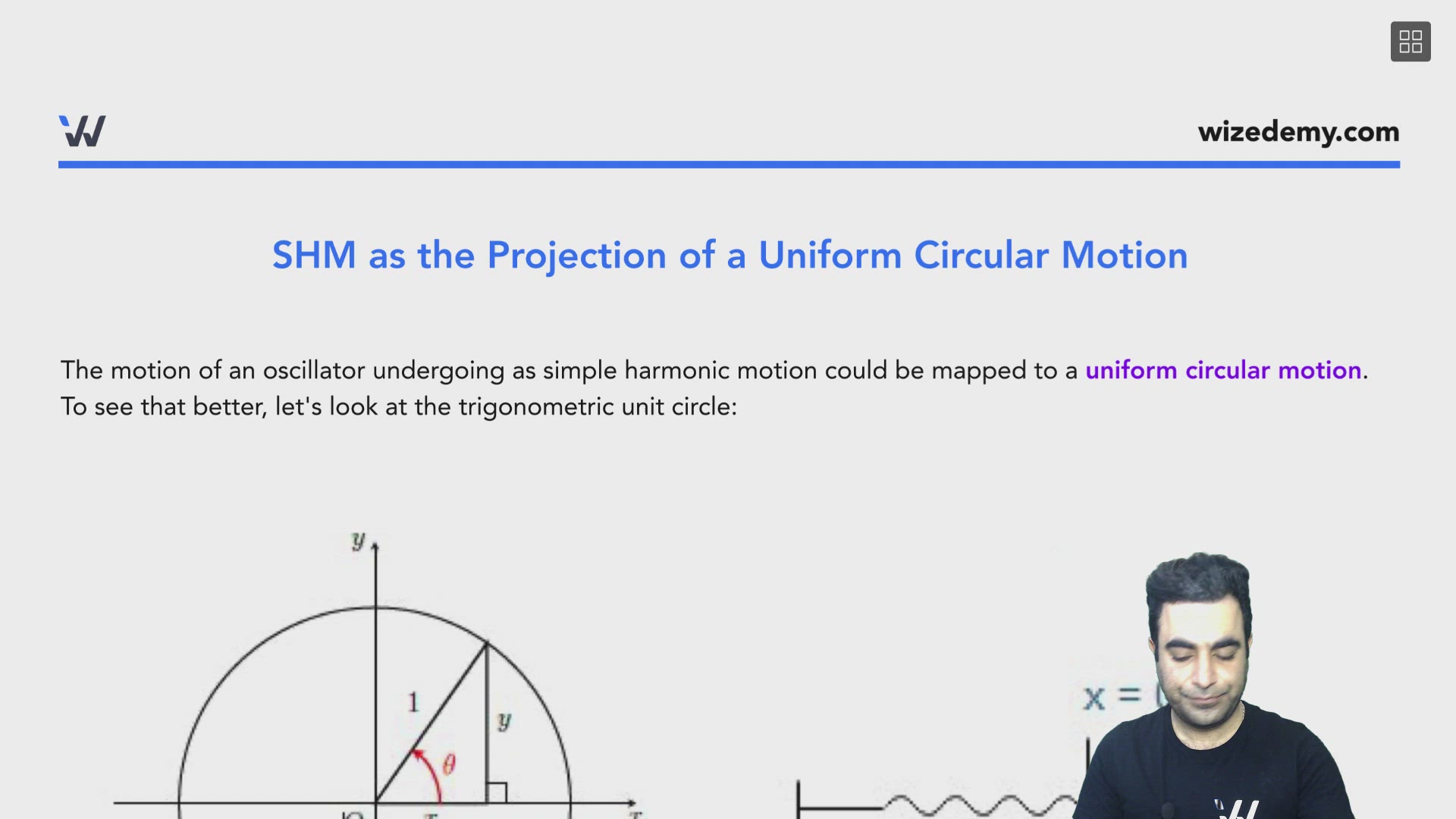
The motion of an oscillator undergoing as simple harmonic motion could be mapped to a uniform circular motion. To see that better, let's look at the trigonometric unit circle:


Image illustrating SHM as the Projection of a Uniform Circular Motion


Let's choose angle θ\thetato be equal to ωt\omega twhere ω\omegais the angular frequency of SHM.


From the picture, using trigonometric relations for the triangle shown at any moment:


x(t)=cos⁡(θ)=cos⁡(ωt) \boxed{x\left(t\right)=\cos\left(\theta\right)=\cos\left(\omega t\right)\ }


y(t)=sin⁡(θ)=sin⁡(ωt) \boxed{y\left(t\right)=\sin\left(\theta\right)=\sin\left(\omega t\right)\ }


Above equations are similar to the functions which describe the position of an oscillator in a SHM.


Example: SHM from Circular Motion


The image below shows the coordinates of a particle moving around a circle at t=0t=0, as well as the direction of motion. Find the equation of its position xx as a cos⁡\cos function. Then find the velocity and acceleration equations as well.
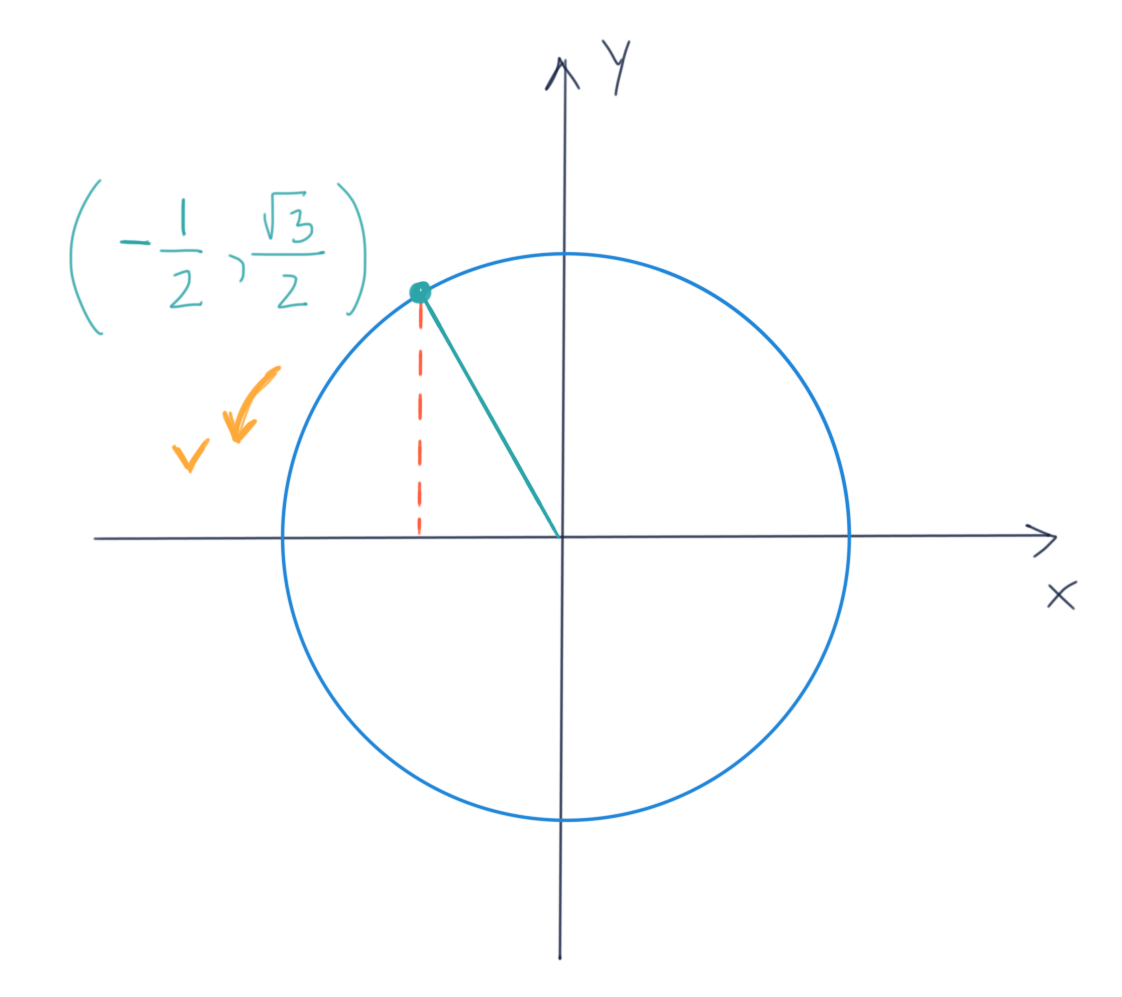

Image illustrating Example: SHM from Circular Motion - Equation of Position (x)


Begin with the position equation for SHM:


x=Acos⁡(ωt+ϕ)x=A\cos(\omega t+\phi)


We see that the circular motion has a radius r=1r=1 because the coordinates of the point are on the unit circle, so the amplitude is A=1A=1. (Alternately, find the radius = hypothenuse of the triangle using the Pythagorean Theorem.)


When t=0t=0, the position is x=−12x=-\dfrac{1}{2}. Put these into the equation to find the phase shift:


x=Acos⁡(ωt+ϕ)x=A\cos(\omega t+\phi)


−12=cos⁡ϕ-\dfrac{1}{2}=\cos\phi


Ignoring the negative sign, we get a reference angle of ϕ=π3\phi=\dfrac{\pi}{3}. But since cos⁡\cos is negative, the angle could be in Quadrants II or III.


To figure out which one it is, we have to look at the velocity. From the diagram, the particle is moving in the negative direction (clockwise), so the velocity should be negative.


The velocity is given by:


v=−Aωsin⁡(ωt+ϕ)v=-A\omega\sin(\omega t+\phi)


At time t=0t=0 we have:


v=−ωsin⁡(ϕ)v=-\omega\sin(\phi)


and since the velocity is negative and ω\omega positive, sin⁡ϕ\sin\phi should be positive, so the angle could be in Quadrants I or II.


Therefore to satisfy both conditions, the angle has to be in Quadrant II and our phase shift is:


ϕ=2π3\phi =\dfrac{2\pi}{3}


Now we have the position equation:


x=Acos⁡(ωt+ϕ)x=A\cos(\omega t+\phi)


x=cos⁡(ωt+2π3)x=\cos\bigg(\omega t+\dfrac{2\pi}{3}\bigg)


The velocity equation is:


v=−Aωsin⁡(ωt+ϕ)v=-A\omega\sin(\omega t+\phi)


v=−ωsin⁡(ωt+2π3)v=-\omega\sin\bigg(\omega t+\dfrac{2\pi}{3}\bigg)


The acceleration is:


a=−Aω2cos⁡(ωt+ϕ)a=-A\omega^2\cos(\omega t+\phi)


a=−ω2cos⁡(ωt+2π3)a=-\omega^2\cos\bigg(\omega t+\dfrac{2\pi}{3}\bigg)


Mark Yourself Question

  1. Grab a piece of paper and try this problem yourself.
  2. When you're done, check the "I have answered this question" box below.
  3. View the solution and report whether you got it right or wrong.

Practice: SHM from Circular Motion


The image below shows the coordinates of a particle moving around a circle at t=0t=0, as well as the direction of motion. Find the equation of its position yy as a sin⁡\sin function. Then find the velocity and acceleration equations as well.


Illustration for practice question: Practice: SHM from Circular Motion

Create a free account to get started

Unlock full course notes by signing up

  • Video lessons taught by top educators
  • Practice questions with guided solutions
  • Written review notes for reference
  • Expert answers anytime from course tutors