Create a free account to get started

Unlock full course notes by signing up

  • Video lessons taught by top educators
  • Practice questions with guided solutions
  • Written review notes for reference
  • Expert answers anytime from course tutors

A Quick Review on Buoyant Forces


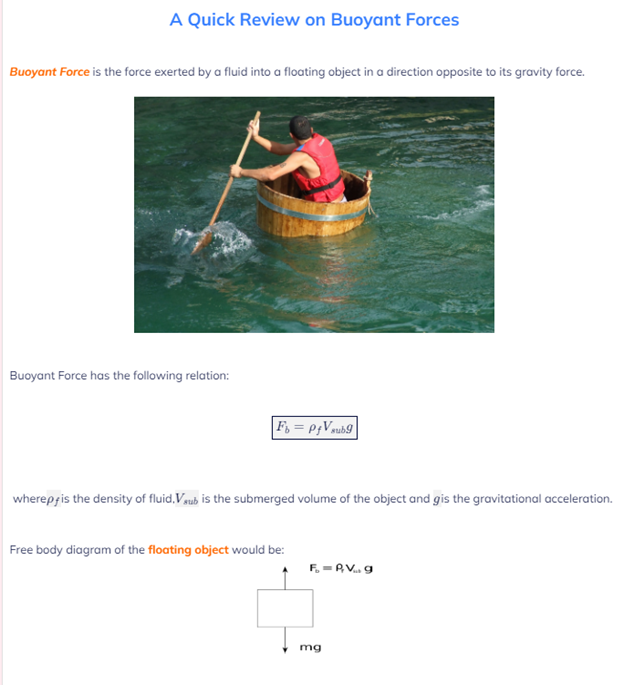
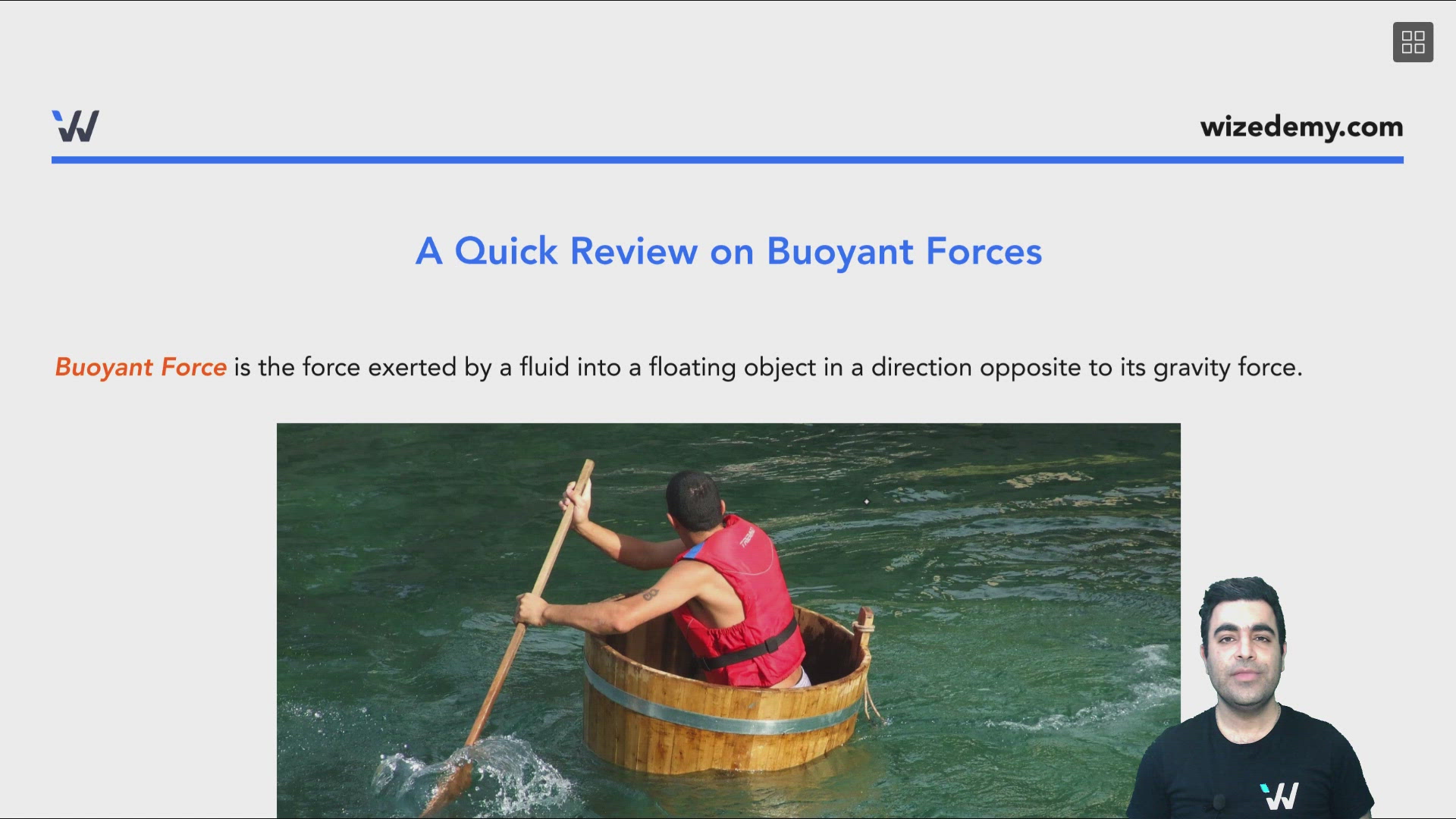
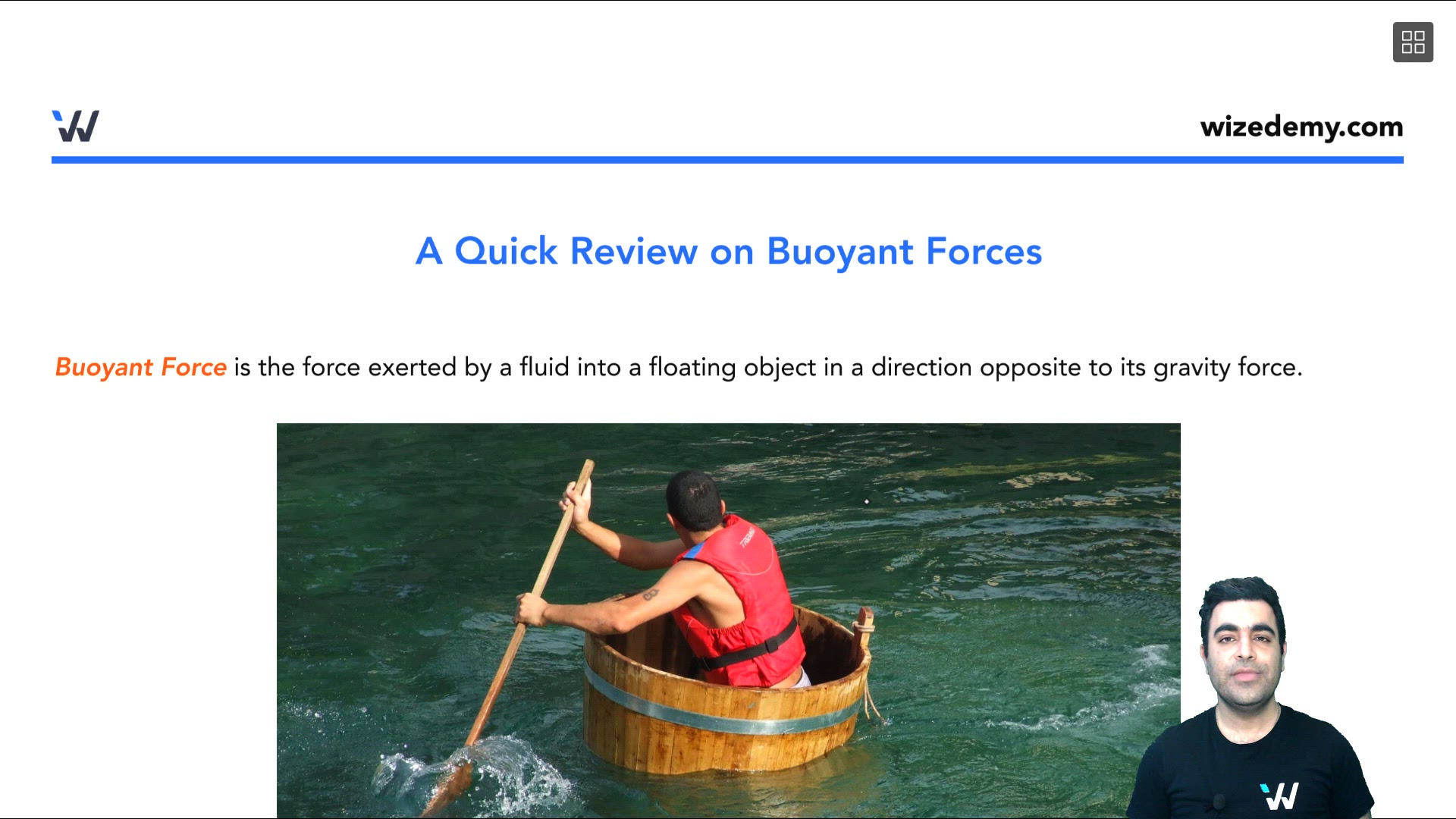
Buoyant Force is the force exerted by a fluid into a floating object in a direction opposite to its gravity force.
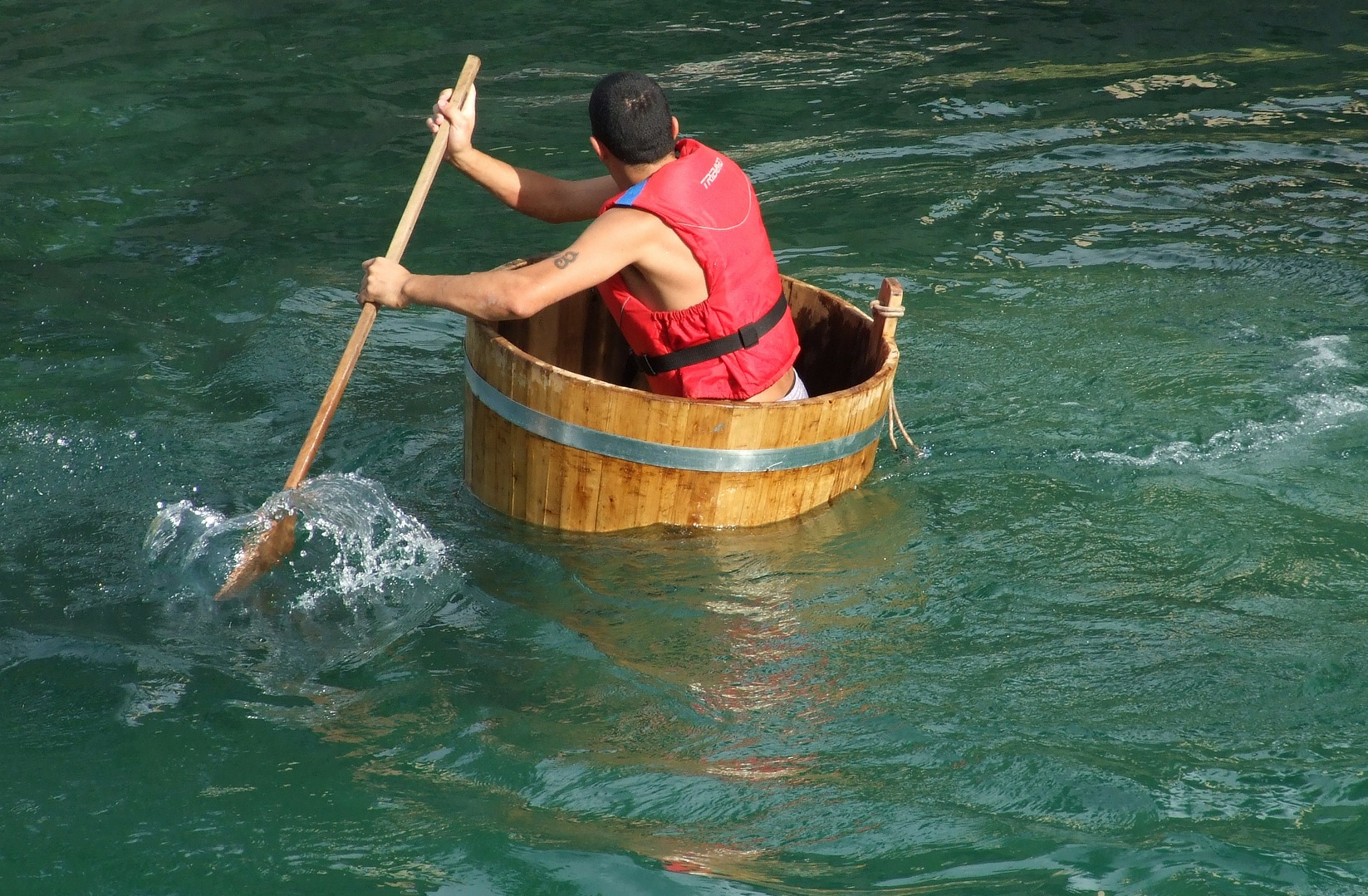

Image illustrating A Quick Review on Buoyant Forces


Buoyant Force has the following relation:


Fb=ρfVsubg\boxed{F_b=\rho_fV_{sub}g}


whereρf\rho_fis the density of fluid,VsubV_{sub} is the submerged volume of the object and ggis the gravitational acceleration.


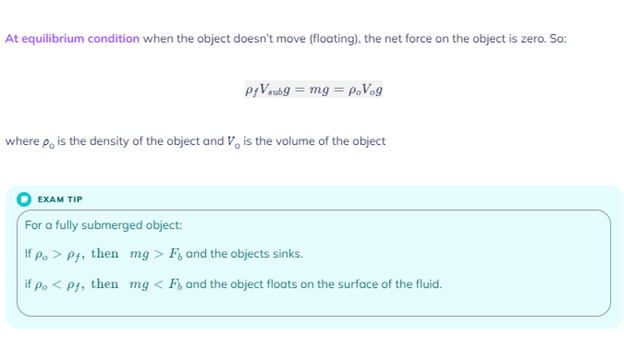
Free body diagram of the floating object would be:
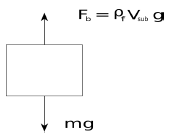
Image illustrating A Quick Review on Buoyant Forces


At equilibrium condition when the object doesn’t move (floating), the net force on the object is zero. So:


ρfVsubg=mg=ρoVog\rho_fV_{sub}g=mg=\rho_oV_og


where 𝜌o is the density of the object and 𝑉o is the volume of the object


Create a free account to get started

Unlock full course notes by signing up

  • Video lessons taught by top educators
  • Practice questions with guided solutions
  • Written review notes for reference
  • Expert answers anytime from course tutors

Image illustrating Buoyancy Theory

Image illustrating Buoyancy Theory

Create a free account to get started

Unlock full course notes by signing up

  • Video lessons taught by top educators
  • Practice questions with guided solutions
  • Written review notes for reference
  • Expert answers anytime from course tutors

Oscillation of Floating Object


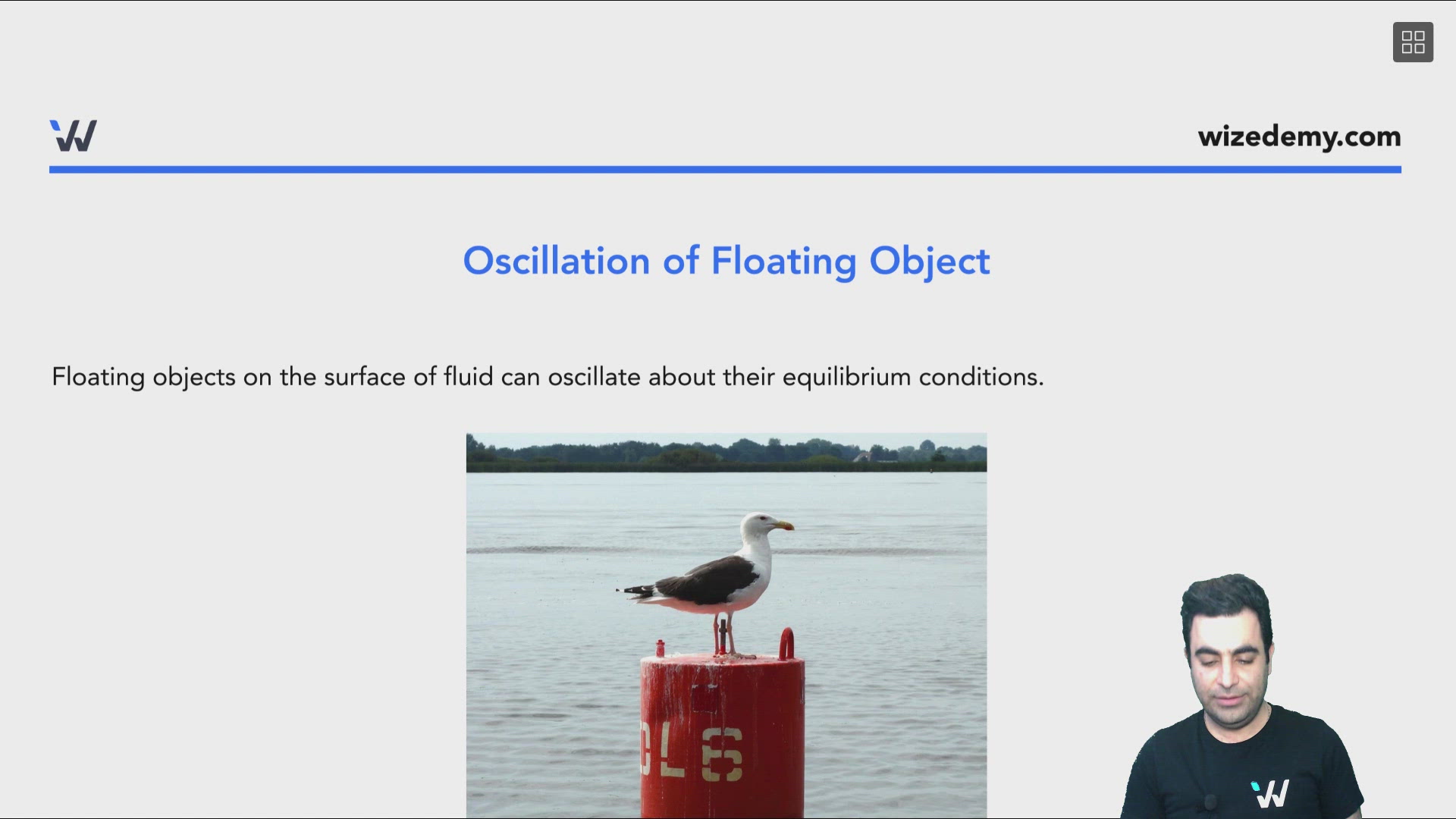
Floating objects on the surface of fluid can oscillate about their equilibrium conditions.


Image illustrating Oscillation of Floating Objects


Imagine we have a floating vertical cylinder with cross sectional area of S on the surface of some fluid. When stationary, the cylinder is at equilibrium and net force on that is zero.


If we push the cylinder down by 𝑥, extra upward buoyant force 𝐹b acts on the cylinder to bring it back to the equilibrium position. This force is equal to:

Fb=−ρfgΔVsub=−ρfgS⋅xF_b=-\rho_fg\Delta V_{sub}= -\rho_fgS\cdot x


where ΔVsub\Delta V_{sub} is the change in the volume of cylinder submerged in water and ρf\rho_fis the density of the fluid.


By compared above force with general form of SHM forces 𝐹 = −𝑘𝑥 we have:


k=ρfgS\boxed{k=\rho_fgS}


kkcan be considered as the effective spring constant for oscillation of a floating object.


Finally, the angular frequency of these type of oscillation could be found as:


ω=km=ρfgSm\boxed{\omega=\sqrt{\dfrac{k}{m}}=\sqrt{\dfrac{\rho_fgS}{m}}}


Create a free account to get started

Unlock full course notes by signing up

  • Video lessons taught by top educators
  • Practice questions with guided solutions
  • Written review notes for reference
  • Expert answers anytime from course tutors

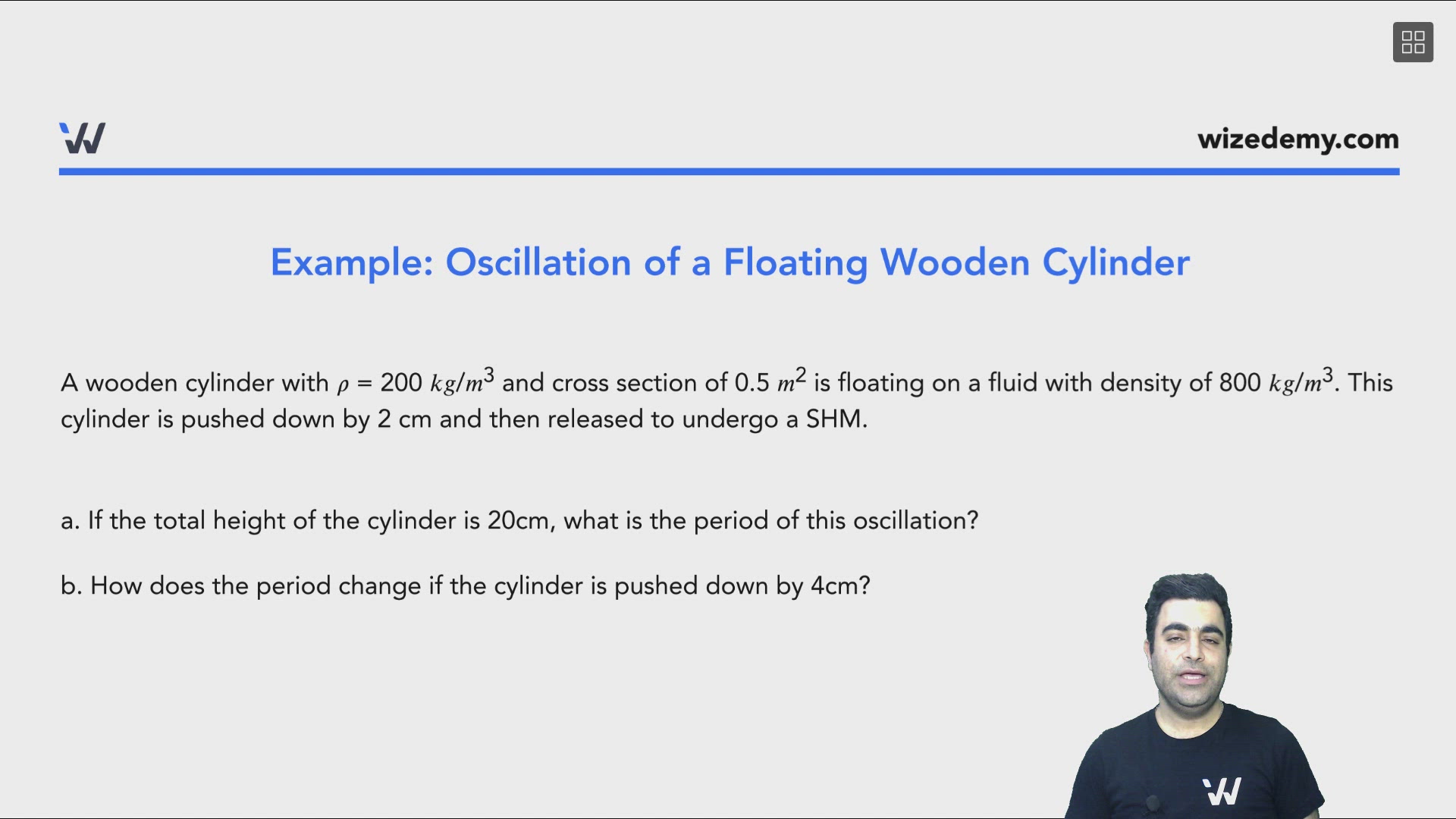
Example: Oscillation of a Floating Wooden Cylinder


A wooden cylinder with 𝜌 = 200 𝑘𝑔/𝑚3 and cross section of 0.5 𝑚2 is floating on a fluid with density of 800 𝑘𝑔/𝑚3. This cylinder is pushed down by 2 cm and then released to undergo a SHM.


a. If the total height of the cylinder is 20cm, what is the period of this oscillation?

b. How does the period change if the cylinder is pushed down by 4cm?


Solution:


Part a)


we remember that for a floating object, the driving force of oscillation is:

Fb=−ρfgS⏞k⋅x       F_b=-\overbrace{\rho_fgS}^\text{k}\cdot x\ \ \ \ \ \ \


where the effective spring constant is also shown in the above equation.


By knowing this effective spring constant, we can find the period of the oscillation as:


T=2πω=2πmk=2πmρfgST=\frac{2\pi}{\omega}=2\pi\sqrt{\frac{m}{k}}=2\pi\sqrt{\frac{m}{\rho_fgS}}

We can find the mass of the cylinder by knowing its dimensions and its density:

mcyl=ρcyl⋅Vcyl=ρcyl⋅S⋅hm_{cyl}=\rho_{cyl}\cdot V_{cyl}=\rho_{cyl}\cdot S_\cdot h

So,


T=2πρcyl⋅S⋅hρfSg=2πρcyl⋅hρfg=2π200800×0.29.8=0.45sT=2\pi\sqrt{\frac{\rho_{cyl}\cdot S\cdot h}{\rho_fSg}}=2\pi\sqrt{\frac{\rho_{cyl}\cdot h}{\rho_fg}}=2\pi\sqrt{\frac{200}{800}\times\frac{0.2}{9.8}}=0.45s


Part b)


The period of SHM is independent of the amplitude of the oscillation. So, it does not change.

Practice: Seagull Sitting on a Buoy


A seagull is sitting on a buoy close to Seward harbour in Alaska. The Seagull has the mass of 2kg and the buoy has the mass of 50kg. It flies away gently at t=0s and the buoy starts oscillating. Find the amplitude and period of this oscillation if the buoy has a cross sectional area of 0.5m20.5 m^2and the density of sea water is equal to 1000kg/m31000 kg/m^3.

Choose an answer

Create a free account to get started

Unlock full course notes by signing up

  • Video lessons taught by top educators
  • Practice questions with guided solutions
  • Written review notes for reference
  • Expert answers anytime from course tutors