Popular Courses
Intro to Physics
University Study Guides
AP Physics C: Mechanics Exam Prep Course
AP Exam Prep
Physics
General Course
PHYS 157
University of British Columbia
Intro to Physics
University Study Guides
PHYS*1300
University of Guelph
PHYS*1080
University of Guelph
PHYS 131
McGill University
APSC 112
Queen's University
PHYSICS 1402A/B
Western University
LE/PHYS 1800 3.00
York University
PHYS-1400
University of Windsor
PHYS 142
McGill University
PHYS 117
University of British Columbia
ENGG 212
University of Calgary
PHYS 111
University of Victoria
PHYS 1050
University of Manitoba
PHYS 101
Simon Fraser University
PHYS-1300
University of Windsor
PHY 1121
University of Ottawa

0:00 / 0:00
Physical Pendulum
If the mass is not concentrated at the lower part of the object (like a simple pendulum (mass on a weightless string)), still the object can oscillate around its pivot point.
- This oscillation for small angles could be also described by simple harmonic motion.
- For this oscillation:
Where
Where
- is the moment of inertia about the pivot point. (Don’t worry about formulas of moment of inertia. If you need it in exam, it should be given to you in the formula sheet.)
- is the distance between the pivot point and the center of mass of the object.
0:00 / 0:00
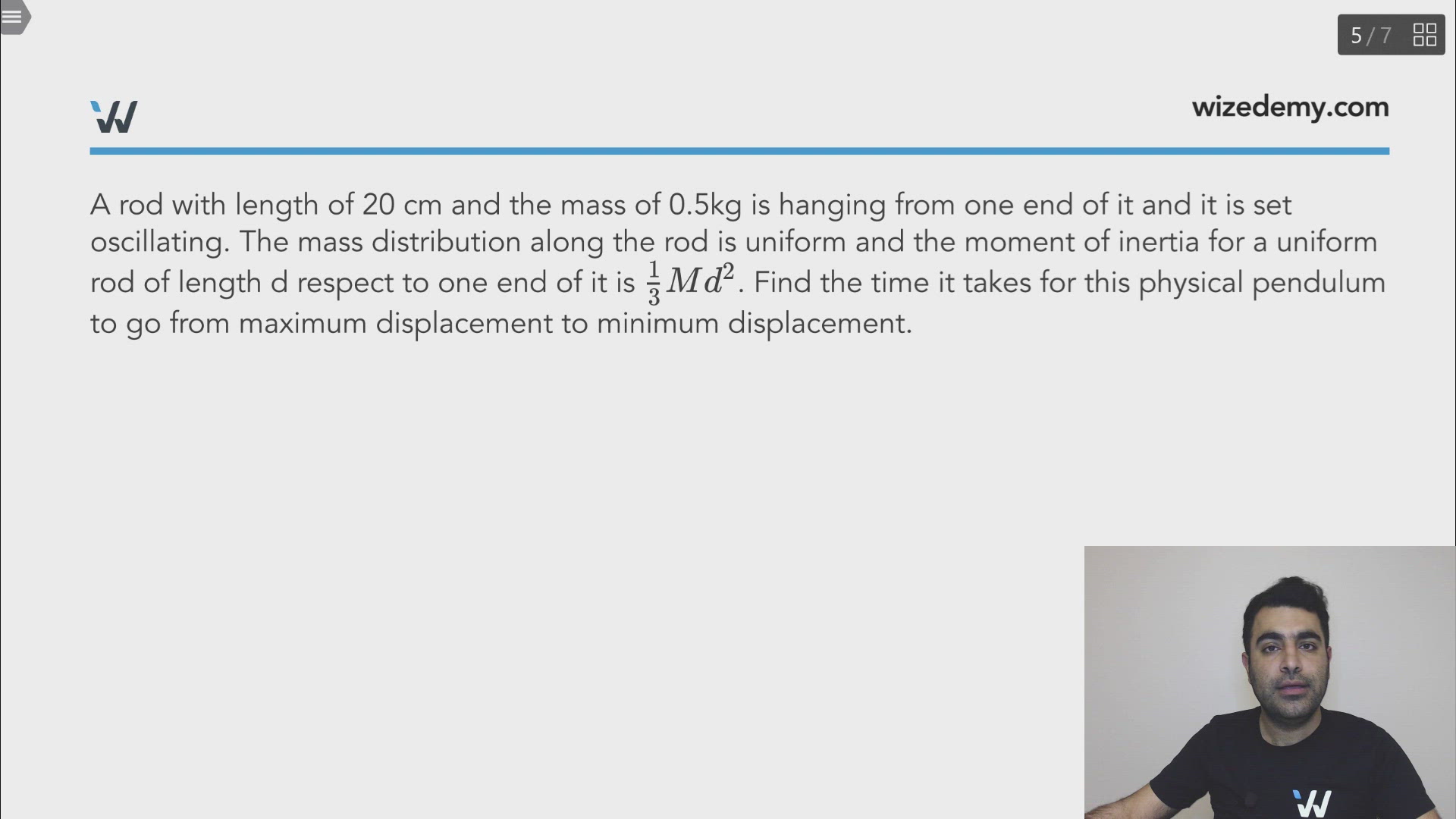
A rod with length of 20 cm and the mass of 0.5kg is hanging from one end of it and it is set oscillating. The mass distribution along the rod is uniform and the moment of inertia for a uniform rod of length d respect to one end of it is . Find the time it takes for this physical pendulum to go from maximum displacement to minimum displacement.
Solution:
Time time to go from Max displacement (x=+A) to minimum displacement (x=-A) is half of one period. Hence, that is enough to find the period of this oscillation first.
where is the distance form the pivot point to the centre of mass. Since we have a uniform rod, its centre of mass would be at the middle of the rod and since it is hanging from one end, the distance between the pivot point and the centre of mass is:
Thus: where I used the fact that
From this: and finally the time we are looking for is:
You pull a simple pendulum to the side and release the mass at an angle of .
If the length of the pendulum is 25 cm, how much time does it take the mass to reach its highest speed? (in s)
You have landed on an unknown planet. You have a simple pendulum with a length of . You measure the frequency of oscillation of the pendulum to be .
a) What is the gravitational acceleration on this planet? (in m/s^2)
b) What would be the period of the oscillation if you used this pendulum on Earth? (in seconds)
The position of an oscillating mass in a simple pendulum is given as: .
What is the maximum velocity of the mass?