Wize University Physics Textbook (Master) > Periodic Motion: Oscillations
Floating Objects Oscillations
Popular Courses
Intro to Physics
University Study Guides
Physics
General Course
PHYS 157
University of British Columbia
Intro to Physics
University Study Guides
PHYS*1300
University of Guelph
LE/PHYS 1800 3.00
York University
PHYS 142
McGill University
ENGG 212
University of Calgary
PHYS 111
University of Victoria
PHYS 1050
University of Manitoba
PHYS 101
Simon Fraser University
PHYS-1300
University of Windsor
PHY 1121
University of Ottawa
PHY 1124
University of Ottawa
PHYS 121
University of Waterloo
PHYC 1310
Dalhousie University
PHYS 227
University of Calgary
SC/PHYS 1411 3.00
York University
PCS 110
Toronto Metropolitan University
PHY 9B
University of California - Davis
0:00 / 0:00
A Quick Review on Buoyant Forces
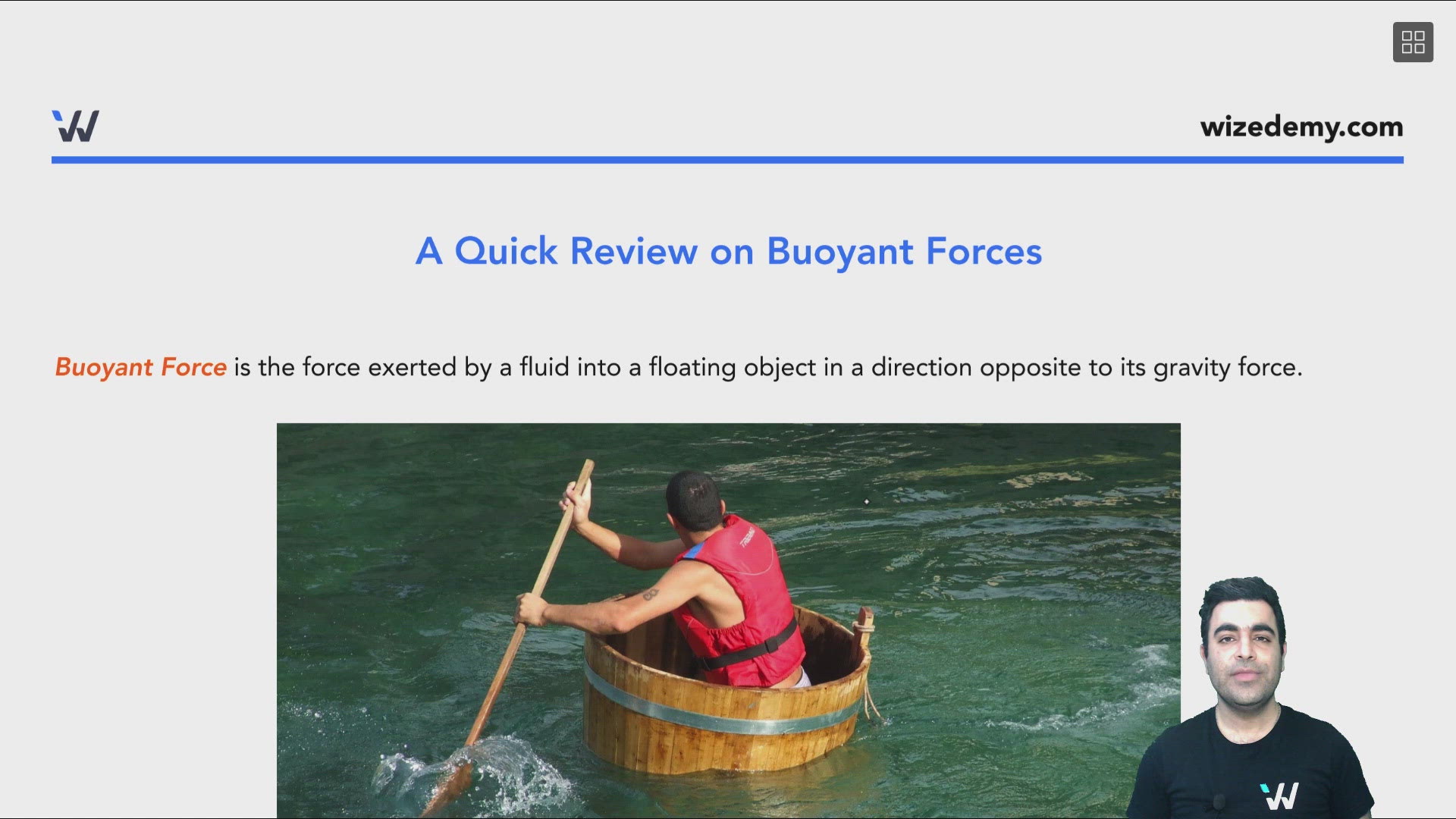
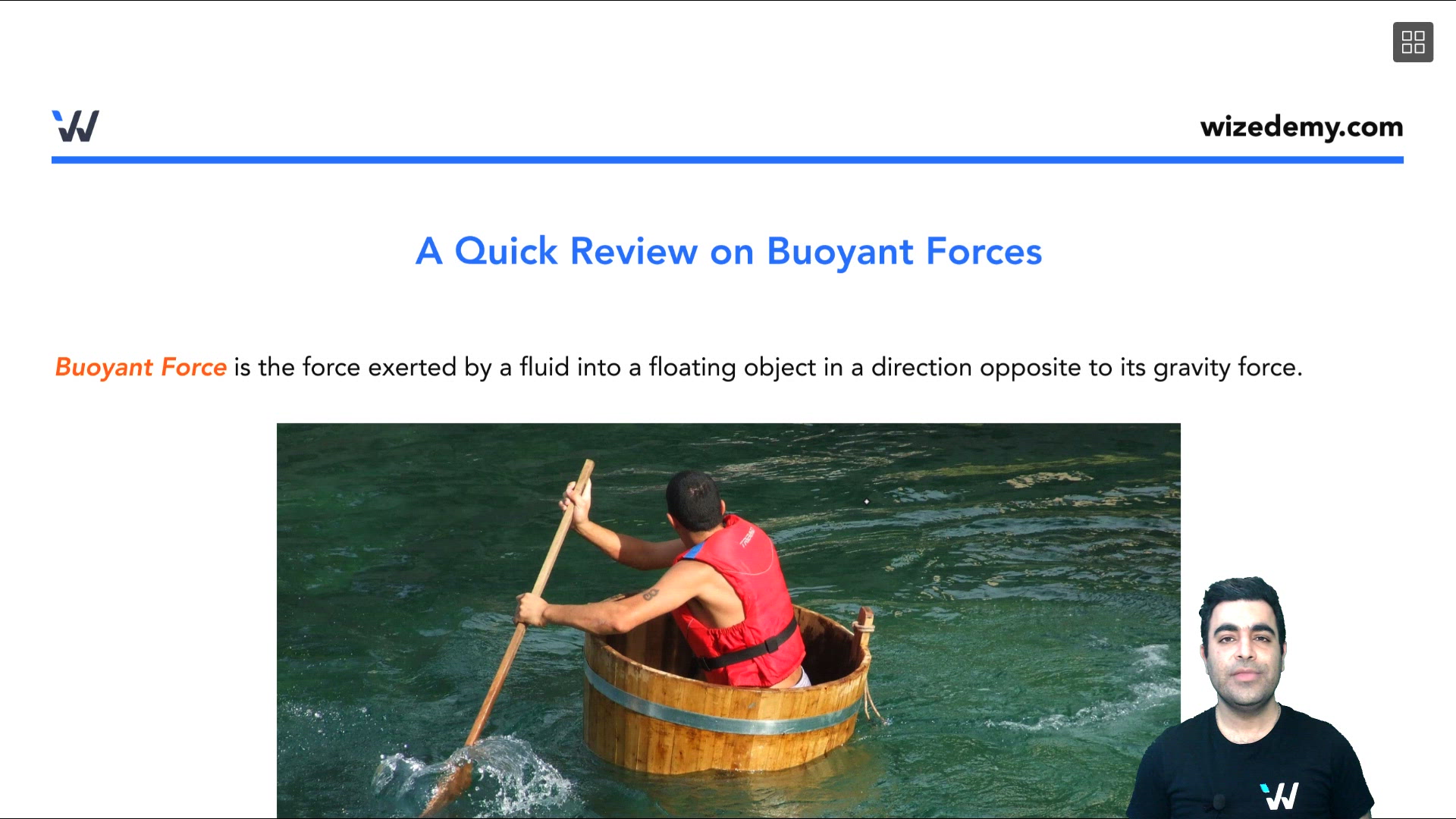
Buoyant Force is the force exerted by a fluid into a floating object in a direction opposite to its gravity force.

Buoyant Force has the following relation:
whereis the density of fluid, is the submerged volume of the object and is the gravitational acceleration.
Free body diagram of the floating object would be:
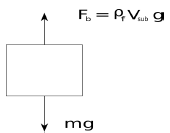
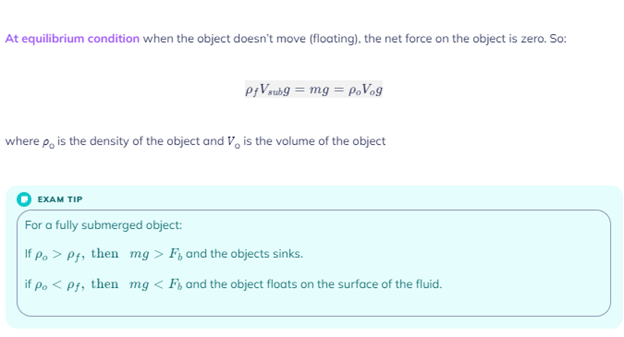
At equilibrium condition when the object doesn’t move (floating), the net force on the object is zero. So:
where 𝜌o is the density of the object and 𝑉o is the volume of the object
Exam Tip
For a fully submerged object:
If and the objects sinks.
if and the object floats on the surface of the fluid.
0:00 / 0:00
0:00 / 0:00
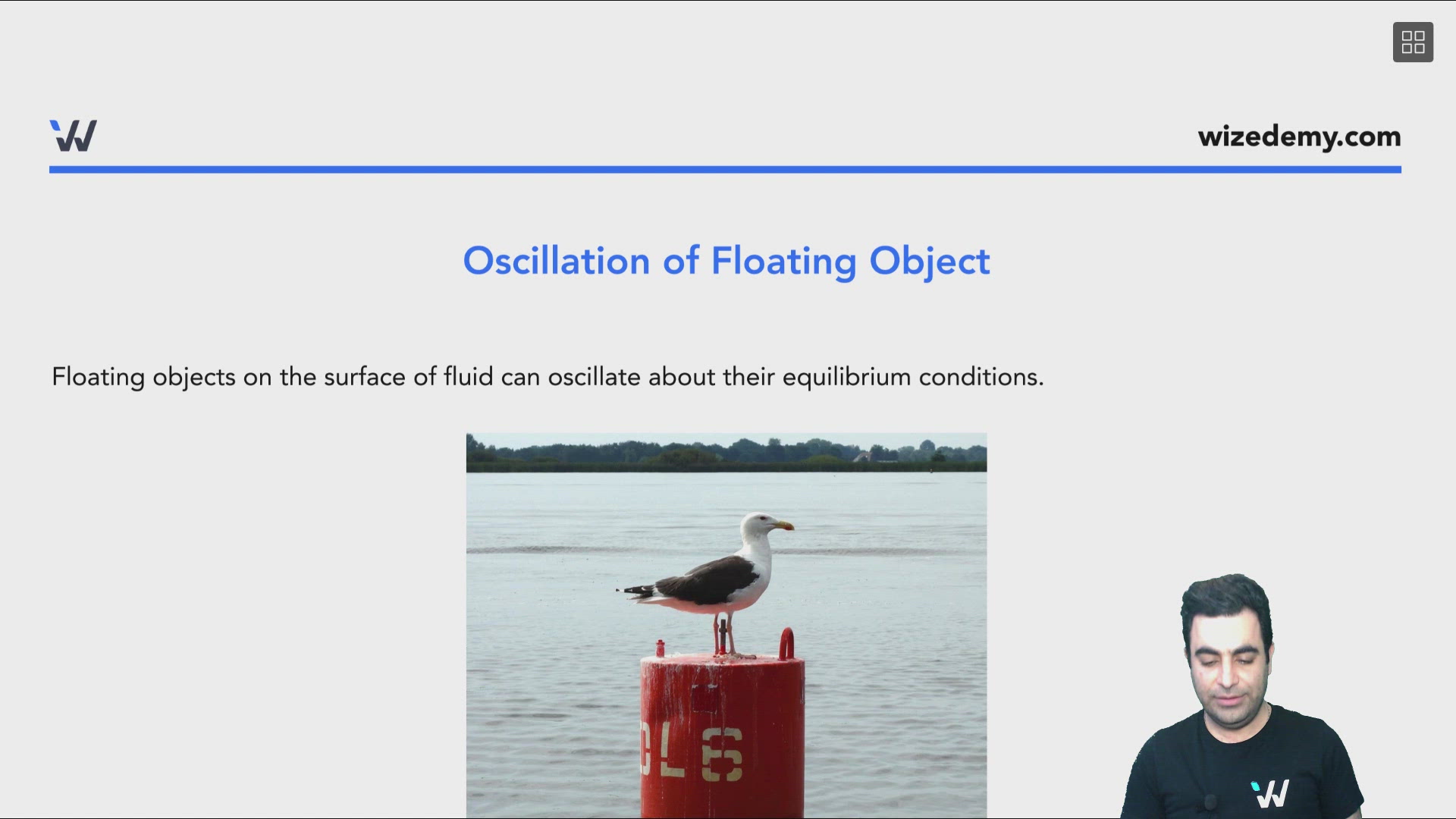
Oscillation of Floating Object
Floating objects on the surface of fluid can oscillate about their equilibrium conditions.

Imagine we have a floating vertical cylinder with cross sectional area of S on the surface of some fluid. When stationary, the cylinder is at equilibrium and net force on that is zero.
If we push the cylinder down by 𝑥, extra upward buoyant force 𝐹b acts on the cylinder to bring it back to the equilibrium position. This force is equal to:
where is the change in the volume of cylinder submerged in water and is the density of the fluid.
Wize Concept
Since this force is proportional to displacement from equilibrium and is restoring, it could be described by SHM!
By compared above force with general form of SHM forces 𝐹 = −𝑘𝑥 we have:
can be considered as the effective spring constant for oscillation of a floating object.
Finally, the angular frequency of these type of oscillation could be found as:
Exam Tip
Note that oscillation of a floating object is very similar to a vertical spring. So, by changing mass of the floating object we can shift the position of equilibrium!
0:00 / 0:00
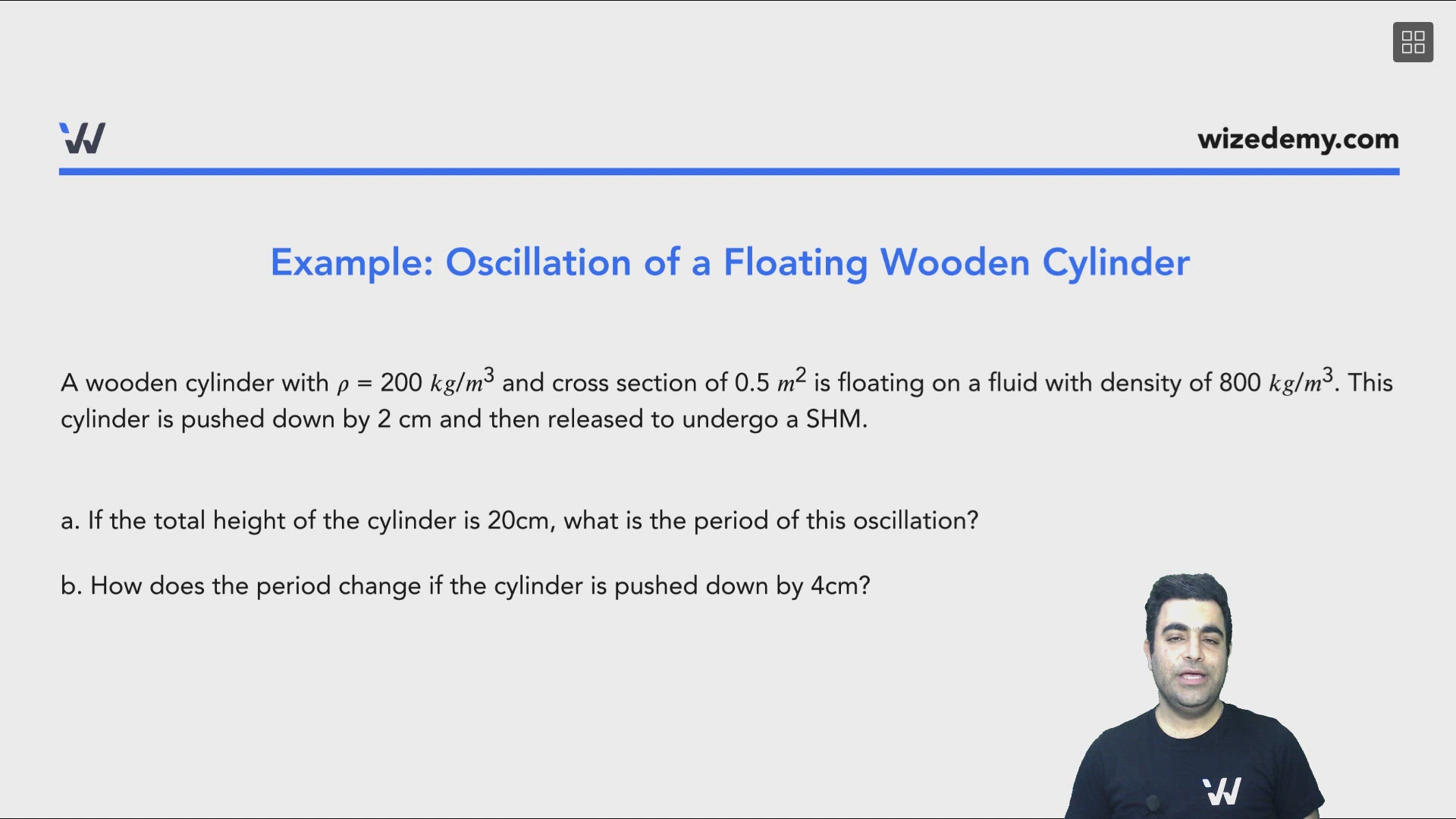
Example: Oscillation of a Floating Wooden Cylinder
A wooden cylinder with 𝜌 = 200 𝑘𝑔/𝑚3 and cross section of 0.5 𝑚2 is floating on a fluid with density of 800 𝑘𝑔/𝑚3. This cylinder is pushed down by 2 cm and then released to undergo a SHM.
a. If the total height of the cylinder is 20cm, what is the period of this oscillation?
b. How does the period change if the cylinder is pushed down by 4cm?
Solution:
Part a)
we remember that for a floating object, the driving force of oscillation is:
where the effective spring constant is also shown in the above equation.
By knowing this effective spring constant, we can find the period of the oscillation as:
We can find the mass of the cylinder by knowing its dimensions and its density:
So,
Part b)
The period of SHM is independent of the amplitude of the oscillation. So, it does not change.
Practice: Seagull Sitting on a Buoy
A seagull is sitting on a buoy close to Seward harbour in Alaska. The Seagull has the mass of 2kg and the buoy has the mass of 50kg. It flies away gently at t=0s and the buoy starts oscillating. Find the amplitude and period of this oscillation if the buoy has a cross sectional area of and the density of sea water is equal to .