
Forced Oscillation and Resonance
The decaying energy of a damped oscillation could be restored by applying a driving force. This type of the oscillation is known as forced or driven oscillation. This force could be periodic and has the following form:
Here is the driven angular frequency which is the frequency at which the force is exerted.
Example: A swinging baby pushed by her father.

The amplitude of a driven oscillation is found to be proportional to the following expression:
If is close to , the amplitude becomes very large.
Example: Forced Oscillation in a Pendulum
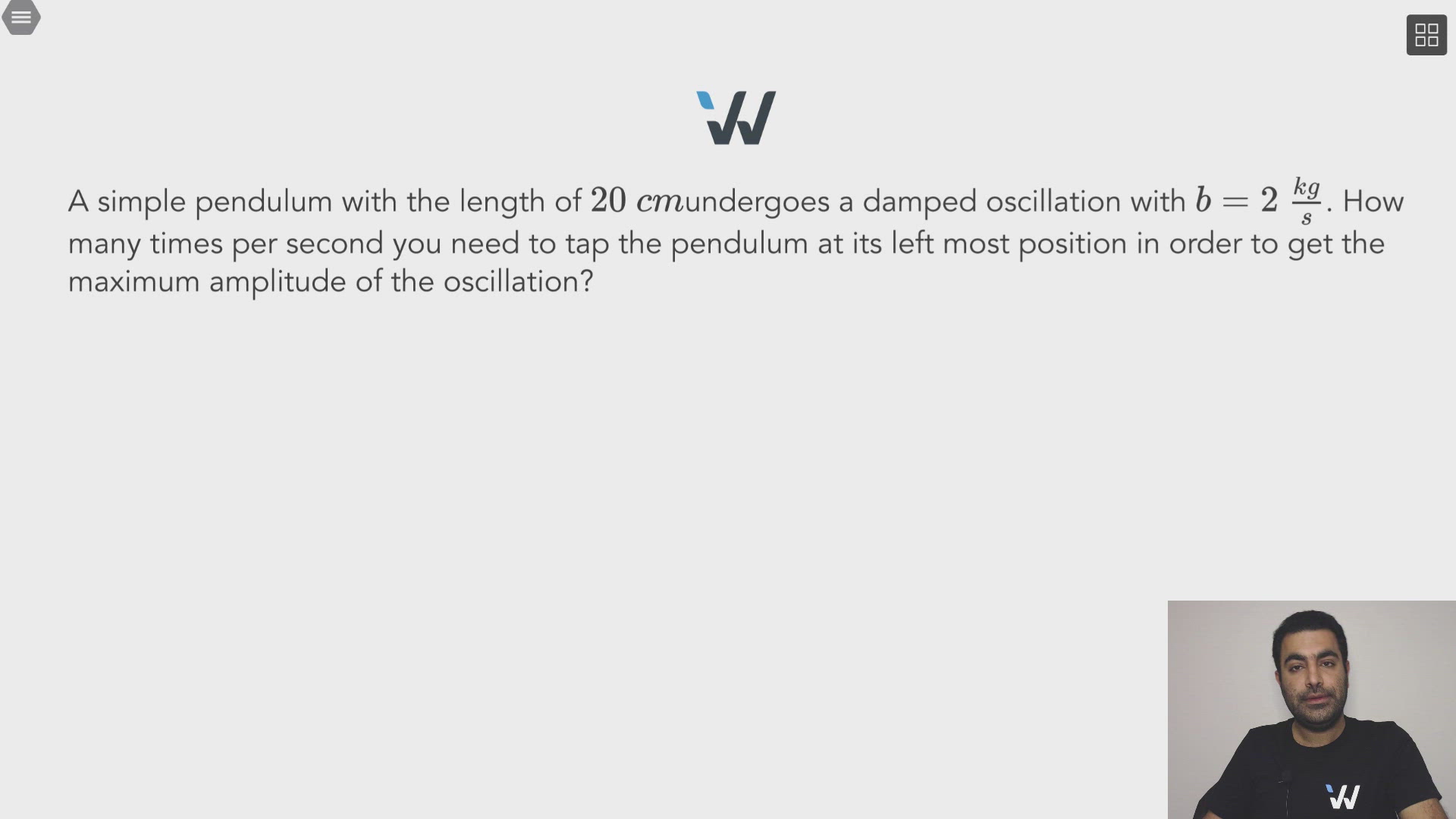
A simple pendulum with the length of undergoes a damped oscillation with . How many times per second you need to tap the pendulum at its left most position in order to get the maximum amplitude of the oscillation? (Hint: The natural frequency of a pendulum is equal to where is the length of the pendulum.)
Solution:
Note that, by tapping, we exert force on the pendulum and force it to oscillate. Thus, we have a forced oscillation. In addition, since we are looking for "maximum amplitude", we are talking about resonance condition. Hence:
at resonance condition
To find the number of times to tap the pendulum to get resonance, we need to find the frequency at which force is exerted: