Wize University Physics Textbook (Master) > Periodic Motion: Oscillations
Critical Damping and Over-Damping Conditions
Popular Courses
Intro to Physics
University Study Guides
PHYSICS 1D03
McMaster University
Physics
General Course
PHYS 157
University of British Columbia
PHYS 131
University of British Columbia
PHYS*1300
University of Guelph
Intro to Physics
University Study Guides
PHYS 131
McGill University
LE/PHYS 1800 3.00
York University
PHYS-1400
University of Windsor
PHYS 142
McGill University
PHYS 117
University of British Columbia
ENGG 212
University of Calgary
PHYS 111
University of Victoria
PHYS 1050
University of Manitoba
PHYS 101
Simon Fraser University
PHYS-1300
University of Windsor
PHY 1121
University of Ottawa
ECE 105
University of Waterloo
PHY 1124
University of Ottawa

0:00 / 0:00
Critical Damping and Over-Damping Conditions
If the damping constant is relatively large, the system does not do even a single oscillation. In this case, the mass just decays to its equilibrium exponentially.
Critical Damping Condition
In underdamped conditions, the oscillation decays faster by increasing . At a very special point when , there would be no oscillation anymore. This condition is called critical damping condition.
- In this condition, . So:
- There is no oscillation and the displacement decays to zero exponentially

Wize Concept
The system has critical damping condition if:
Overdamping Condition
If , the system would be in overdamping condition
- There is again no oscillation in overdamped condition.
- decays to zero at a slower rate compared to a critically damped condition.
- The bigger the value of the damping constant is, the slower goes to zero
Wize Tip
The bigger the value of the damping constant is, the slower goes to zero.
Watch Out!
Usually you only need to describe these two conditions qualitatively.
0:00 / 0:00
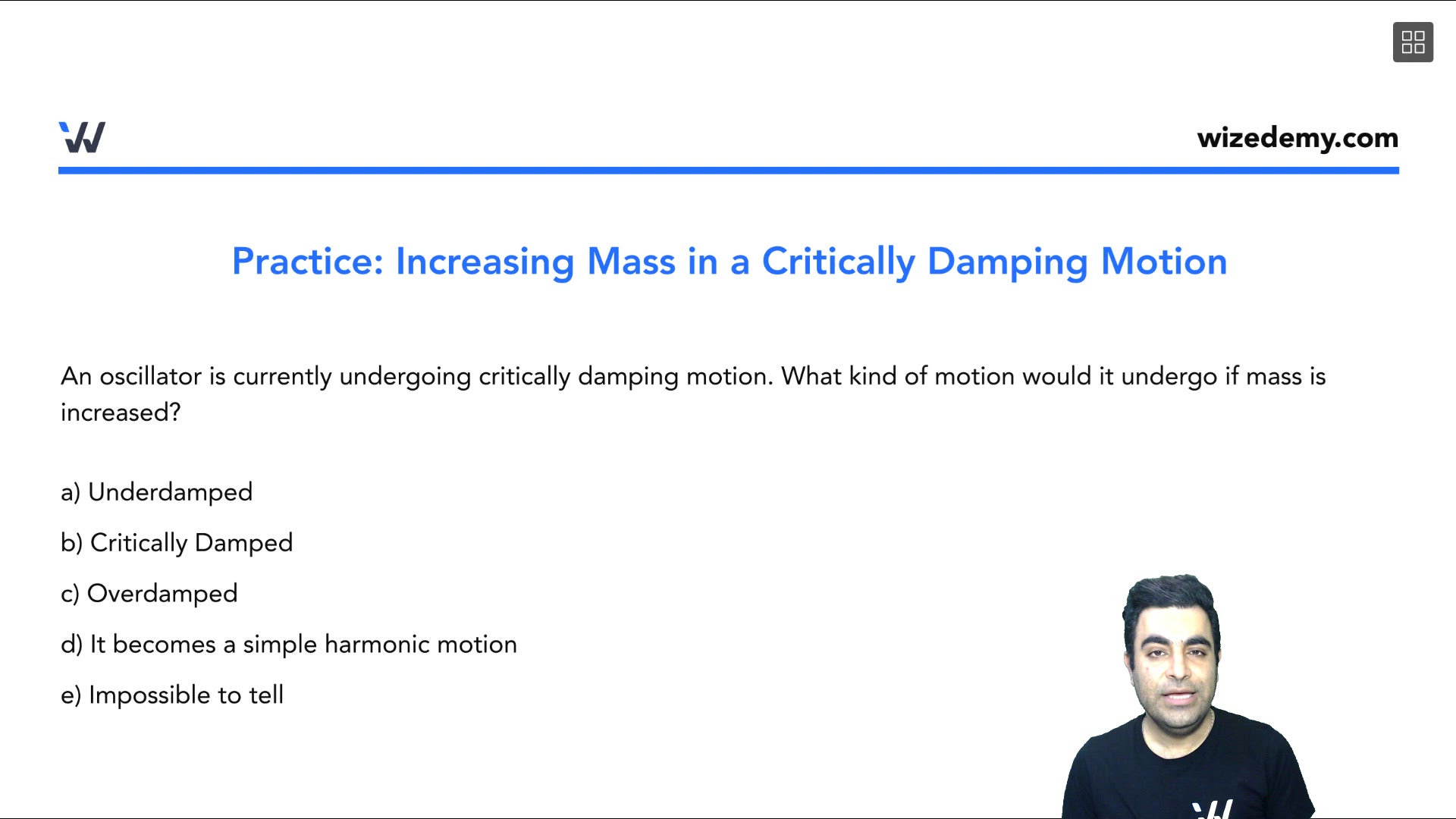
An oscillator is currently undergoing critically damping motion. What kind of motion would it undergo if mass is increased?
UNDERDAMPED

An oscillator is currently undergoing critically damping motion. What kind of motion would it undergo if friction is increased?