Wize University Physics Textbook (Master) > Periodic Motion: Oscillations
Underdamped Oscillations
Popular Courses
Intro to Physics
University Study Guides
PHYSICS 1D03
McMaster University
Physics
General Course
PHYS 157
University of British Columbia
PHYS 131
University of British Columbia
PHYS*1300
University of Guelph
Intro to Physics
University Study Guides
PHYS 131
McGill University
LE/PHYS 1800 3.00
York University
PHYS-1400
University of Windsor
PHYS 142
McGill University
PHYS 117
University of British Columbia
ENGG 212
University of Calgary
PHYS 111
University of Victoria
PHYS 1050
University of Manitoba
PHYS 101
Simon Fraser University
PHYS-1300
University of Windsor
PHY 1121
University of Ottawa
ECE 105
University of Waterloo
PHY 1124
University of Ottawa

0:00 / 0:00
Damped Oscillation
In real systems, there are always resistive forces that oppose oscillation. These resistive forces cause the total energy of the system to decay. A type of these resistive forces is proportional to the speed of the oscillator and is show by:
where is the damping constant and shows the strength of the resistive force.

The net force acting on the oscillator in this case is equal to:
The solution of the above equation for and the behaviour of the physical system depend on the magnitude of the damping constant.
Watch Out!
We still see some oscillations only for relatively small damping constants. This condition is known as underdamped condition and the oscillation in this case is known as damped oscillation.
Underdamped Condition
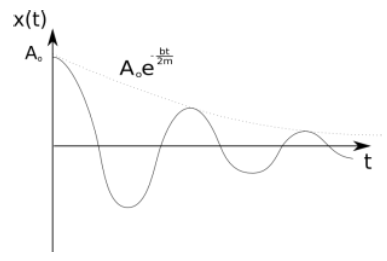
For small values of damping constants, the object undergoes an underdamped oscillation which is described by:
Wize Concept
The system still oscillates in underdamped condition but with a decaying amplitude. The amplitude of this oscillation is given by:
where is the initial amplitude or
Note: The larger the damping constant is, the faster goes to zero.
The Time Constant is defined as and it is a measure of damping strength. It is a time it takes for the amplitude of the oscillation to drop to of its initial value.
Wize Tip
The bigger the time constant is, the longer time it takes for the amplitude to decay to of its initial value which means that there is a smaller damping constant.
Underdamped oscillation happens with a different angular velocity than the one for SHM. This angular frequency is known as damped angular frequency and is usually shown by ,or:
- is the angular frequency of the undamped system (SHM) and is also known as natural frequency.

0:00 / 0:00
Energy in a Damped Oscillation
Energy is no longer conserved in a damped oscillation. The total energy of the system could still be obtained by but here is a function of time:
Watch Out!
Pay attention to the difference in the exponent of in and ! The energy exponent is twice the amplitude exponent. This means that energy function decays faster than the amplitude function.
0:00 / 0:00
Example: Decaying Amplitude vs Decaying Energy
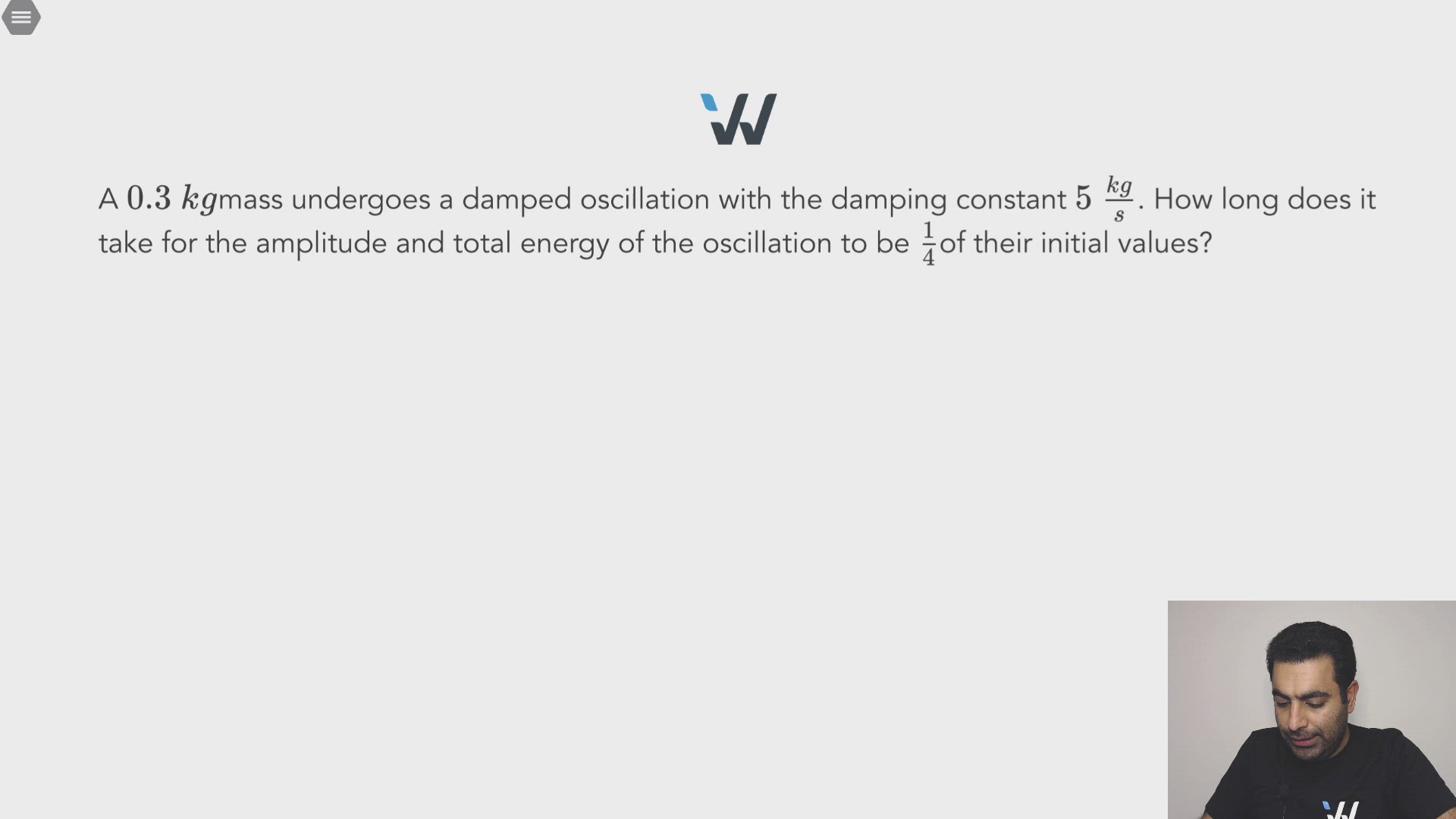
A mass undergoes a damped oscillation with the damping constant . How long does it take for the amplitude and total energy of the oscillation to be of their initial values?
Solution:
Let's set to be the time at which amplitude is dropped to of its initial value.
Now let's do the same calculations for energy and set as the time at which energy is dropped to of its initial value.
As you can see it takes shorter for energy to decay to one quarter of its initial value compared to amplitude.
50 person taking a bungee jump:
If the initial length of the bungee cord is 20 and at the lowest point the length of the cord is 25, what is the spring constant of the cord?