Create a free account to get started

Unlock full course notes by signing up

  • Video lessons taught by top educators
  • Practice questions with guided solutions
  • Written review notes for reference
  • Expert answers anytime from course tutors

Mechanical Work

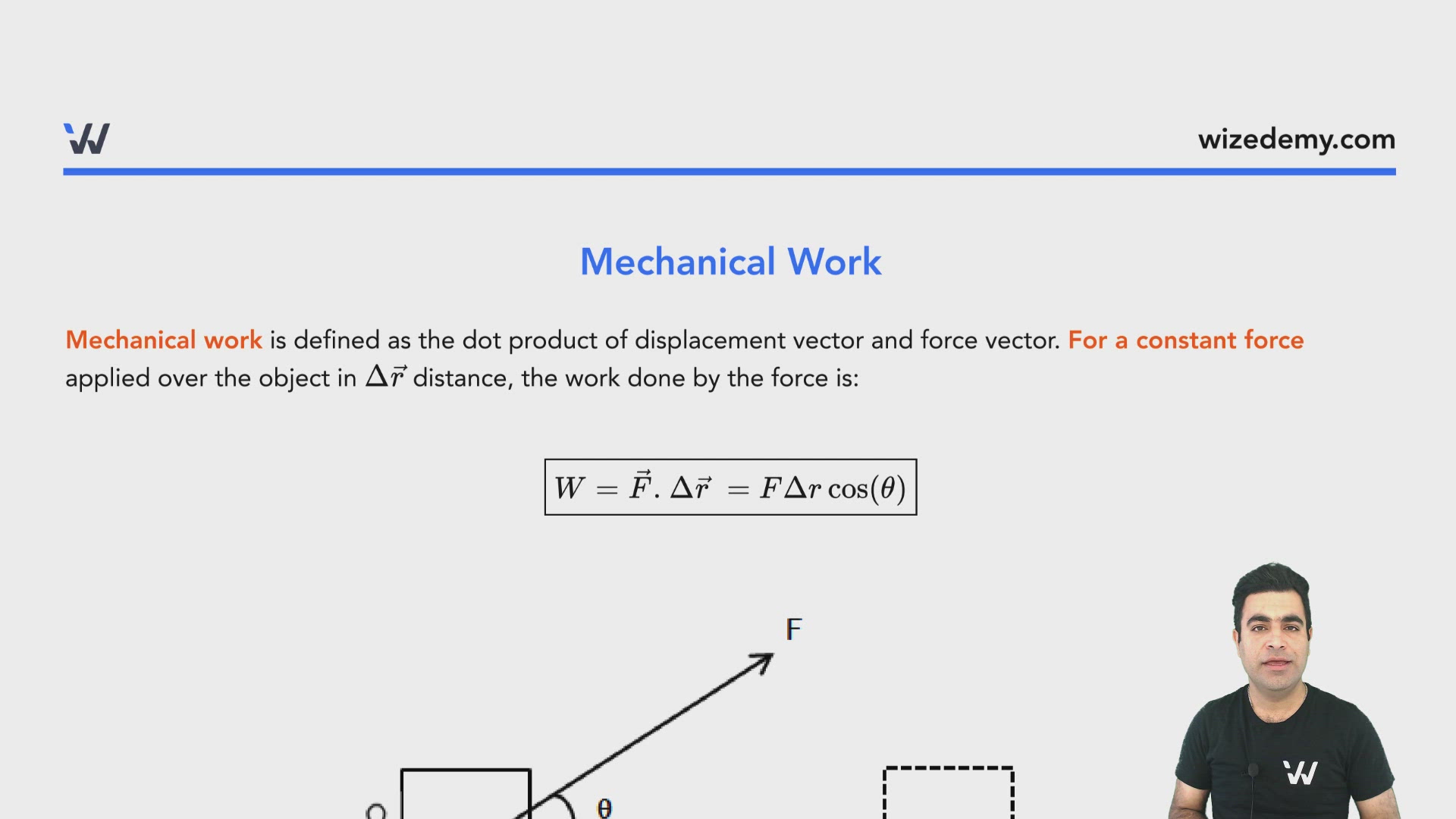
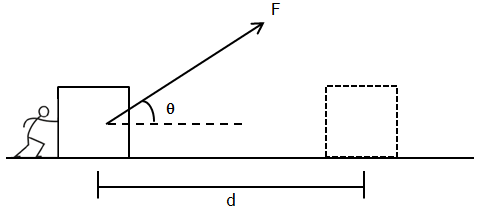
Mechanical work is defined as the dot product of displacement vector and force vector. For a constant force applied over the object in Δr⃗\Delta\vec{r} distance, the work done by the force is:

W=F⃗. Δr⃗ =FΔrcos⁡(θ)\boxed{W=\vec{F}.\ \Delta\vec{r}\ =F\Delta r \cos(\theta)}


Image illustrating Mechanical Work


where θ\thetais the angle between force direction and direction of motion of the object.

The SI unit of work is the Joule.1 J=1N⋅m=1 kg⋅m2s21\ J=1N\cdot m=1\ \frac{kg\cdot m^2}{s^2}


Mechanical Work Sign

Work is a scalar quantity and can be either positive, negative or zero:

  1. If the applied force F (and the displacement d are in the same direction, work done is positive – e.g: pushing block forward
  2. If F and d are in opposite directions (cos 180° = −1), work done is negative – e.g. applying brakes in a moving car
  3. Work is zero if either
  • displacement is zero, so the work done is zero – e.g. pushing against a wall OR
  • θ = 90°, so cos θ = 0 (force is perpendicular to displacement) – e.g. you are carrying a box and moving horizontally (no work done against the force of gravity)


Three cases:
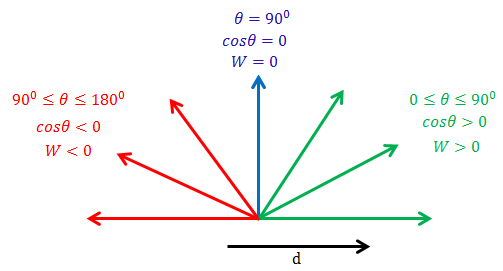

Image illustrating Mechanical Work


Create a free account to get started

Unlock full course notes by signing up

  • Video lessons taught by top educators
  • Practice questions with guided solutions
  • Written review notes for reference
  • Expert answers anytime from course tutors

Example: Sign of Mechanical Work


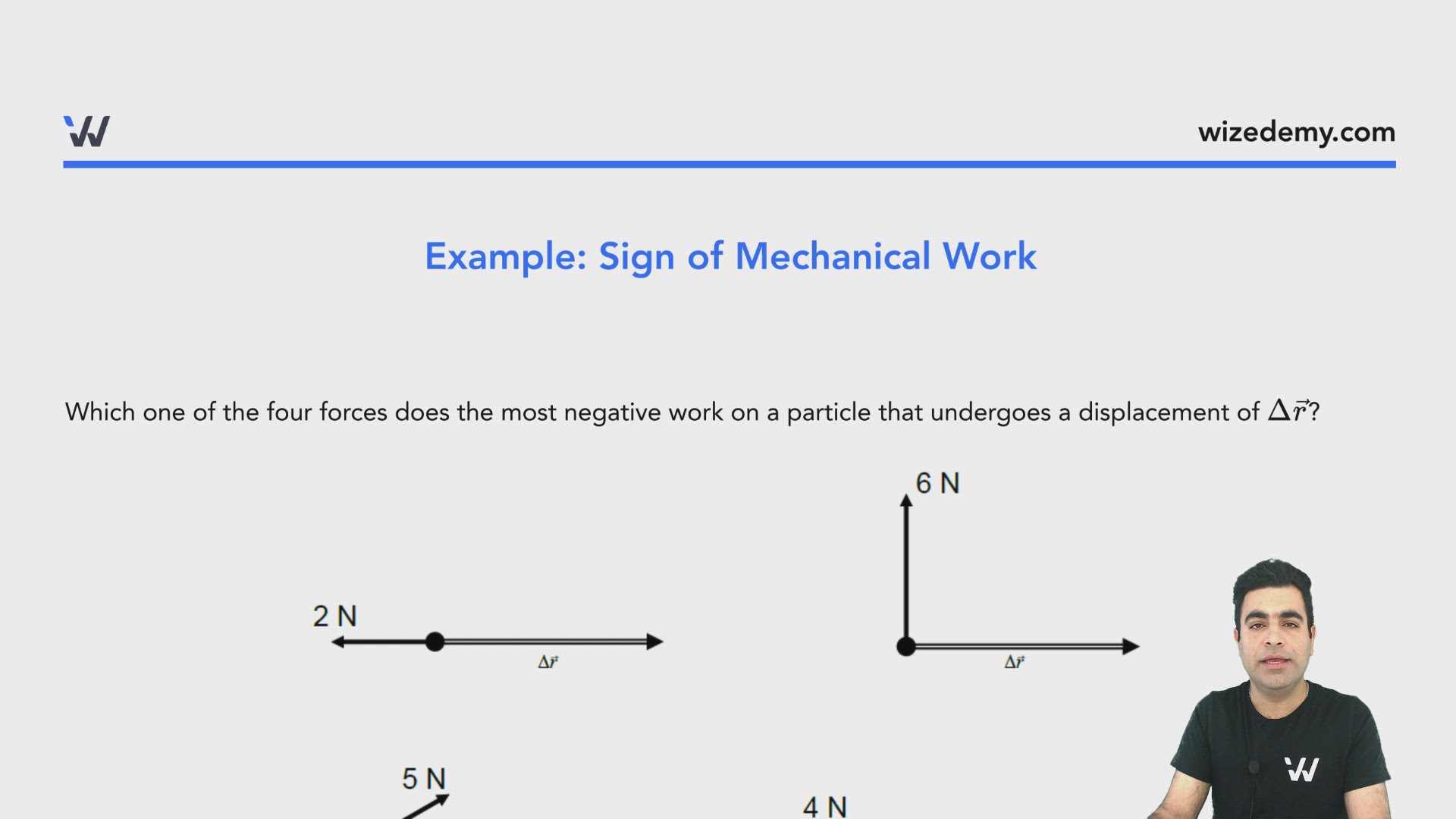
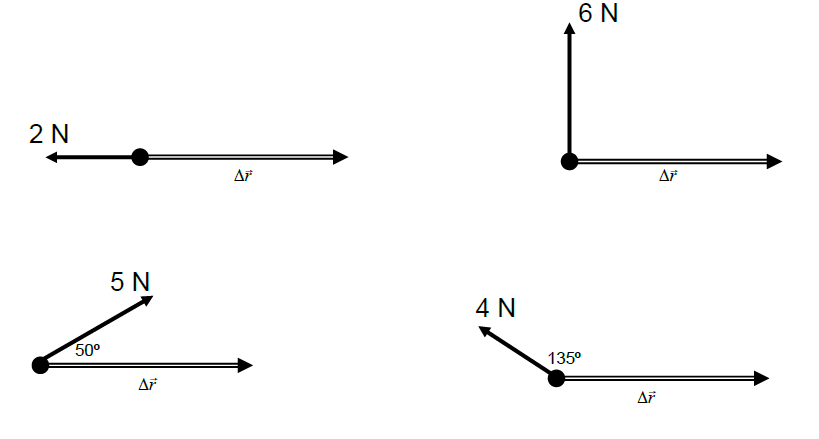
Which one of the four forces does the most negative work on a particle that undergoes a displacement of Δr⃗\Delta\vec{r}?


Image illustrating Example: Positive vs. Negative Work

Solution:


Note that all cases has the same displacement vector. Using the definition of work as W=F . Δr⃗=F Δrcos⁡(θ)W=F\ .\ \Delta\vec{r}=F\ \Delta r\cos\left(\theta\right) indicates that:


For the top left case:

W=2×Δr×cos⁡(180)=−2ΔrW=2\times\Delta r\times\cos\left(180\right)=-2\Delta r

For the top right case:

W=6×Δr×cos⁡(90)=0W=6\times\Delta r\times\cos\left(90\right)=0

For the bottom left case:

W=5×Δr×cos⁡(50)=+3.2ΔrW=5\times\Delta r\times\cos\left(50\right)=+3.2\Delta r

For the bottom right case:

W=4×Δr×cos⁡(135)=−2.82ΔrW=4\times\Delta r\times\cos\left(135\right)=-2.82\Delta r


Thus, the answer is the 4 N force, on the bottom right corner, which makes angle of 135 degrees with the displacement vector.


A 20 kg wagon rests on an inclined plane with angle 30°. The wagon is pulled up the inclined plane by a 200 N tension force along the plane and is displaced by 2 m. The coefficient of kinetic friction between the surfaces is 0.3. What is the net work done on this box? (Hint: You can find the net work by finding the work done on it by all the forces acting on it)

Choose an answer

Create a free account to get started

Unlock full course notes by signing up

  • Video lessons taught by top educators
  • Practice questions with guided solutions
  • Written review notes for reference
  • Expert answers anytime from course tutors

Extra Practice