Create a free account to get started

Unlock full course notes by signing up

  • Video lessons taught by top educators
  • Practice questions with guided solutions
  • Written review notes for reference
  • Expert answers anytime from course tutors

Damped Oscillation


In real systems, there are always resistive forces that oppose oscillation. These resistive forces cause the total energy of the system to decay. A type of these resistive forces is proportional to the speed of the oscillator and is show by:


Fresistive=−bvF_{resistive}=-bv


where bb is the damping constant and shows the strength of the resistive force.


Image illustrating Damped Oscillation Theory


The net force acting on the oscillator in this case is equal to:


F=−kx−bv=maF=-kx-bv=ma


The solution of the above equation for x(t)x\left(t\right)and the behaviour of the physical system depend on the magnitude of the damping constant.


Underdamped Condition

For small values of damping constants(b2m<km)\left(\frac{b}{2m}<\sqrt{\frac{k}{m}}\right), the object undergoes an underdamped oscillation which is described by:
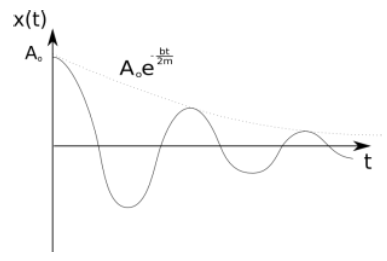


x(t)=Aoe−bt2mcos⁡(ω′t+φ)\boxed{x\left(t\right)=A_oe^{-\frac{bt}{2m}}\cos\left(\omega't+\varphi\right)}


Image illustrating Damped Oscillation Theory


The Time Constant τ\tau is defined as τ=2mb\tau=\dfrac{2m}{b}and it is a measure of damping strength. It is a time it takes for the amplitude of the oscillation to drop to 1/e1/eof its initial value.


Underdamped oscillation happens with a different angular velocity than the one for SHM. This angular frequency is known as damped angular frequency and is usually shown by ωdamped\omega_{damped},orω′\omega':


  ω′=ωo2−(b2m)2=km−(b2m)2  \boxed{\ \ \omega'=\sqrt{\omega_o^2-\left(\frac{b}{2m}\right)^2}=\sqrt{\frac{k}{m}-\left(\frac{b}{2m}\right)^2}\ \ }
  • ωo\omega_ois the angular frequency of the undamped system (SHM) and is also known as natural frequency.


Create a free account to get started

Unlock full course notes by signing up

  • Video lessons taught by top educators
  • Practice questions with guided solutions
  • Written review notes for reference
  • Expert answers anytime from course tutors

Energy in a Damped Oscillation


Energy is no longer conserved in a damped oscillation. The total energy of the system could still be obtained by 12kA2\frac{1}{2}kA^2but here AA is a function of time:


E(t)=12kA2(t)=12kAo2e−btm\boxed{E\left(t\right)=\frac{1}{2}kA^2\left(t\right)=\frac{1}{2}kA_o^2e^{-\frac{bt}{m}}}


Create a free account to get started

Unlock full course notes by signing up

  • Video lessons taught by top educators
  • Practice questions with guided solutions
  • Written review notes for reference
  • Expert answers anytime from course tutors

Example: Decaying Amplitude vs Decaying Energy


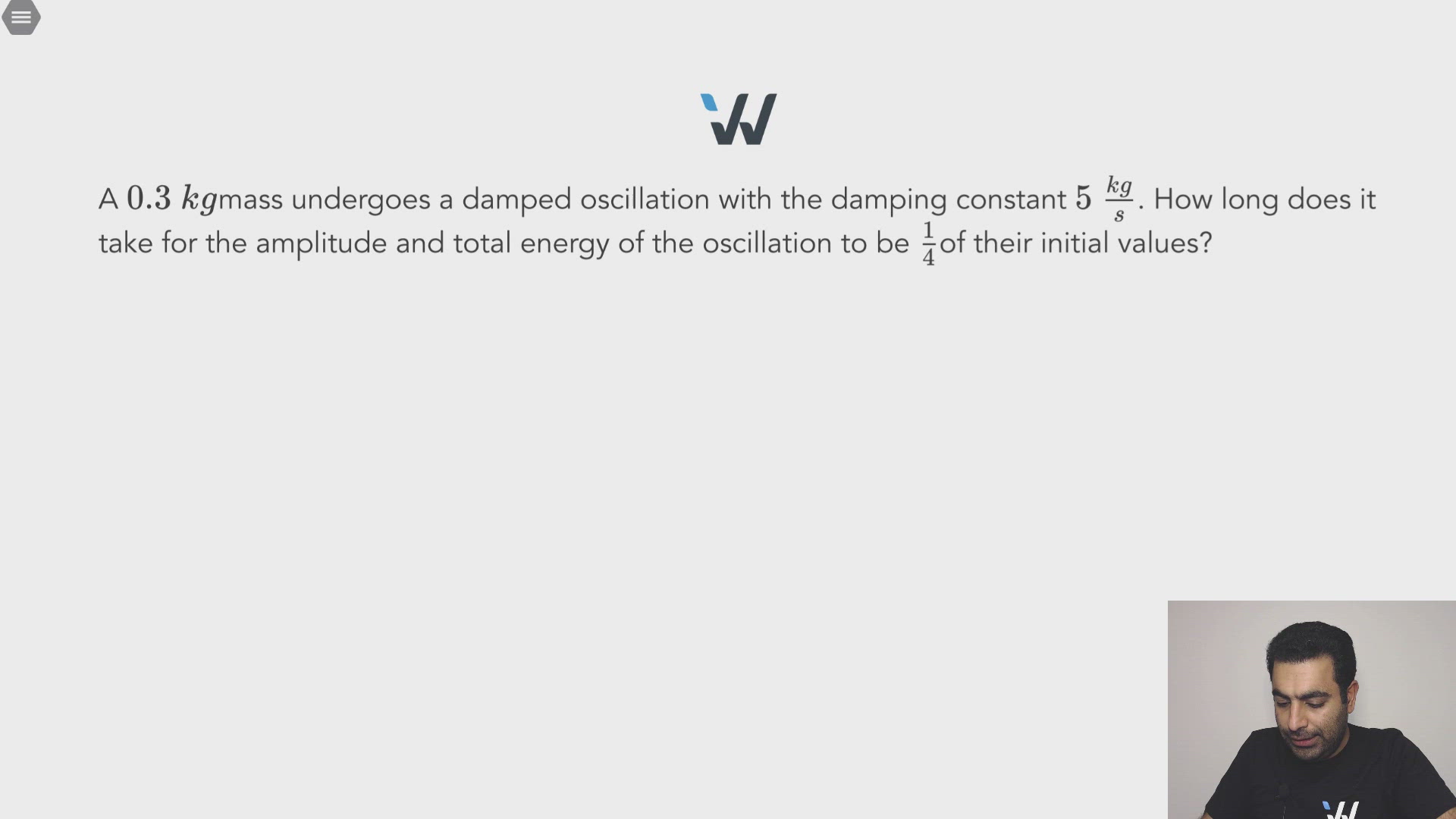
A 0.3 kg0.3\ kgmass undergoes a damped oscillation with the damping constant 5 kgs5\ \frac{kg}{s}. How long does it take for the amplitude and total energy of the oscillation to be 14\frac{1}{4}of their initial values?


Solution:


Let's set t1t_1to be the time at which amplitude is dropped to 14\frac{1}{4}of its initial value.


A(t1)=A0 e−bt12m=14A0A\left(t_1\right)=A_{0\ }e^{-\dfrac{bt_1}{2m}}=\dfrac{1}{4}A_0→e−bt12m=14→ln⁡(14)=−bt12m=−ln⁡(4)\to e^{-\dfrac{bt_1}{2m}}=\dfrac{1}{4}\to\ln\left(\dfrac{1}{4}\right)=-\dfrac{bt_1}{2m}=-\ln\left(4\right)


→ln⁡(4)=bt12m→t1=2mln⁡(4) b=2×0.3×ln⁡(4)5=0.1663 s\to\ln\left(4\right)=\dfrac{bt_1}{2m}\to t_1=\dfrac{2m\ln\left(4\right)\ }{b}=\dfrac{2\times0.3\times\ln\left(4\right)}{5}=0.1663\ s


Now let's do the same calculations for energy and set t2t_2as the time at which energy is dropped to 14\frac{1}{4}of its initial value.


E(t2)=12kA02e−bt2m=14E0=14×12kA02E\left(t_2\right)=\dfrac{1}{2}kA_0^2e^{-\dfrac{bt_2}{m}}=\dfrac{1}{4}E_0=\dfrac{1}{4}\times\dfrac{1}{2}kA_0^2→e−bt2m=14→ln⁡(4)=bt2m\to e^{-\dfrac{bt_2}{m}}=\dfrac{1}{4}\to\ln\left(4\right)=\dfrac{bt_2}{m}


→t2=mln⁡(4)b=0.3ln⁡(4)5=0.0832 s\to t_2=\dfrac{m\ln\left(4\right)}{b}=\dfrac{0.3\ln\left(4\right)}{5}=0.0832\ s


As you can see it takes shorter for energy to decay to one quarter of its initial value compared to amplitude.


50 kgkg person taking a bungee jump:

If the initial length of the bungee cord is 20 mm and at the lowest point the length of the cord is 25mm, what is the spring constant of the cord?


Choose an answer

Create a free account to get started

Unlock full course notes by signing up

  • Video lessons taught by top educators
  • Practice questions with guided solutions
  • Written review notes for reference
  • Expert answers anytime from course tutors