Uniform Circular Motion
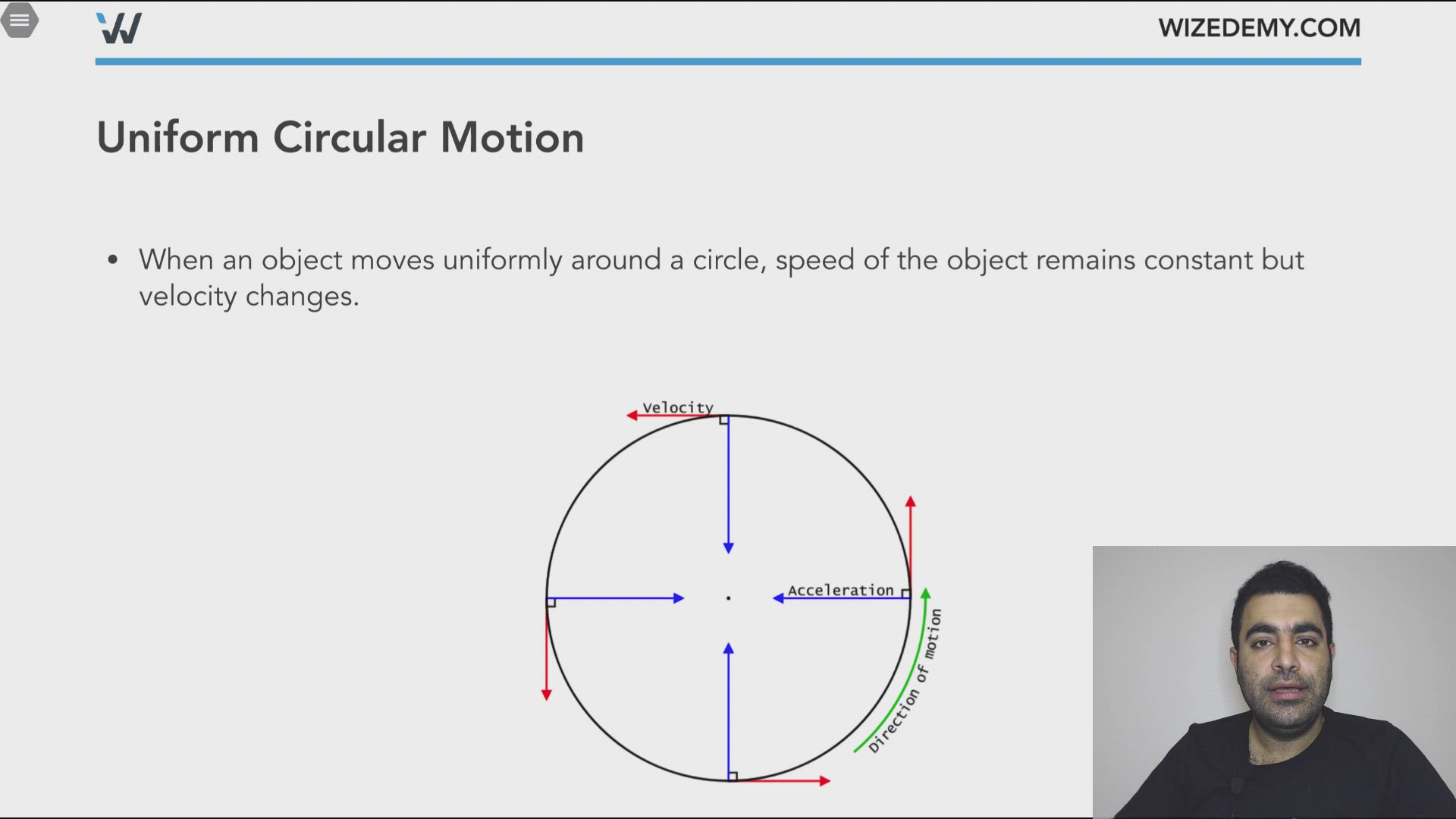
- When an object moves uniformly around a circle, speed of the object remains constant but velocity changes.

- Speed of the object is found by dividing circumference of the circle by the period of motion T (time to traverse a full circle):
- Instantaneous velocity here is tangent to the circular path at any point.
- In uniform circular motion, vector which shows the direction of acceleration, is pointing towards the center of rotation.
The acceleration is called Centripetal Acceleration- directed towards the center of a circle, that keeps an object moving in a circular path.
Examples of uniform circular motion:
- A vehicle moving around a circular track
- Amusement park rides, ferris wheel, merry-go-round
- The moon, or satellites orbiting the Earth in a circular orbit
- Any object moving in a circle with constant speed!
Centripetal Force
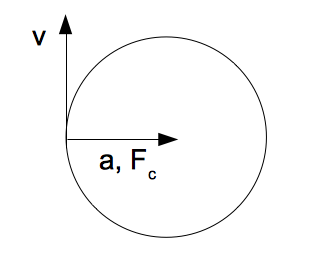
- For objects moving in uniform circular motion, the acceleration always points in towards the center of the circle.
- This means that there must be a net force towards the center of the circle that is providing this acceleration.
This force is not a separate force, but it is a force that is part of the situation acting on the object or is a net force. For example, it could be friction, an applied force, gravity, or tension.
- The centripetal force is equal to the net force on the object. This is the condition in which motion in a circle enforces.
- For an object of mass m moving at tangential speed v around a circular path of radius r, the magnitude of its centripetal force is:
Tips for solving uniform circular motion problems:
Draw a clearly labeled free body diagram.
Calculate the net force
Set the net force equal to the centripetal force equation (net force = centripetal force here)
Solve for the unknown!
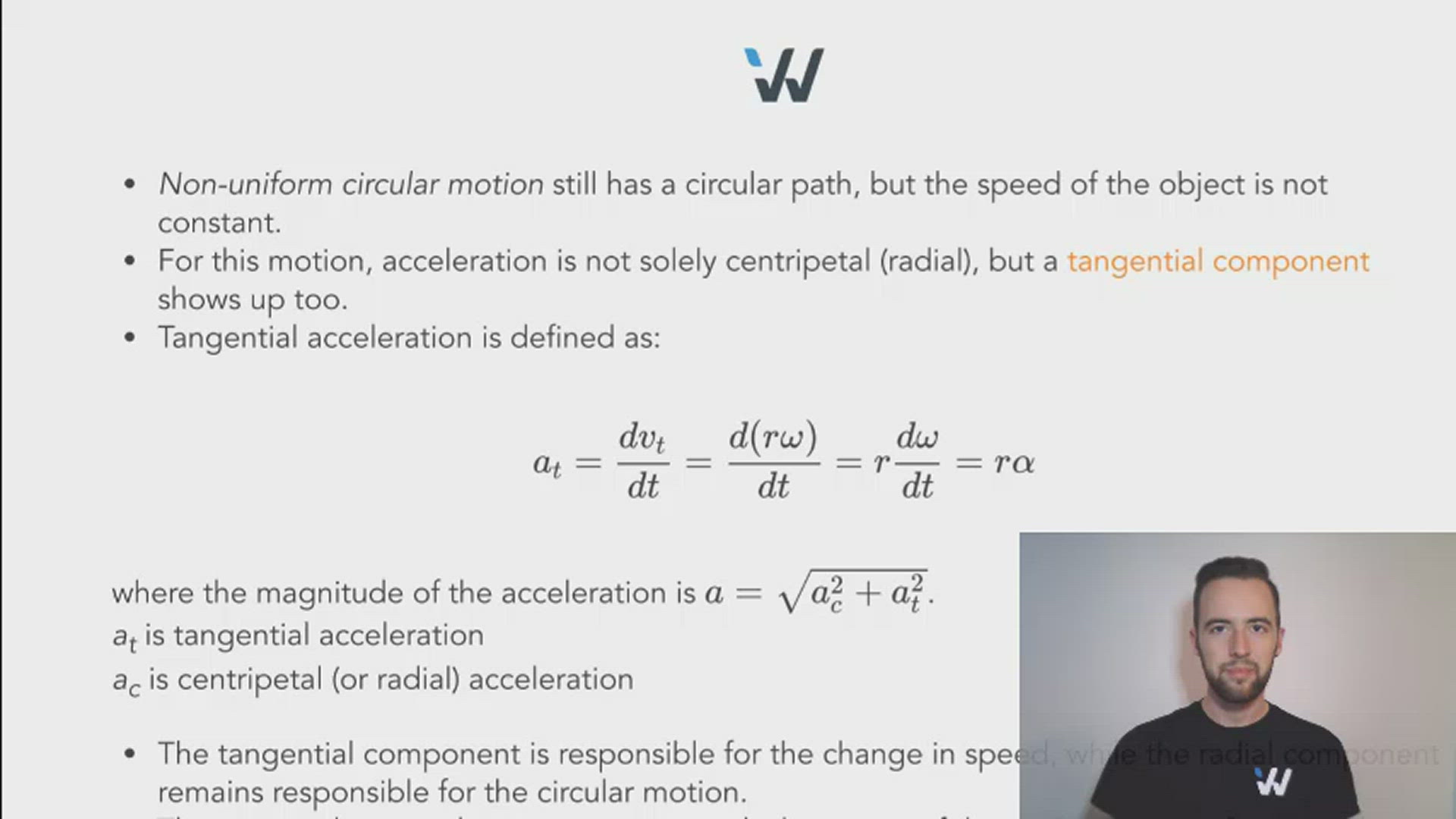
- Non-uniform circular motion still has a circular path, but the speed of the object is not constant.
- For this motion, acceleration is not solely centripetal (radial), but a tangential component shows up too.
- Tangential acceleration is defined as:
where the magnitude of the acceleration is .
at is tangential acceleration
ac is centripetal (or radial) acceleration
- The tangential component is responsible for the change in speed, while the radial component remains responsible for the circular motion.
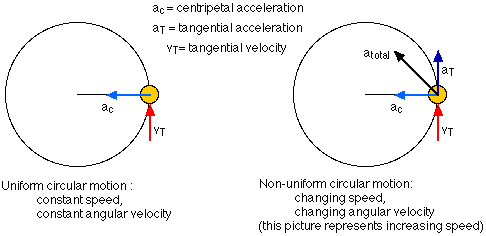
- The net acceleration does not point towards the center of the circle in non-uniform circular motion.
Note:
- If the angle between at and v is less than 90o, the object is speeding up
- If the angle between at and v is greater than 90o, the object is slowing up
An object rotates at distance of 1.8m from the center, traveling with an angular velocity of 2.0 rad/s. What is the centripetal acceleration of the object?
Centripetal (aka Radial) Acceleration = ac = ar = v2/r
Linear (v) and Angular Velocity (w): v = r w
therefore, ac = (r w)2/r = r w2 = (1.8)(2.0)2 = 7.2 m/s2