Wize University Physics Textbook (Master) > Motion in Two Dimensions
The Position, Velocity, and Acceleration Vectors
Popular Courses
PHYSICS 1201A/B
Western University
Intro to Physics
University Study Guides
Physics
General Course
PHYSICS 1E03
McMaster University
PHYS 211
University of Calgary
PHYSICS 1401A/B
Western University
Intro to Physics
University Study Guides
PHYS 223
University of Calgary
PHYS*1080
University of Guelph
PHYS 124
University of Alberta
PHY 1321
University of Ottawa
APSC 112
Queen's University
APSC 111
Queen's University
PHYSICS 1402A/B
Western University
PHYS 205
Concordia University
PCS 120
Toronto Metropolitan University
PHYS 110
University of Victoria
PHY 1331
University of Ottawa
PHY 1122
University of Ottawa
PHYS 142
McGill University
0:00 / 0:00
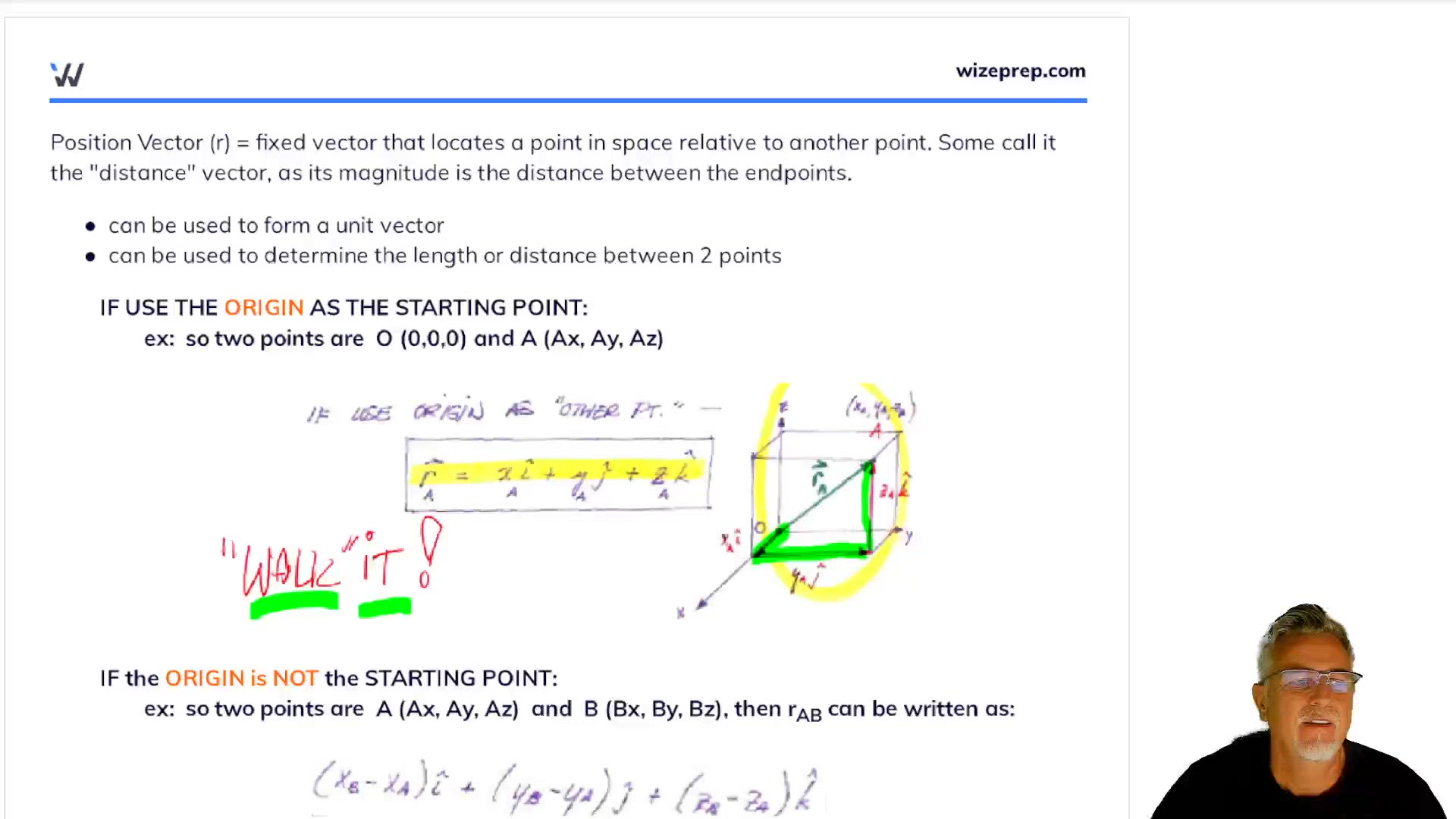
Position Vector (r) = fixed vector that locates a point in space relative to another point. Some call it the "distance" vector, as its magnitude is the distance between the endpoints.
- can be used to form a unit vector
- can be used to determine the length or distance between 2 points
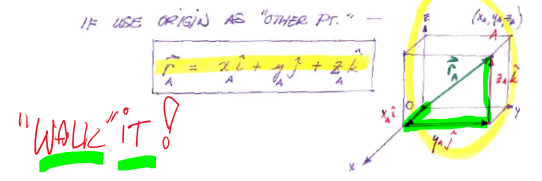
IF USE THE ORIGIN AS THE STARTING POINT:
ex: so two points are O (0,0,0) and A (Ax, Ay, Az)
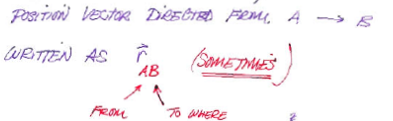
IF the ORIGIN is NOT the STARTING POINT:
ex: so two points are A (Ax, Ay, Az) and B (Bx, By, Bz), then rAB can be written as:

Wize Tip
Reduce errors by re-writing the coordinates A(x, y, z) and B(x, y, z) BEFORE building the position vector. Don't pull the numbers right from the figure as you build it - easy to make mistakes!
0:00 / 0:00
Two- and Three-Dimensional Kinematics: Part 1
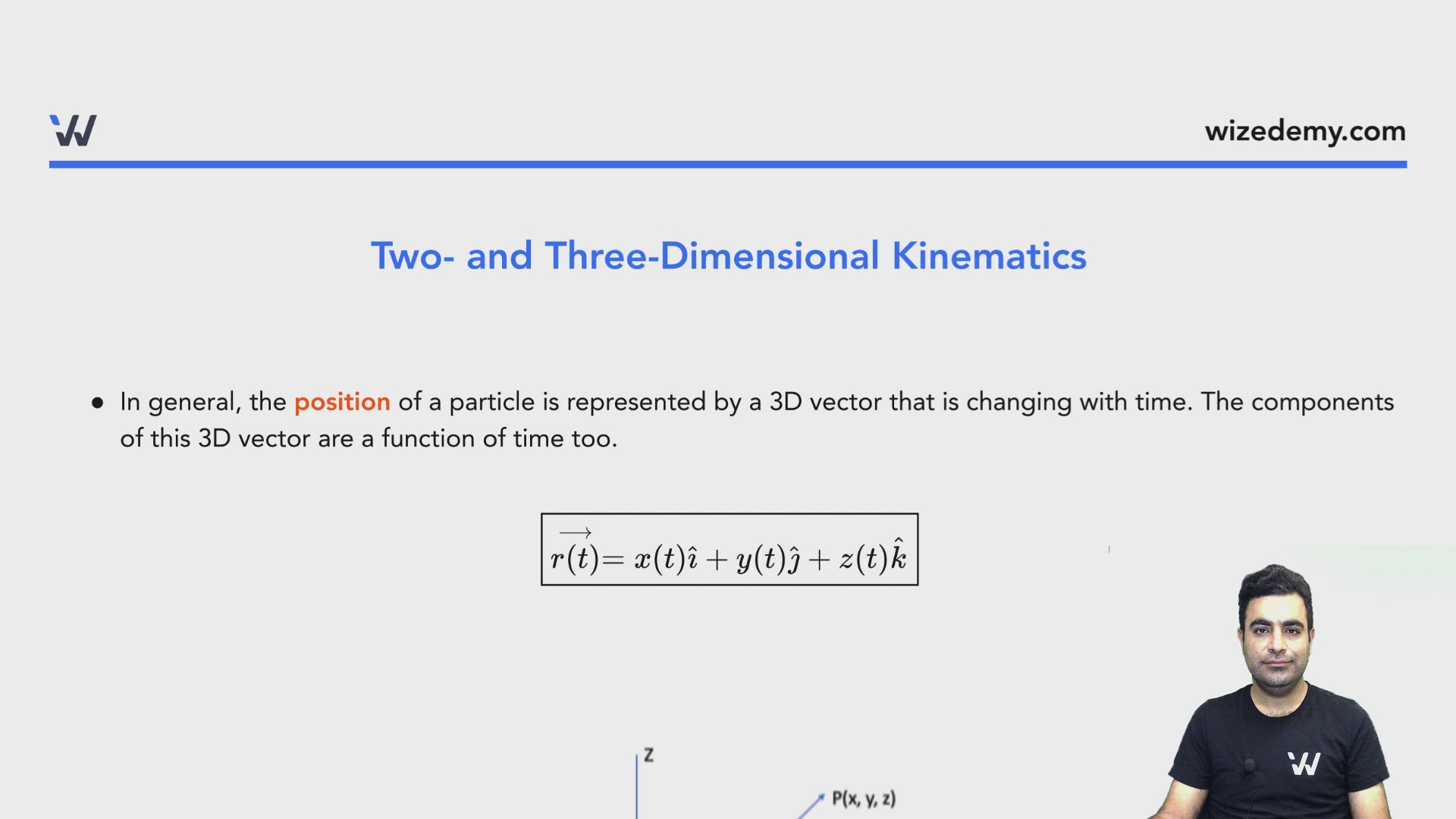
- In general, the position of a particle is represented by a 3D vector that is changing with time. The components of this 3D vector are a function of time too.
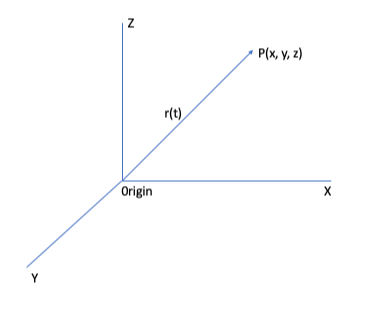
- Displacement is a vector that shows the change in position of the particle. The unit of displacement is m.
- Distance is the length of the path travelled by the particle
- Average velocity is defined as
- Instantaneous velocity is the velocity of an object in a specific time or position which in general might be different from the average velocity
- So, basically, the instantaneous velocity is obtained by taking the derivative of position with respect to time.
Wize Tip
Average speed and instantaneous speed could be found similarly if displacement vector is replaced by distance in above equations.
0:00 / 0:00
Example: Position and Velocity
Given that the velocity of a body, starting from the origin, and moving along the x-axis, is , find the position of the moving body at .
Since the velocity is the derivative of position, position will be the integral of the velocity:
Integrate to find position:
Find the constant using the fact that the object starts at the origin, that is, position is zero when time is zero: . Put this in the equation to get:
Therefore the position function is:
At the position is:
Practice: Position Vectors
Given the points and find
0:00 / 0:00
Example: Velocity and Acceleration in 3D
The position of a particle in 3D is given by
a) Calculate instantaneous velocity at t =5 sec
b) Calculate the average velocity for an interval (3-5 sec).
c) Calculate the instantaneous acceleration at t =1 sec.
Solution:
Part a)
We know that Instantaneous velocity is
Part b)
Average velocity:
Part c)
Instantaneous acceleration:

Mark Yourself Question
- Grab a piece of paper and try this problem yourself.
- When you're done, check the "I have answered this question" box below.
- View the solution and report whether you got it right or wrong.
A particle moves back and forth along a line such that it has a position function , where is measured in seconds and in meters. Find the velocity, speed and acceleration at .