Wize University Physics Textbook (Master) > Motion in Two Dimensions
Tangential and Radial Acceleration
Popular Courses
PHYSICS 1201A/B
Western University
Intro to Physics
University Study Guides
Physics
General Course
PHYSICS 1E03
McMaster University
Intro to Physics
University Study Guides
PHYS 223
University of Calgary
PHYS*1080
University of Guelph
PHYS 124
University of Alberta
PHY 1321
University of Ottawa
APSC 112
Queen's University
APSC 111
Queen's University
PHYSICS 1402A/B
Western University
PHYS 205
Concordia University
PCS 120
Toronto Metropolitan University
PHYS 110
University of Victoria
PHY 1331
University of Ottawa
PHY 1122
University of Ottawa
PHYS 142
McGill University
PHYC 1190
Dalhousie University
ENGG 212
University of Calgary
0:00 / 0:00
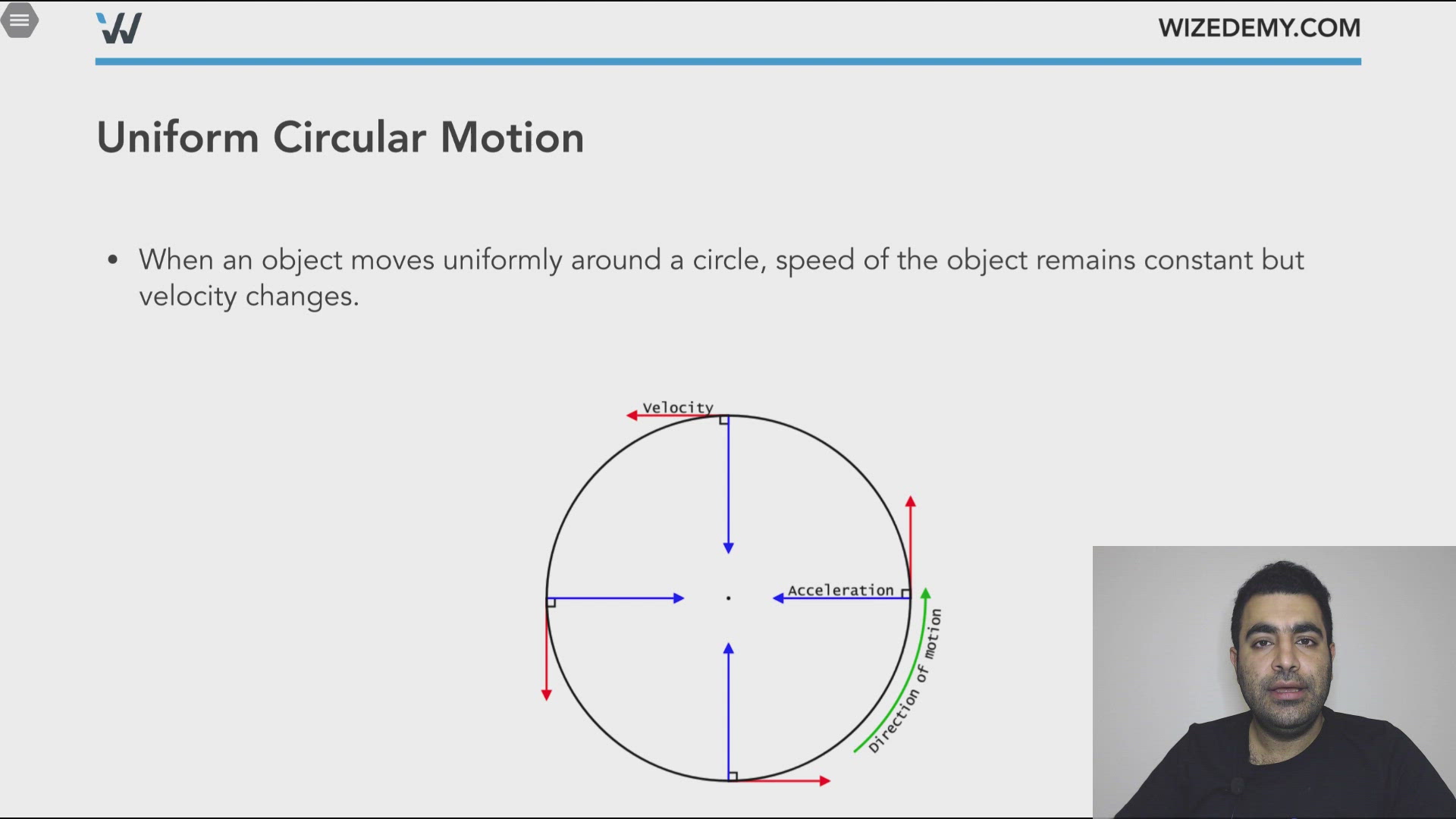
Uniform Circular Motion
- When an object moves uniformly around a circle, speed of the object remains constant but velocity changes.

- Speed of the object is found by dividing circumference of the circle by the period of motion T (time to traverse a full circle):
- Instantaneous velocity here is tangent to the circular path at any point.
- In uniform circular motion, vector which shows the direction of acceleration, is pointing towards the center of rotation.
The acceleration is called Centripetal Acceleration- directed towards the center of a circle, that keeps an object moving in a circular path.
Examples of uniform circular motion:
- A vehicle moving around a circular track
- Amusement park rides, ferris wheel, merry-go-round
- The moon, or satellites orbiting the Earth in a circular orbit
- Any object moving in a circle with constant speed!
Centripetal Force
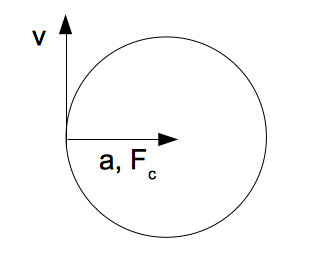
- For objects moving in uniform circular motion, the acceleration always points in towards the center of the circle.
- This means that there must be a net force towards the center of the circle that is providing this acceleration.
This force is not a separate force, but it is a force that is part of the situation acting on the object or is a net force. For example, it could be friction, an applied force, gravity, or tension.
- The centripetal force is equal to the net force on the object. This is the condition in which motion in a circle enforces.
- For an object of mass m moving at tangential speed v around a circular path of radius r, the magnitude of its centripetal force is:
Tips for solving uniform circular motion problems:
Draw a clearly labeled free body diagram.
Calculate the net force
Set the net force equal to the centripetal force equation (net force = centripetal force here)
Solve for the unknown!
0:00 / 0:00
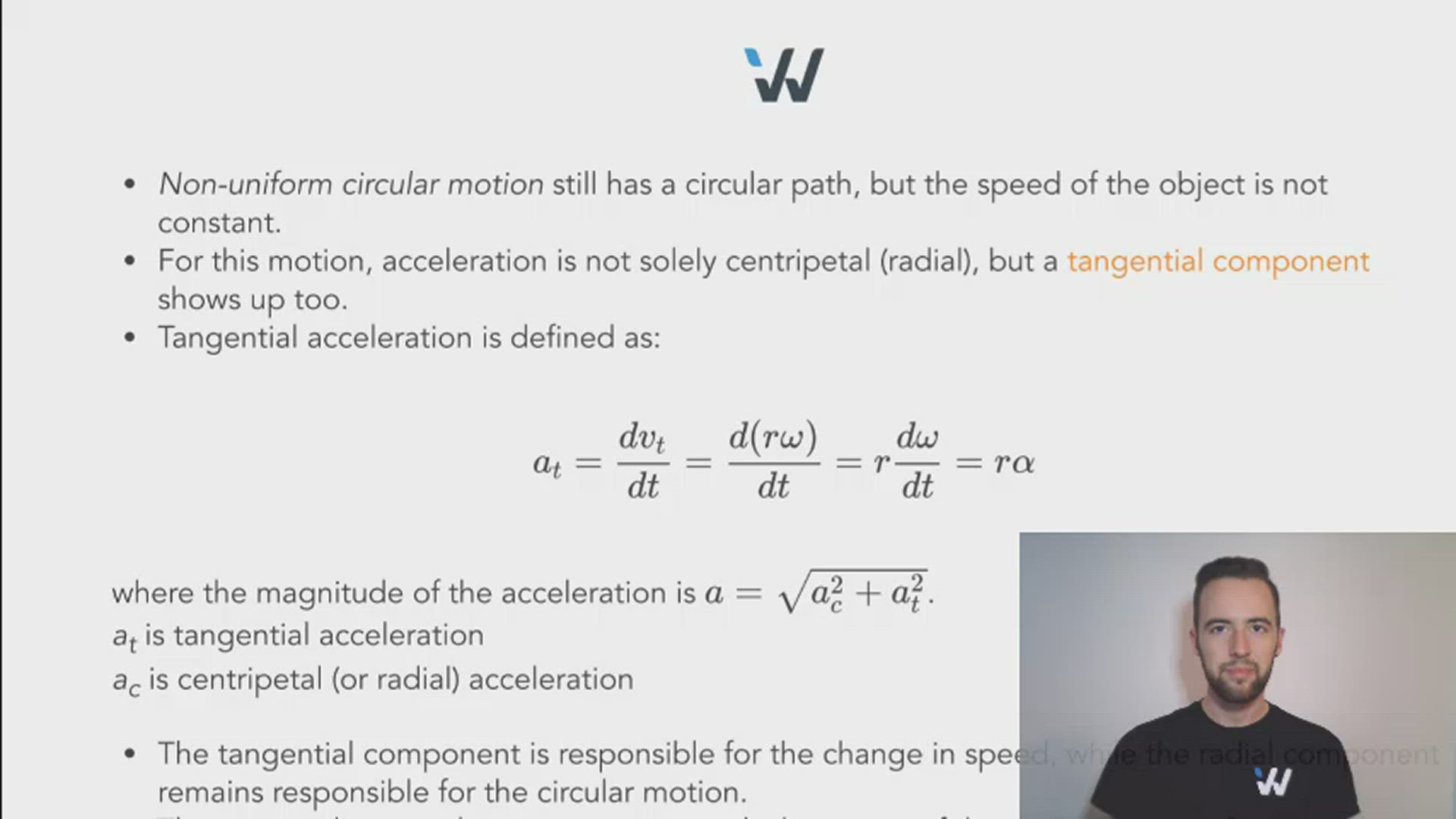
- Non-uniform circular motion still has a circular path, but the speed of the object is not constant.
- For this motion, acceleration is not solely centripetal (radial), but a tangential component shows up too.
- Tangential acceleration is defined as:
where the magnitude of the acceleration is .
at is tangential acceleration
ac is centripetal (or radial) acceleration
- The tangential component is responsible for the change in speed, while the radial component remains responsible for the circular motion.
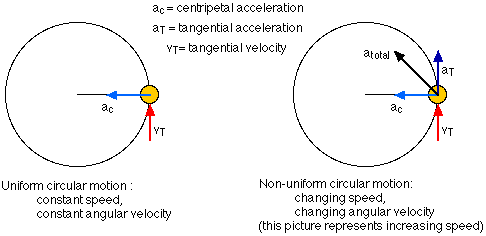
- The net acceleration does not point towards the center of the circle in non-uniform circular motion.
Note:
- If the angle between at and v is less than 90o, the object is speeding up
- If the angle between at and v is greater than 90o, the object is slowing up
An object rotates at distance of 1.8m from the center, traveling with an angular velocity of 2.0 rad/s. What is the centripetal acceleration of the object?
Centripetal (aka Radial) Acceleration = ac = ar = v2/r
Linear (v) and Angular Velocity (w): v = r w
therefore, ac = (r w)2/r = r w2 = (1.8)(2.0)2 = 7.2 m/s2
A car travels in a circular track of radius 10 m. Its speed is changing at a rate of 15.0 m/s2 at an instant when its speed is 40.0 m/s. What is the magnitude of the acceleration of the car?