Faraday's Law of Induction - with calculus

Faraday's Law
Often, we need to use calculus to fully explore problems with Faraday's Law.
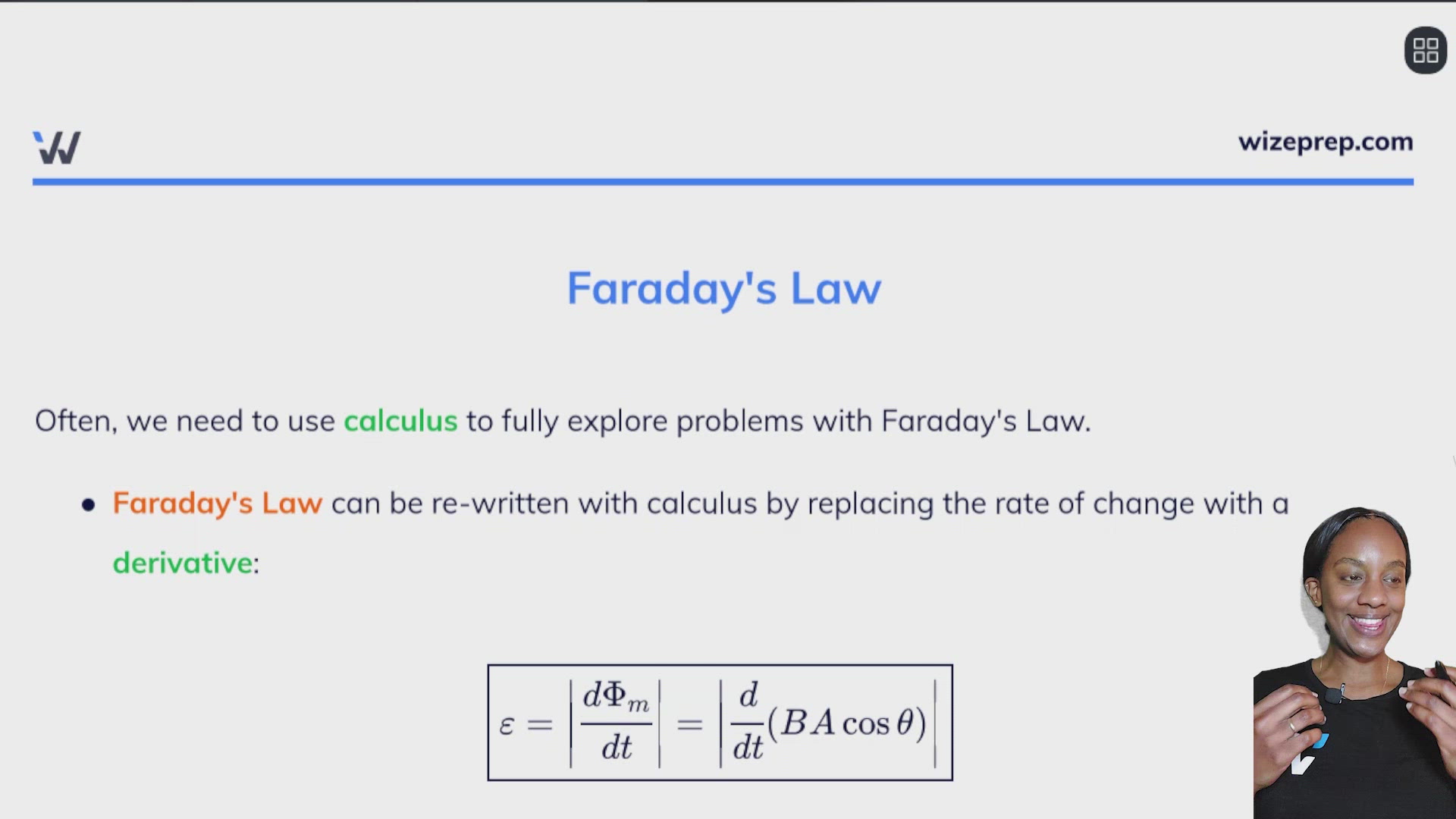
- Faraday's Law can be re-written with calculus by replacing the rate of change with a derivative:
ε=dtdΦm=dtd(BAcosθ)
- With this version of Faraday's Law, we can use the product rule to see what happens if more than one variable is changing.
- For example, if the magnetic field strength B(t)and area A(t)are both functions of time, Faraday's Law would be written as follows:
- If the flux needs to be determined with an integral, the most general form of Faraday's Law can be written as follows:
Practice: Two Rings of Current
Two circles of wire are located on the same plane and have the same center point, as shown below.

The outer loop has a radius of a, and the radius of the inner loop is 8a. The outer loop has a linearly increasing current of I(t)=βt.
a) What is the magnitude of the magnetic field created at the center point by the outer current loop?
b) Assume that the magnetic field at the center point from part (a) is the only magnetic field passing through the inner loop. What is the induced current in the inner loop if it has a resistance of R?
Part a)
Part b)
Practice: Expanding Triangle
Two conducting wires are located in a uniform magnetic field B that points out of the page. The two wires are at an angle of 60 degrees. A vertical bar with resistanceR with constant speed v moves along the axis in the positive x-direction as shown below.
What is the induced current in the bar as a function of x?
