Popular Courses
Grade 12 Physics
Ontario High School
High School Physics
US High School
Grade 12 Physics
Canada High School
PHYSICS 1202A/B
Western University
PHYSICS 1E03
McMaster University
Physics 30
Alberta High School
PHYS 223
University of Calgary
APSC 112
Queen's University
PHYSICS 1402A/B
Western University
PHYS 205
Concordia University
Physics 12
British Columbia High School
PHYS 118
University of British Columbia
PHYS 142
McGill University
ENGG 212
University of Calgary
PHY132H1
University of Toronto
PHY132H1
University of Toronto
PHYS-1300
University of Windsor
PHY 1121
University of Ottawa
PHYS 121
University of Waterloo
PHYSICS 1102A/B
Western University
0:00 / 0:00
Lenz's Law
While Faraday's Law gives the magnitude of an induced emf, we still need a tool to determine the direction of induced currents.
- Lenz’s Law states that an induced current due to a change in magnetic flux will be oriented in a direction such that the magnetic field generated by the induced current will oppose the change in magnetic flux.
- An alternative (and well-known) way of saying it: nature abhors a change in flux.
Wize Concept
Typically, you will need to use the right-hand rule when using Lenz's Law: if your right thumb points in the direction of magnetic field (or flux), then your right-hand fingers will show the corresponding direction of positive current.
- Based on Lenz's Law, Faraday's Law is sometimes re-written with a negative sign as follows:
Exam Tip
Steps to finding the direction of induced current:
- Determine if the magnetic flux is increasing or decreasing.
- Point your right thumb either in the same or opposite direction as the flux:
- If the flux is increasing, point in the opposite direction of the flux (the induced current will try to decrease the flux)
- If the flux is decreasing, point in the same direction of the flux (the induced current will try to add more flux)
- Curl your fingers. The direction of curl shows the direction of the induced current.

0:00 / 0:00
Example: Lenz's Law
The following magnetic field increases in strength at a constant rate. What is the direction of the induced current in the loop?
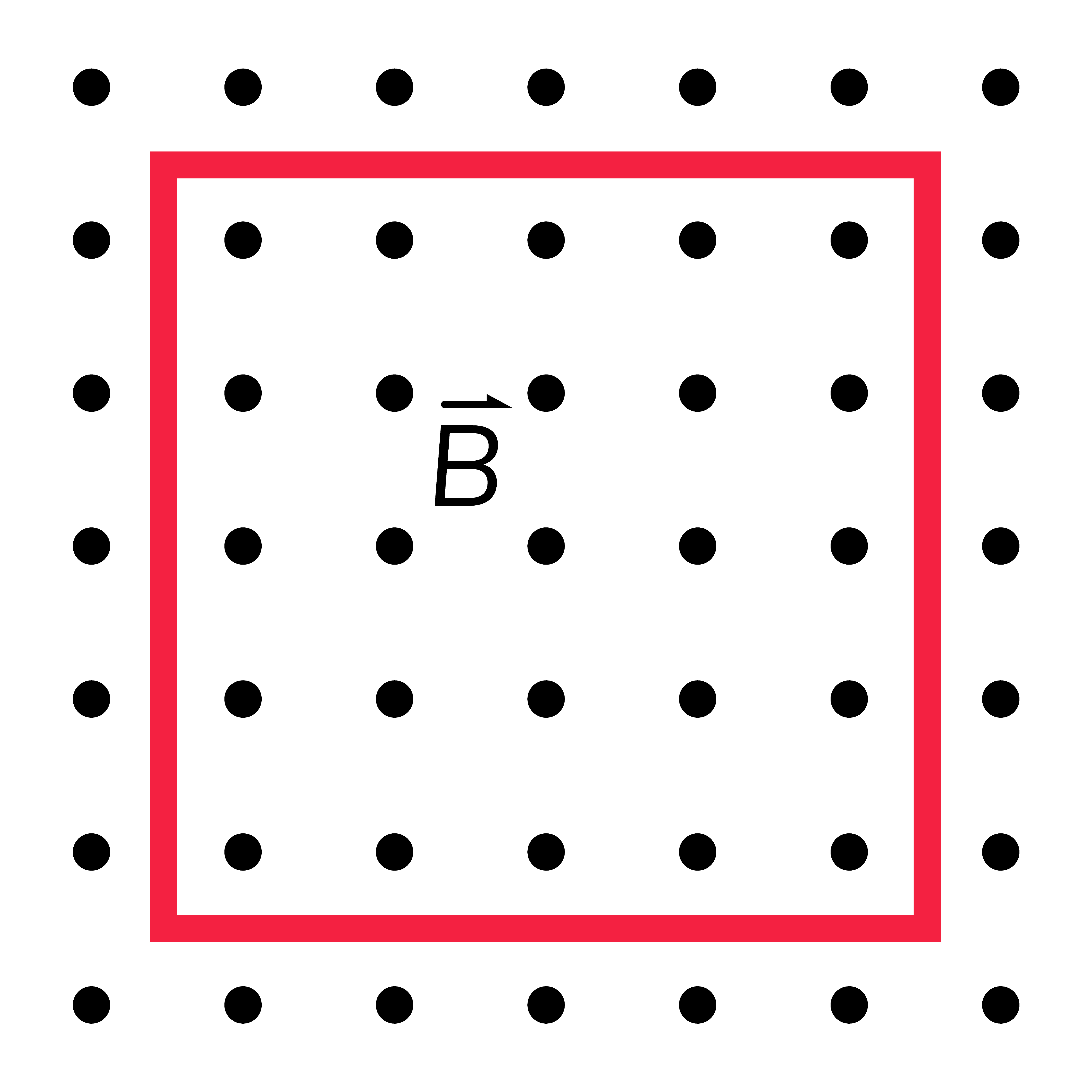
The flux is out of the page, and the question says that it is getting stronger.
Lenz's law tells us that the induced current direction will act to "resist the change" - that is, it will try to create a magnetic flux against this increase. So the current will try to produce a magnetic field into the page.
Pointing our right thumb into the page, we see that our fingers curl clockwise. This is the direction of the induced current.

Mark Yourself Question
- Grab a piece of paper and try this problem yourself.
- When you're done, check the "I have answered this question" box below.
- View the solution and report whether you got it right or wrong.
Practice: Lenz's Law
A wire loop of constant area is pulled to the right at a constant speed over a magnetic field that points into the page. The angle of incidence between the loop and field is also constant.
At each point of the loop's motion (shown below), describe the induced current.

Practice: Terminal Velocity and EM Induction
In the picture below, a conducting rod of mass with a length of and resistance of is on a wire loop tilted by from horizontal. The rod slides down the wire loop without friction. There is a uniform magnetic field of pointing straight down (this is at an angle into the tilted surface).
The rod is released from rest and reaches a terminal velocity. What is the terminal velocity of the rod?
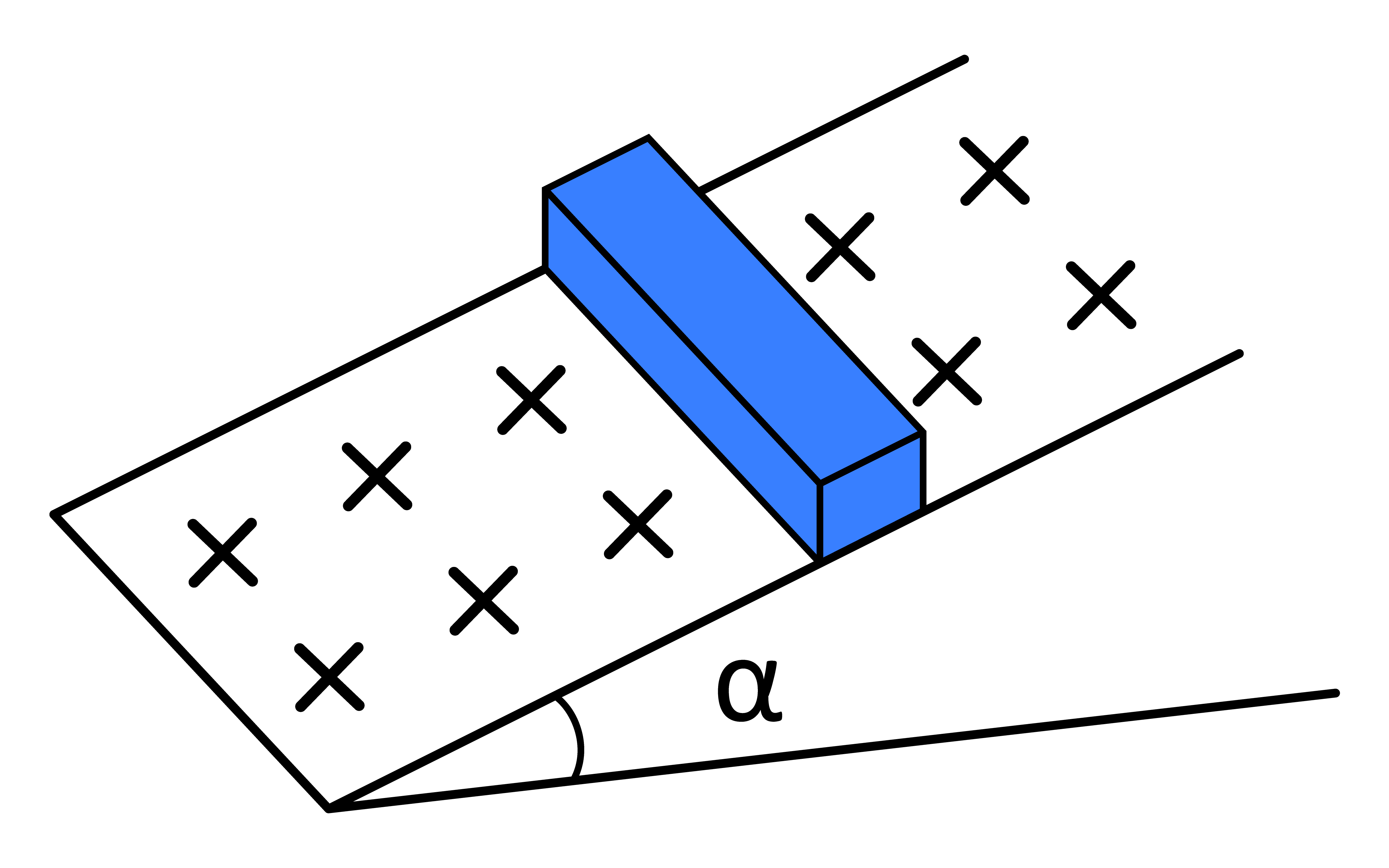
Hint: If the rod has reached its terminal velocity, then it is no longer accelerating.