Popular Courses
PHYSICS 1202A/B
Western University
PHYSICS 1E03
McMaster University
APSC 112
Queen's University
PHYSICS 1402A/B
Western University
PHYS 205
Concordia University
PHYS 142
McGill University
ENGG 212
University of Calgary
PHY132H1
University of Toronto
PHY132H1
University of Toronto
PHYS 102B
University of Victoria
PHYS-1300
University of Windsor
PHY 1121
University of Ottawa
PHYS 121
University of Waterloo
PHYSICS 1102A/B
Western University
PHYS 227
University of Calgary
SC/PHYS 2020 3.00
York University
PHYS 116
Queen's University
PHY 9B
University of California - Davis
PHY 131
Arizona State University - Tempe
MCG 1101
University of Ottawa
0:00 / 0:00
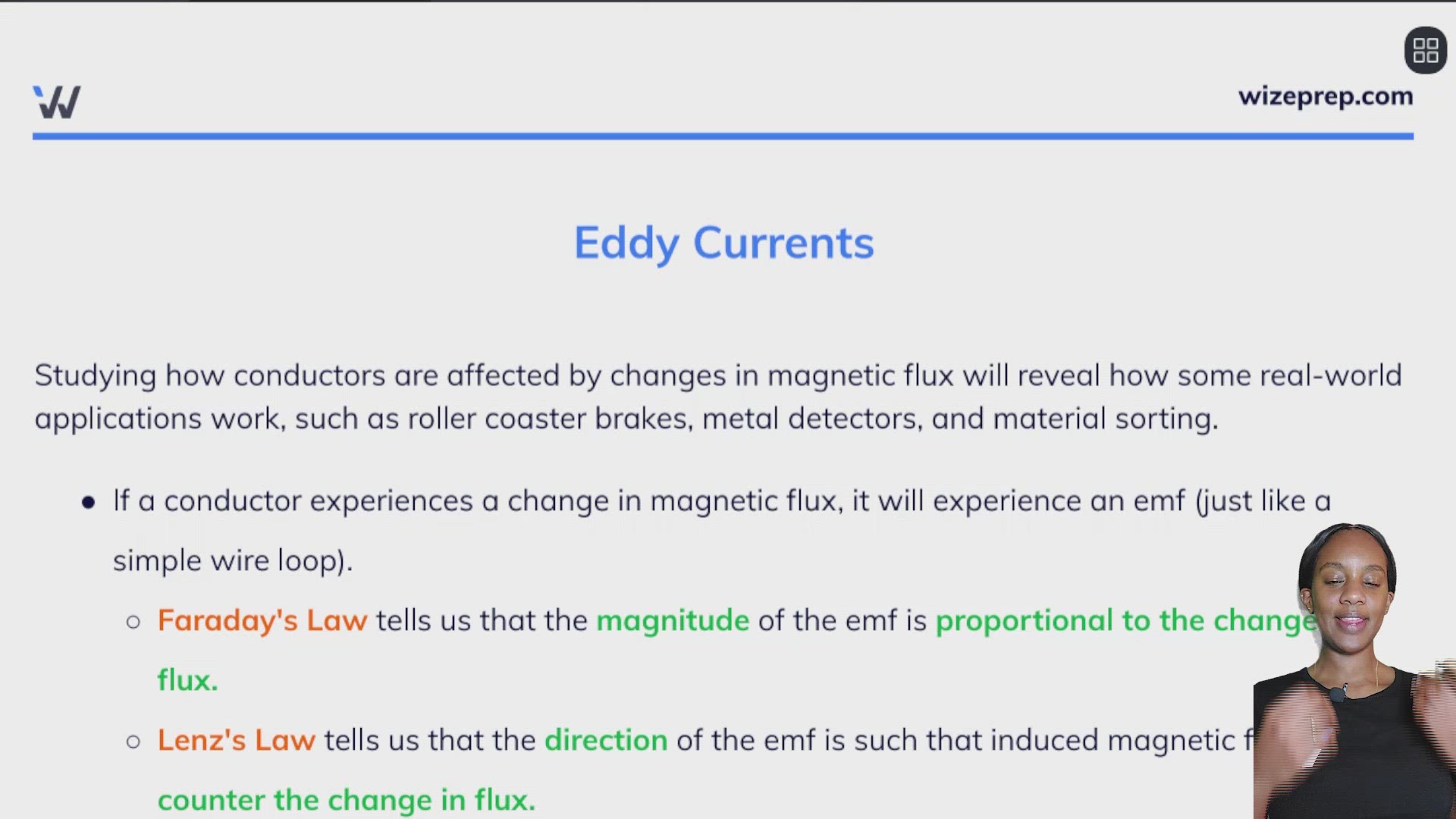
Eddy Currents
Studying how conductors are affected by changes in magnetic flux will reveal how some real-world applications work, such as roller coaster brakes, metal detectors, and material sorting.
- If a conductor experiences a change in magnetic flux, it will experience an emf (just like a simple wire loop).
- Faraday's Law tells us that the magnitude of the emf is proportional to the change in flux.
- Lenz's Law tells us that the direction of the emf is such that induced magnetic fields will counter the change in flux.
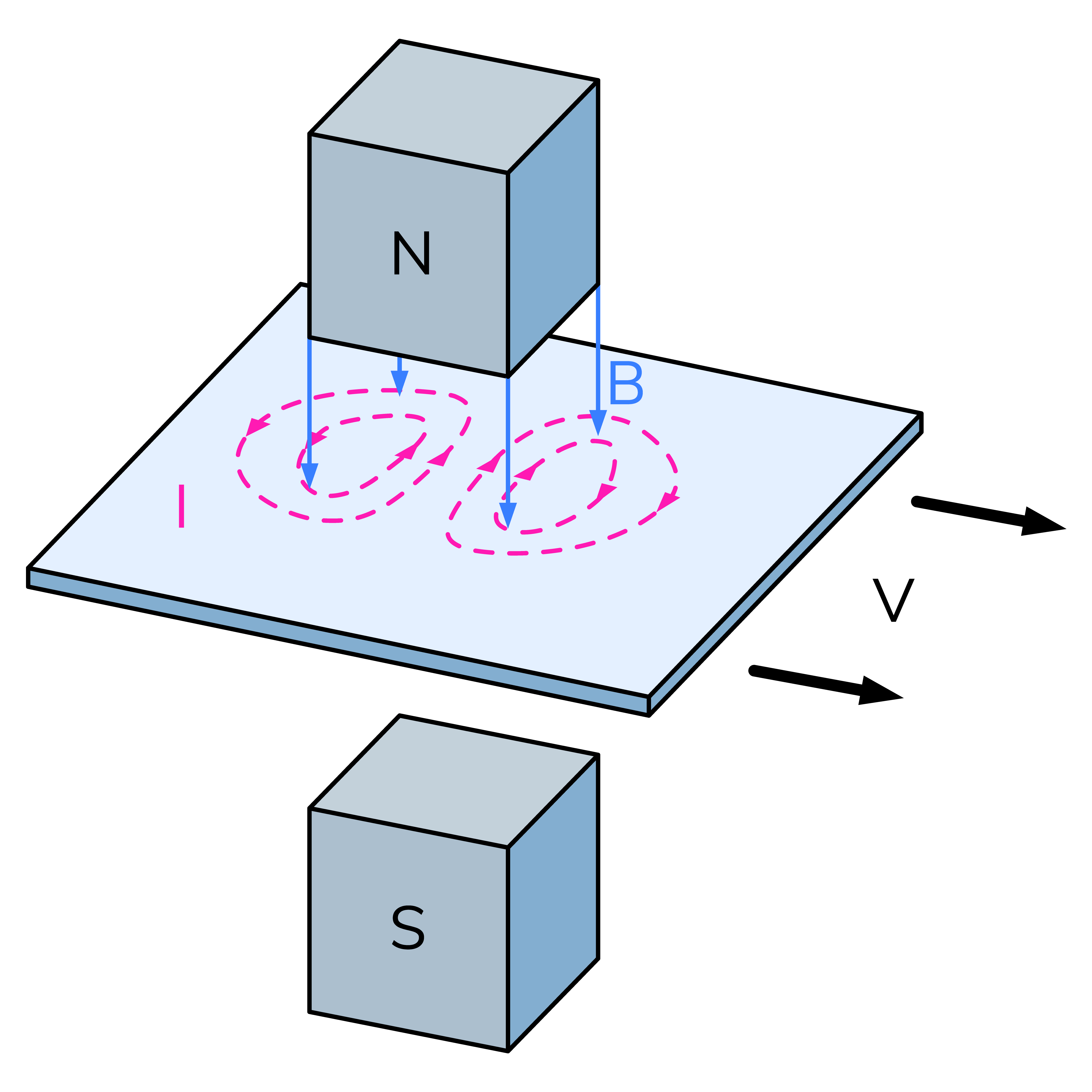
- The induced currents in the conductor will be in the shape of a whirlpool and are called eddy currents.
- The magnitude of the currents is also inversely proportional to the resistivity of the material. (E.g. the eddy currents in a non-conducting material would be very weak.)
Wize Tip
If the change in magnetic flux is only experienced by one section of a conductor, then eddy currents will only be produced in that section.
Examples of eddy current applications
- Detection and sorting: Since conductors respond differently than non-conductors to changes in magnetic flux, we can pass materials through rapidly changing magnetic fields to separate materials based on their conducting properties.
- Magnetic braking: If a conducting material enters a strong external magnetic field and experiences a large change in flux, a magnetic drag force will be applied to the conducting material.
- For example, many roller coasters use magnetic braking to decelerate at the end of the ride.
0:00 / 0:00
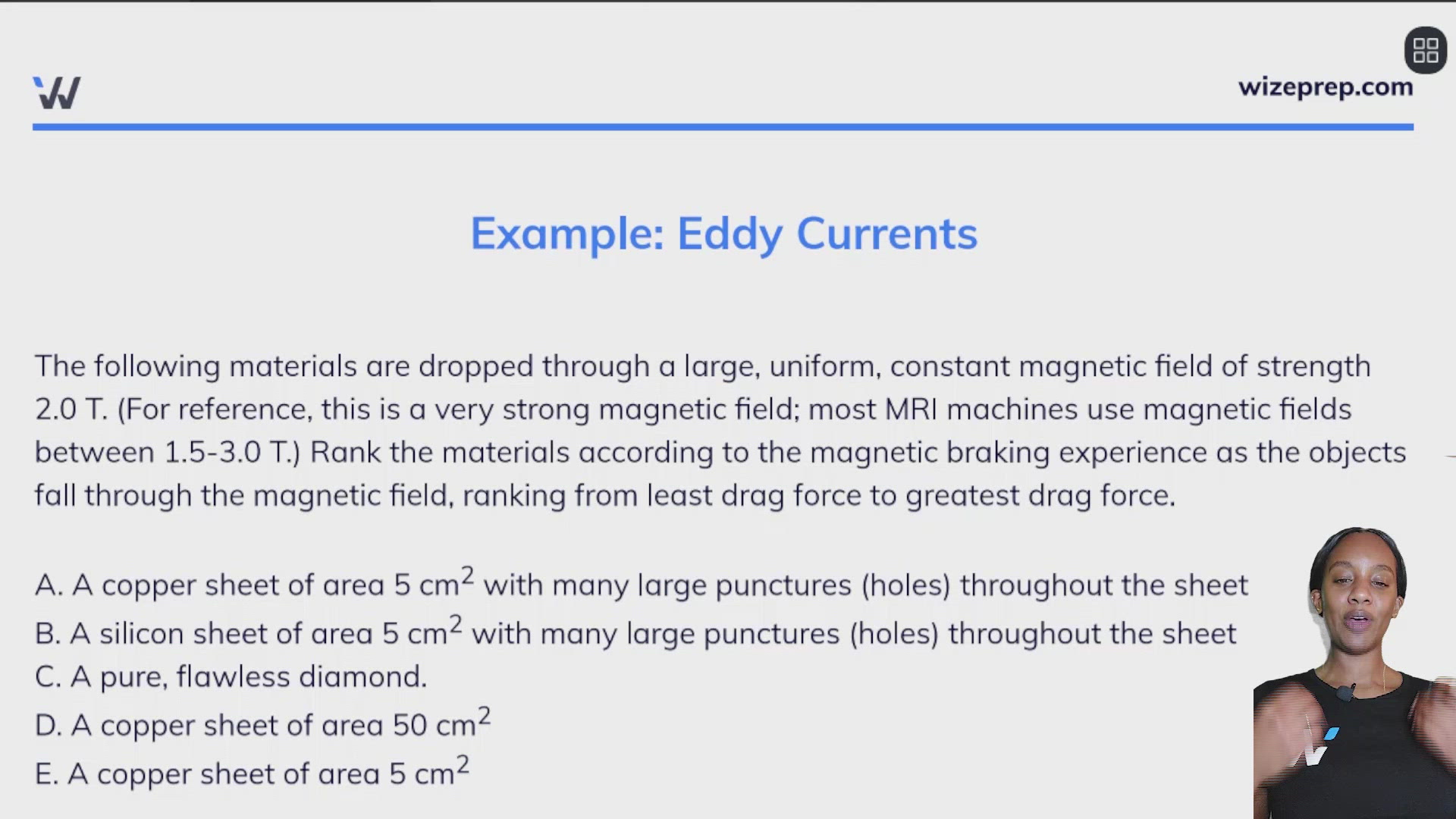
Example: Eddy Currents
The following materials are dropped through a large, uniform, constant magnetic field of strength 2.0 T. (For reference, this is a very strong magnetic field; most MRI machines use magnetic fields between 1.5-3.0 T.) Rank the materials according to the magnetic braking experience as the objects fall through the magnetic field, ranking from least drag force to greatest drag force.
A. A copper sheet of area 5 cm2 with many large punctures (holes) throughout the sheet
B. A silicon sheet of area 5 cm2 with many large punctures (holes) throughout the sheet
C. A pure, flawless diamond.
D. A copper sheet of area 50 cm2
E. A copper sheet of area 5 cm2
Hints: Pure diamonds cannot conduct electricity at all. Silicon conducts electricity, but not as well as copper.
Eddy currents arise due to electrons moving in materials - if it is impossible for a current to be induced in a material, then it will not host eddy currents and it will not be possible to apply magnetic braking. Therefore, the diamond has zero drag force. (C) Following the same logic, the silicon sheet (B) will not be affected as strongly as (A) since silicon does not conduct electricity as well as copper.
If a larger conductor passes through a magnetic field, then there is more surface area to experience a change in magnetic flux, so the eddy currents will be stronger. If there are holes in a material, then the eddy currents are more restrained and cannot flow over as large of an area, so the magnetic braking effect is weaker.
Following this logic, the ranking of the five materials (from lowest to most magnetic braking): C, B, A, E, D.