Wize University Physics Textbook (Master) > Magnetic Induction
Motors and Generators
Popular Courses
PHYSICS 1202A/B
Western University
PHYSICS 1E03
McMaster University
PHYSICS 1402A/B
Western University
PHYS 205
Concordia University
PHYS 118
University of British Columbia
PHYS 142
McGill University
ENGG 212
University of Calgary
PHY132H1
University of Toronto
PHY132H1
University of Toronto
PHYS 102B
University of Victoria
PHYS-1300
University of Windsor
PHY 1121
University of Ottawa
PHYS 121
University of Waterloo
PHYSICS 1102A/B
Western University
PHYS 227
University of Calgary
SC/PHYS 2020 3.00
York University
PHYS 116
Queen's University
PHY 9B
University of California - Davis
PHY 131
Arizona State University - Tempe
MCG 1101
University of Ottawa
0:00 / 0:00
Generators and Motors
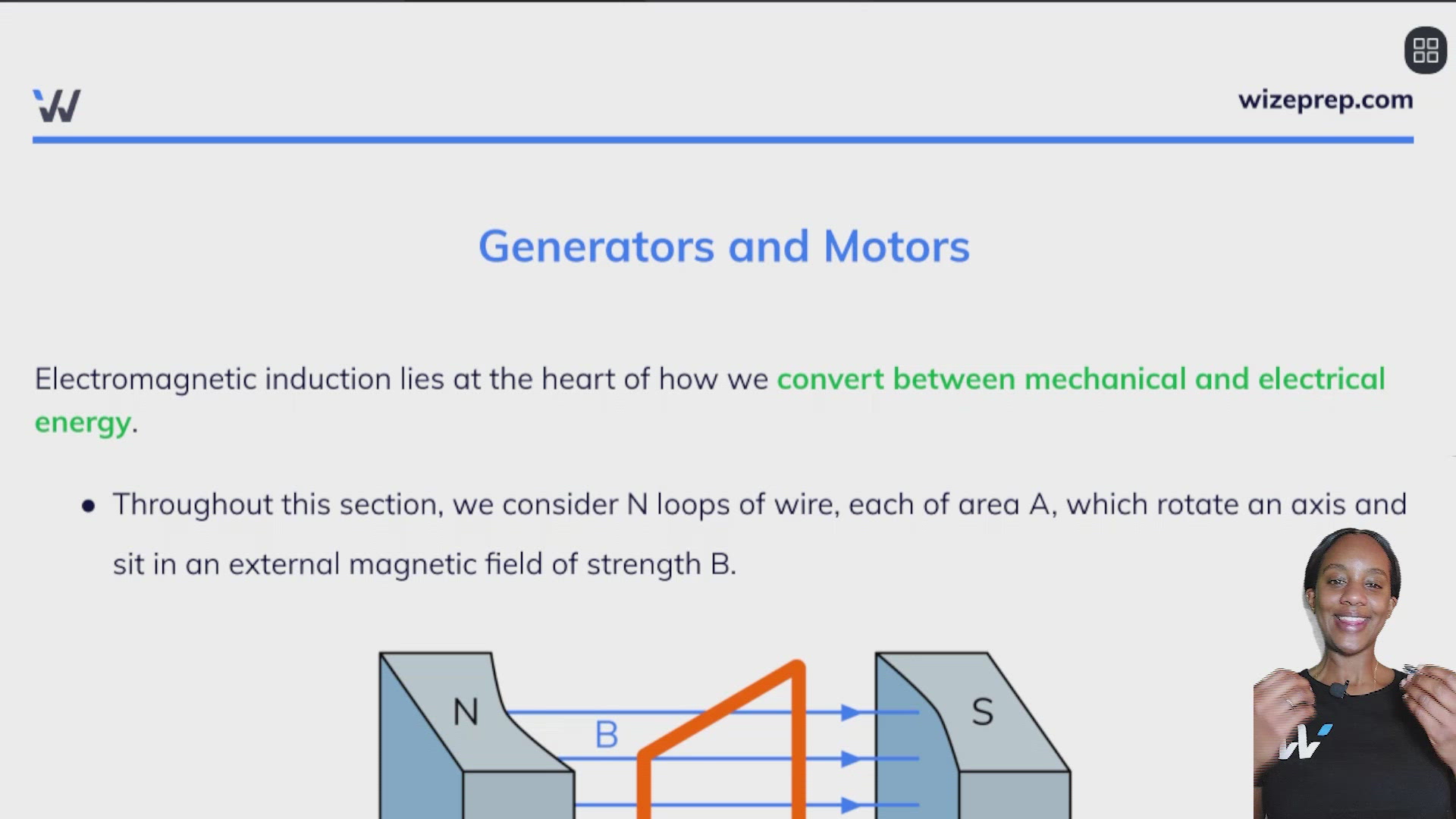
Electromagnetic induction lies at the heart of how we convert between mechanical and electrical energy.
- Throughout this section, we consider N loops of wire, each of area A, which rotate an axis and sit in an external magnetic field of strength B.

Generators
- Generators convert mechanical energy to electrical energy (e.g. flashlights that you charge by winding up).
- The wire loops are turned at some angular frequency , giving a magnetic flux of .
- This results in the following induced emf by Faraday's Law, which can act as an AC voltage source.
Wize Tip
The "mechanical force" for a generator could be wind (turbines), water (dams and hydroelectricity), your arms (emergency flashlights)
Motors
- Motors convert electrical energy to mechanical energy (e.g. cars, power tools, fans...)
- We attach an external AC voltage source to the current loop which results in a current .
- This results in a torque on the current loop which causes rotation.
Watch Out!
If the current provided is constant, then the torque would cause the loop to oscillate back and forth - this would not be a very useful motor!
The applied current must change directions every half-cycle so that the wire loop rotates continuously.
- Once the motor is spinning, the magnetic flux will be changing constantly, and there will be an induced emf that opposites the rotation of the motor.
- This induced emf for motors has a special name: back emf
- The back emf has the same formula as the emf provided by a generator:
- The back emf results in an induced current, so the actual current through the motor is lower than the current expected from the voltage source:
0:00 / 0:00
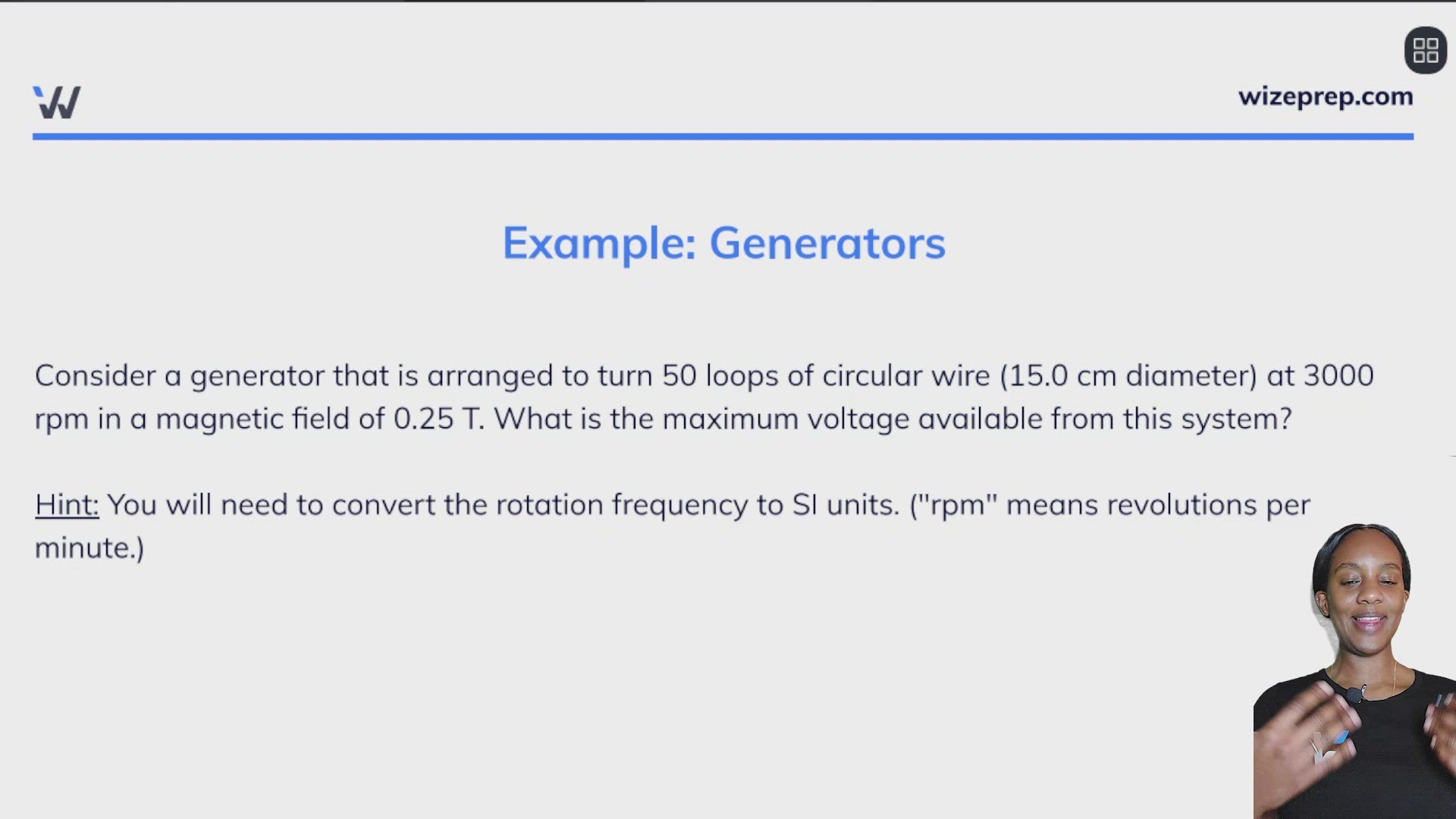
Example: Generators
Consider a generator that is arranged to turn 50 loops of circular wire (15.0 cm diameter) at 3000 rpm in a magnetic field of 0.25 T. What is the maximum voltage available from this system?
Hint: You will need to convert the rotation frequency to SI units. ("rpm" means revolutions per minute.)
The equation for the emf supplied by a generator is . We assume there is no internal resistance in the wires, so that the maximum voltage is equal to the emf.
To find the maximum emf, we set the sine term equal to 1, resulting in . The system will alternate between maximum and minimum values equal to this expression.
To convert rpm to radians per second, we convert as follows:
This gives 3000 rpm = 314.2 rad/s. Now we can plug values into the formula (note that diameter was provided, not radius).
Practice: Motors and Back EMF
Consider a motor with 20 square loops of wire, each of dimension 15cm x 20cm. The motor is spinning at 750 rpm. An external voltage source of 40 V is applied and we measure the maximum current measured in the system.
a) In the absence of the motor, we would have expected a 40 V source to produce a maximum current of 5.0 A. What is the resistance of the system?
b) The measured maximum current was 2.75 A. What must be the strength of the magnetic field?
Part a)