Popular Courses
PHYSICS 1202A/B
Western University
PHYSICS 1E03
McMaster University
PHYSICS 1402A/B
Western University
PHYS 205
Concordia University
PHYS 142
McGill University
ENGG 212
University of Calgary
PHY132H1
University of Toronto
PHY132H1
University of Toronto
PHYS 102B
University of Victoria
PHYS-1300
University of Windsor
PHY 1121
University of Ottawa
PHYS 121
University of Waterloo
PHYSICS 1102A/B
Western University
PHYS 227
University of Calgary
SC/PHYS 2020 3.00
York University
PHYS 116
Queen's University
PHY 9B
University of California - Davis
PHY 131
Arizona State University - Tempe
MCG 1101
University of Ottawa
PHYS 1010
York University
0:00 / 0:00
Transformers
The electricity that powers our homes is produced at industrial power generation sites and must be transported to us. This mechanism, along with many other applications, is enabled by transformers.
- A transformer can be modelled as an iron core with two sets of coil windings: the primary coils (input) and the secondary coils (output).
- The primary coils are wrapped around the core times.
- The secondary coils are wrapped around the core times.
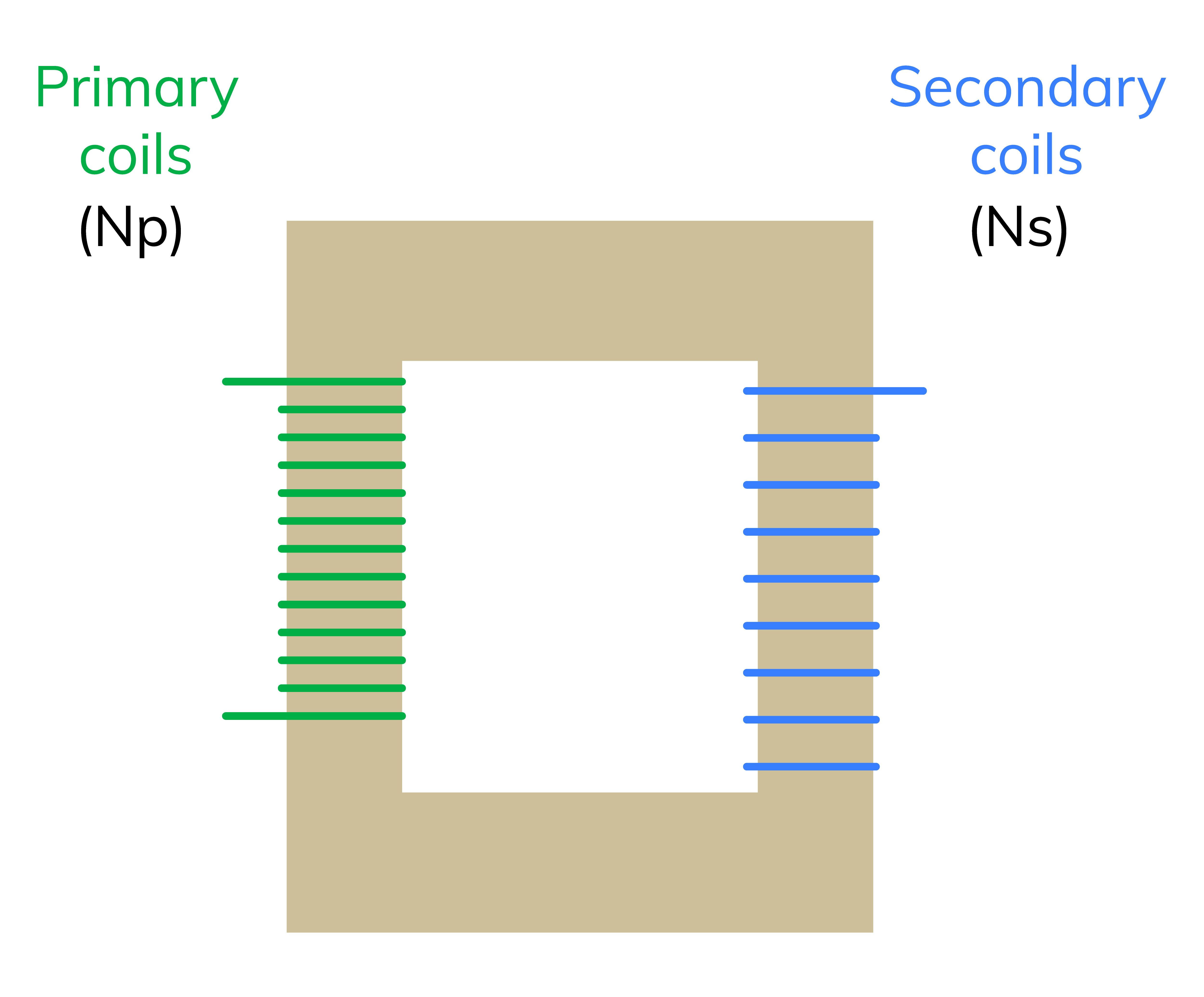
- We assume the core has constant cross-sectional area and that all magnetic flux is preserved throughout the core.
- Therefore, the change in magnetic flux is equal for both sets of coils.
- Faraday's Law for one set of coils gives .
- Since the flux is equal, we can relate the induced voltage through the two sets of coils:
Wize Concept
A transformer that causes an increase in voltage from input to output is called a step-up transformer. Likewise, a transformer that causes a decrease in voltage from input to output is called a step-down transformer.
- The total electrical power input to the transformer equals the total electrical power output from the transformer.
- Using the equation , we can also relate the induced current through the coils:
Watch Out!
For the transformer equation with currents, the primary and secondary currents are flipped!
0:00 / 0:00
Example: Transformers
Typically, power converted at a power plant is transformed to extremely high voltages for more efficient energy transmissions, and then stepped down to useable levels closer to the destination.
Consider a power plant where electricity is produced at 5.0 kilovolts. It is desired to step up this voltage to 800 kilovolts for transmission.
a) Using a standard transformer, what would be the ratio of primary coil turns to secondary coil turns for this step-up transformer?
b) If this higher voltage was to be stepped down all at once to 200 V, and there are only 10 secondary coil turns, how many primary coil turns must there be on the step-down transformer?
Part a)
We simply plug the given voltages into the transformer equation:
So for every 1 primary coil turn, there must be 160 secondary coil turns.
Part b)
To step-down from 800 kilovolts to 200 volts with 10 secondary coil turns, we plug values into the same equation (note, the "secondary" values from before are now "primary"):
Note - in real life, this would usually be done by two or more separate step-down transformers - having 10 coil turns on one side and 40,000 on the other would not be an ideal engineering arrangement.