Wize University Physics Textbook (Master) > Magnetic Induction
Faraday's Law of Induction - with calculus
Popular Courses
PHYSICS 1202A/B
Western University
PHYSICS 1E03
McMaster University
PHYSICS 1402A/B
Western University
PHYS 205
Concordia University
PHYS 118
University of British Columbia
PHYS 142
McGill University
ENGG 212
University of Calgary
PHY132H1
University of Toronto
PHY132H1
University of Toronto
PHYS-1300
University of Windsor
PHY 1121
University of Ottawa
PHYS 121
University of Waterloo
PHYSICS 1102A/B
Western University
PHYS 227
University of Calgary
SC/PHYS 2020 3.00
York University
PHY 9B
University of California - Davis
PHY 131
Arizona State University - Tempe
MCG 1101
University of Ottawa
PHYS 1010
York University
PHYS 1020
University of Manitoba
0:00 / 0:00
Faraday's Law
Often, we need to use calculus to fully explore problems with Faraday's Law.
- Faraday's Law can be re-written with calculus by replacing the rate of change with a derivative:
- With this version of Faraday's Law, we can use the product rule to see what happens if more than one variable is changing.
- For example, if the magnetic field strength and area are both functions of time, Faraday's Law would be written as follows:
- If the flux needs to be determined with an integral, the most general form of Faraday's Law can be written as follows:
Practice: Non-Uniform, Time-Dependent Magnetic Field
A square loop of wire with sides of length lies in the positive quadrant of the xy-plane with one corner at the origin of the coordinate system. There is a magnetic field present given by the following expression:
a) What are the units of ?
b) Determine the induced emf as a function of time.
Part a)
Practice: Two Rings of Current
Two circles of wire are located on the same plane and have the same center point, as shown below.
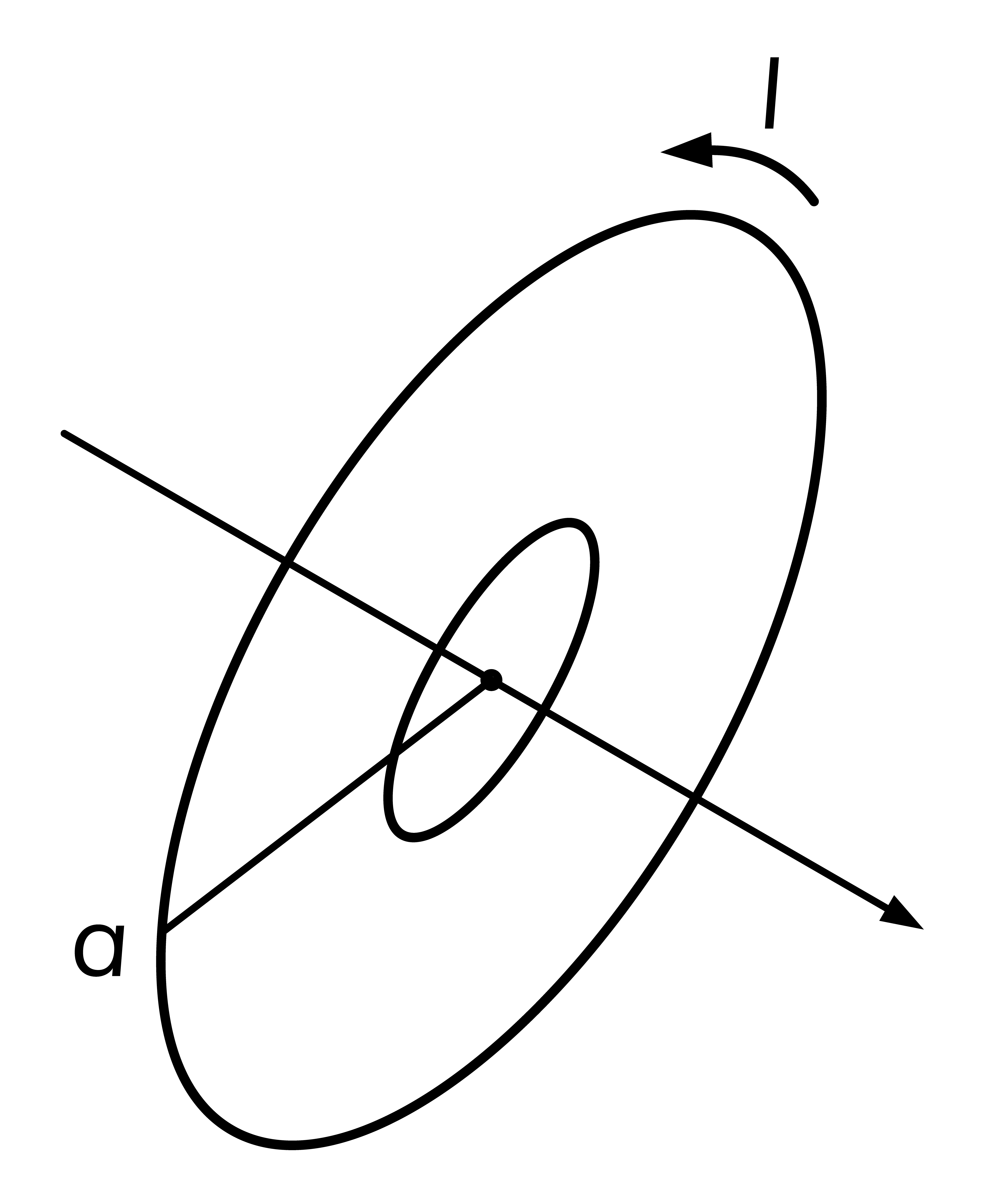
The outer loop has a radius of , and the radius of the inner loop is . The outer loop has a linearly increasing current of .
a) What is the magnitude of the magnetic field created at the center point by the outer current loop?
b) Assume that the magnetic field at the center point from part (a) is the only magnetic field passing through the inner loop. What is the induced current in the inner loop if it has a resistance of ?
Part a)
Practice: Expanding Triangle
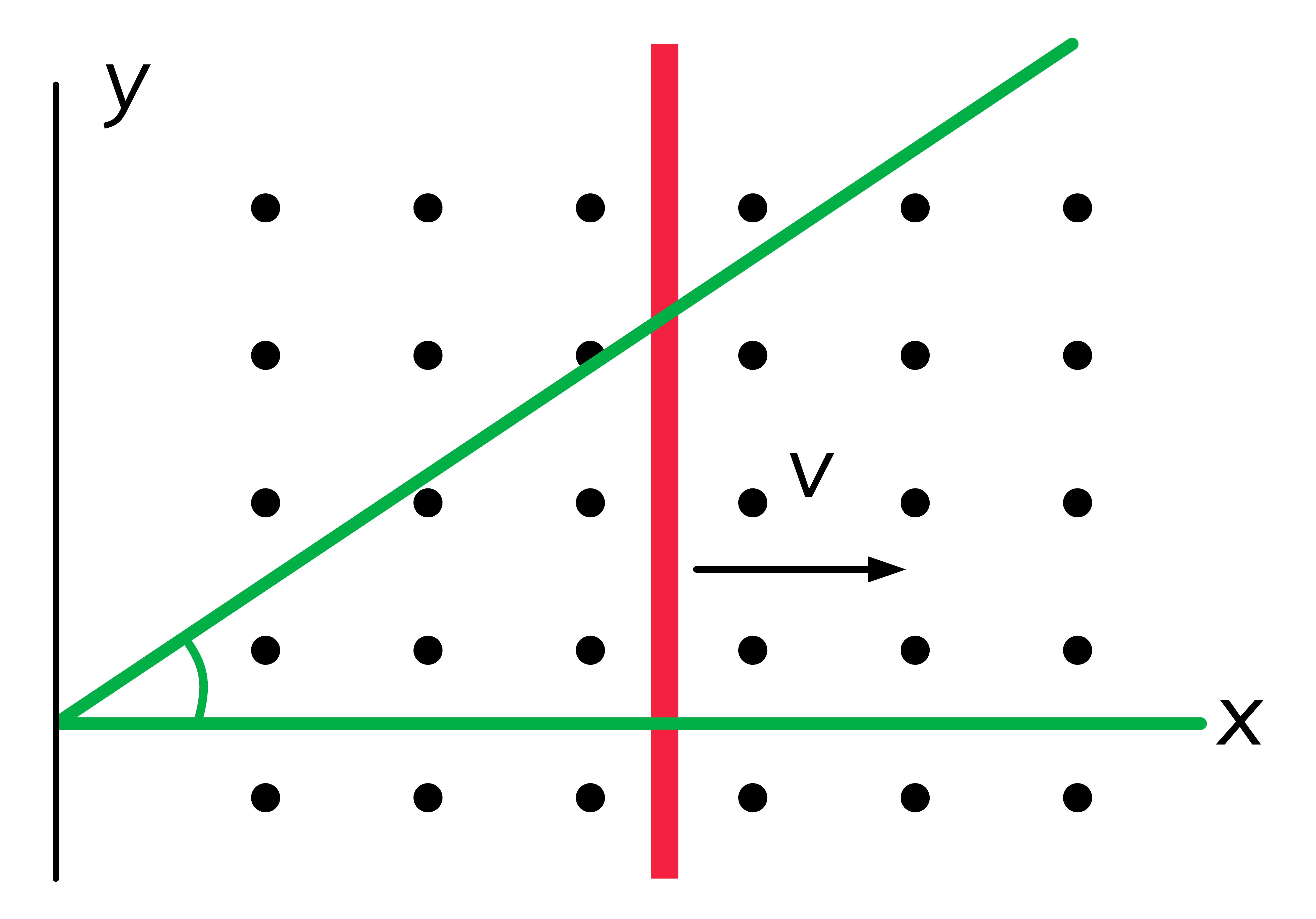
Two conducting wires are located in a uniform magnetic field that points out of the page. The two wires are at an angle of 60 degrees. A vertical bar with resistance with constant speed moves along the axis in the positive x-direction as shown below.
What is the induced current in the bar as a function of ?